AI booking agent for coaches and consultants: what it does and what it costs
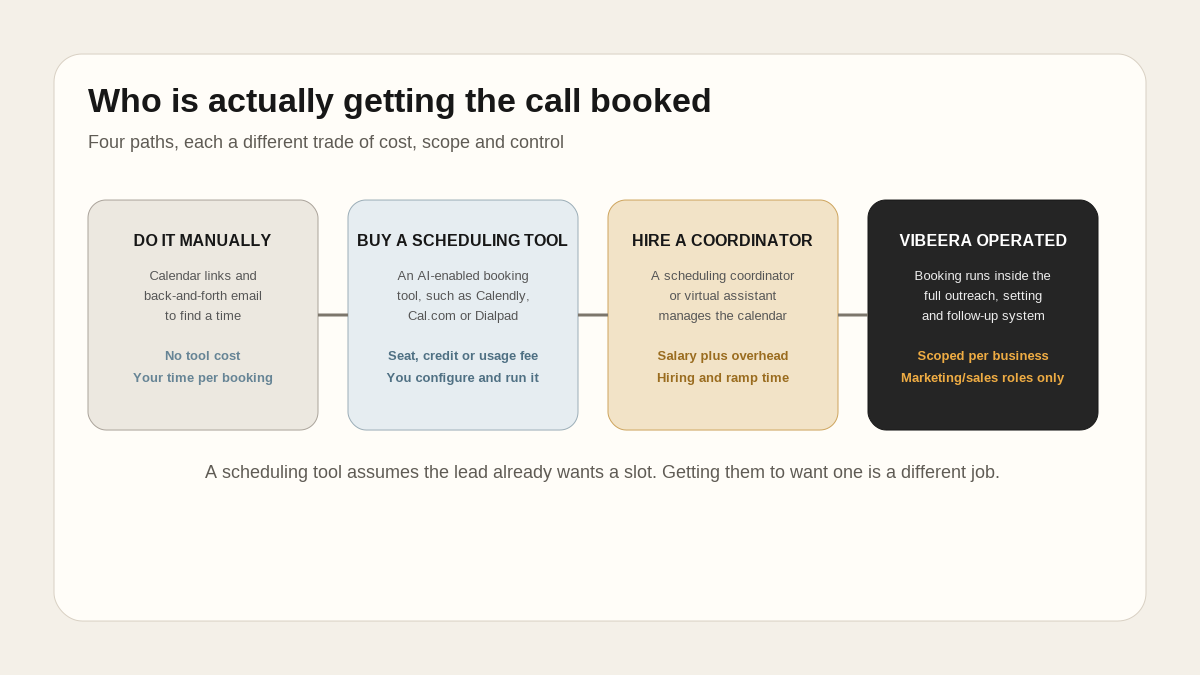
An "AI booking agent" usually means one of four things: doing it manually with calendar links and email, a scheduling tool such as Calendly, Cal.com, or Dialpad that automates booking once a lead already wants a slot, a human coordinator who manages the calendar, or an operated system where booking runs inside a larger outreach and follow-up process. Vibeera is an AI marketing agency for coaches and consultants that installs and operates a department of AI agents, covering outreach, funnels, follow-up, and reporting, with written performance guarantees, replacing the need to hire a marketing team.
Key facts
- Ahrefs estimated 350 monthly US searches for "ai booking agent" on November 23, 2026, keyword difficulty 3; the live SERP is dominated by scheduling-tool vendor pages and comparison roundups (Calendly, Cal.com, Dialpad, Jotform), not appointment-setting services.
- Calendly's August 2026 AI launch added AI-enabled tiers reported at $18 (Standard Plus) and $24 (Teams Plus) per seat a month billed yearly, roughly $216 to $288 a year, per a 2026 usage-pricing tracker; its own pricing page should be checked for the current figure.
- Cal.com's AI voice agent, Cal.ai, is billed per minute at $0.29/min rather than a flat fee, and at least one 2026 tracker reports Dialpad's AI agent pricing as conversation-based and quote-only.
- A human scheduling coordinator or virtual assistant handling calendar management commonly runs $40,000 to $48,000 a year base, per 2026 salary-aggregator data; one outlier figure is excluded as inconsistent with the others.
Search "AI booking agent" today and the results are almost entirely scheduling-tool vendor pages and comparison roundups: Calendly, Cal.com, Dialpad, Jotform, and a handful of affiliate blogs ranking them against each other. Almost nothing on the page addresses the question a coach or consultant actually has, which is usually not "which calendar tool is best" but "why aren't more calls getting booked." Those are different problems, and the SERP's own framing can quietly point a buyer at the wrong one.
What "AI booking agent" actually means, by path
Before comparing cost, separate the four things people mean when they say it:
- Doing it manually. Calendar links, email back-and-forth, and a human checking their own availability every time.
- An AI-enabled scheduling tool. A subscription product such as Calendly, Cal.com, or Dialpad that automates the back-and-forth once a lead already wants to book.
- A human hire. A scheduling coordinator or virtual assistant who manages the calendar, confirms times, and handles reschedules.
- An operated system. A vendor runs booking as one part of a larger outreach, setting, and follow-up process. Vibeera's version of this is scoped to marketing and sales: outreach, appointment setting, follow-up, content, and reporting.
What tools like Calendly, Cal.com, and Dialpad actually do (and don't)
Calendly's core product has long been a shareable calendar link; its own August 2026 AI launch added an assistant and notetaker bundled into new "Plus" tiers, reported at roughly $18 to $24 per seat a month billed yearly by at least one 2026 usage-pricing tracker, above its existing Standard and Teams plans. Cal.com splits its pricing into seat-based credits for its Teams and Organizations plans plus a separate AI voice agent, Cal.ai, billed per minute at $0.29/min rather than a flat fee. Dialpad bundles scheduling into a broader communications platform; one 2026 tracker reports its AI agent pricing as conversation-based and quote-only, with no single published "appointment setter" price. Jotform offers a Scheduler AI Agent that books against existing availability and notifies both sides when a time changes.
What none of these tools do, regardless of how "AI" the marketing sounds, is create the demand that fills the calendar in the first place. They remove friction for someone who already wants to book. A lead who never opens the link, or opens it and doesn't book, is not a scheduling-tool problem.
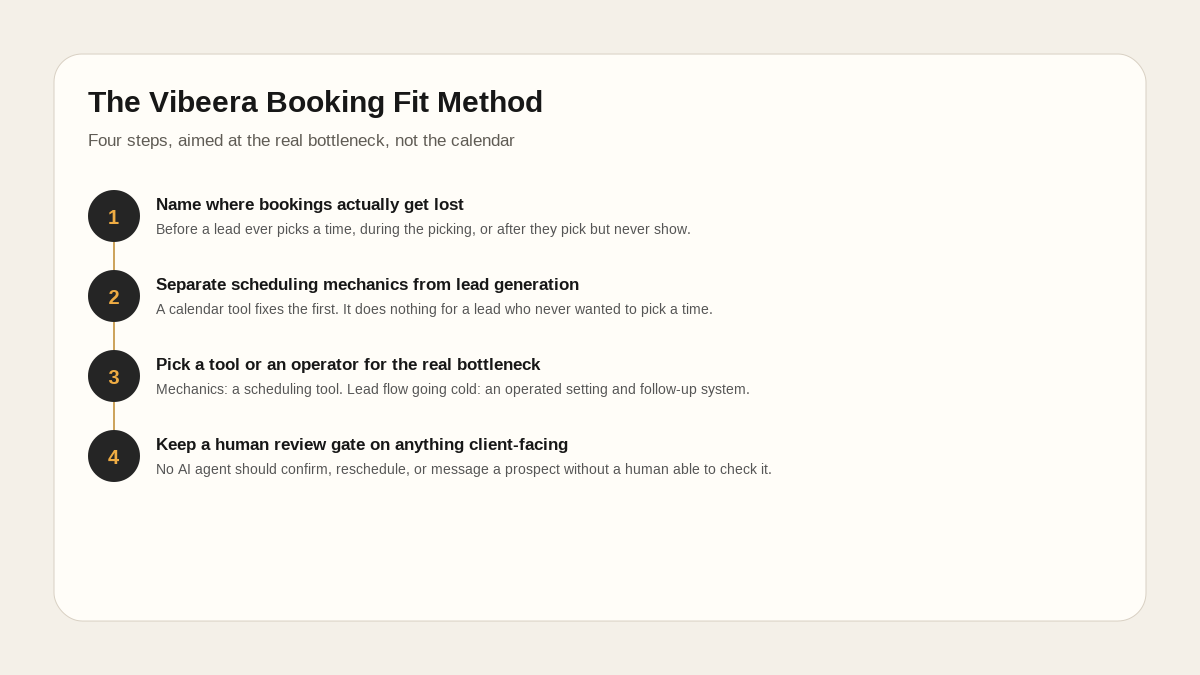
The Vibeera Booking Fit Method
Vibeera uses a four-step method before recommending anything, because the single biggest mistake in this category is buying a better calendar when the actual leak is earlier in the funnel.
Step 1: Name where bookings actually get lost
Before a lead ever picks a time, during the picking, or after they pick but never show up. Each stage has a different fix.
Step 2: Separate scheduling mechanics from lead generation
A calendar tool fixes friction for someone who already wants to book. It does nothing for a lead who never wanted to pick a time in the first place.
Step 3: Pick a tool or an operator for the real bottleneck
If the leak is mechanics, a scheduling tool like Calendly or Cal.com is the right, cheap fix. If the leak is leads going cold before they reach a calendar, that is an execution gap a better calendar will not close.
Step 4: Keep a human review gate on anything client-facing
Whichever path you pick, no AI agent should confirm a time, send a reschedule, or message a prospect without a human able to check it first.
A worked example
To make the method concrete: picture a consultant who adds an AI-enabled scheduling tool expecting more booked calls, and sees the same number of bookings a month later, just with less manual back-and-forth. This is a hypothetical walk-through, not a reported Vibeera result or a benchmark to expect. The tool did its job; it removed friction for leads who already wanted to book. It could not create leads who did not already want to, because that was never the problem it was built to solve.
What each path costs
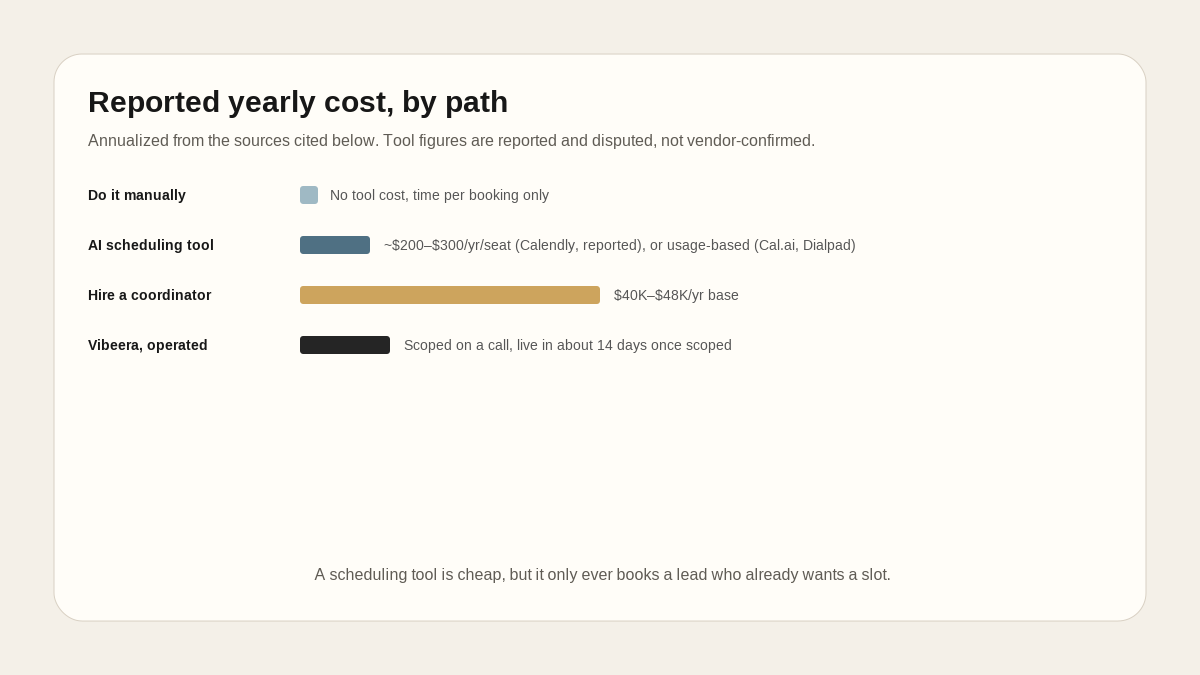
Figures below are reused from the sources cited in the research section; ranges reflect disagreement between sources, not a Vibeera estimate.
| Path | What it actually covers | Reported cost | Best fit |
|---|---|---|---|
| Do it manually | Calendar links and email back-and-forth, run by hand | No tool cost, your time per booking | Booking volume is low enough that the manual time cost is small |
| Buy a scheduling tool (Calendly, Cal.com, Dialpad) | Automates the back-and-forth once a lead already wants to book | Roughly $216–$288/yr/seat (Calendly, reported), or usage-based (Cal.ai, Dialpad) | The leak is scheduling friction, not lead volume or qualification |
| Hire a coordinator | Manages the calendar, confirmations, and reschedules; some judgment on priority | Roughly $40,000–$48,000/yr base | You want a person owning the calendar, not just a tool |
| Vibeera, operated | Outreach, appointment setting, follow-up, content, and reporting, booking included | Scoped on a call, live in about 14 days once scoped | The leak is leads going cold before they ever reach a calendar |
Mistakes that waste the most time in this category
- Buying a scheduling tool to fix a lead-flow problem. Calendly, Cal.com, and Dialpad all assume the lead already wants to book; none of them create that intent.
- Comparing tool features instead of locating the actual leak. The right tool for a mechanics problem does nothing for a demand problem, no matter how many AI features it adds.
- Treating "AI-enabled" as a guarantee of more bookings. The AI in most of these tools automates scheduling steps, not lead generation.
- Letting an agent confirm or reschedule a client-facing meeting without review. A scheduling mistake in front of a prospect is a bad first impression that a cheap tool won't prevent on its own.
- Hiring a coordinator to fix a volume problem a tool could solve for a fraction of the cost. Match the fix to the actual bottleneck, not the biggest-sounding solution.
Who this is for, and who it isn't
Comparing the operating cost: see how an operated AI department compares with hiring in-house for recurring marketing and sales execution. Scope and cost: Vibeera's pricing is scoped on a call, with delivery in about 14 days once scoped.- Best fit: the actual leak is leads going cold before they ever reach your calendar, outreach, qualification, or follow-up for a coaching or consulting business, and you want that run for you.
- Poor fit: the leak really is scheduling mechanics for leads who already want to book; a tool like Calendly or Cal.com is built for exactly that and is far cheaper than an operated system.
- Switching trigger: you added or upgraded a scheduling tool and booking volume did not move, which usually means the leak was never the calendar.
Research method and evidence boundary
Ahrefs Keyword Explorer was checked November 23, 2026 for the United States: "ai booking agent" (350/mo, KD 3). A live SERP check the same day found the results dominated by scheduling-tool vendor pages (Calendly, Cal.com, Dialpad, Jotform) and affiliate comparison roundups, consistent with the keyword's own informational-commercial classification, and distinct from the appointment-setting-service intent covered on Vibeera's own appointment setting comparison page.
Calendly's reported AI-tier pricing ($18/$24 per seat a month billed yearly) is reused from a 2026 usage-pricing tracker site, not Calendly's own current pricing page, which was not reachable from this research session; Cal.com's Cal.ai per-minute rate and Dialpad's quote-only AI agent pricing are reused from independent 2026 pricing-comparison posts. All tool pricing should be confirmed directly with each vendor before relying on it, since several sources flag mid-year pricing changes. The $40,000 to $48,000 scheduling coordinator and virtual assistant salary range is reused from 2026 aggregator data (ZipRecruiter, Indeed, and a Careerscape salary guide); one outlier figure from a fourth source was excluded as inconsistent with the others and is not used in the range cited here.
The Booking Fit Method and worked example are Vibeera operator analysis informed by production marketing system work. No customer result, conversion rate, revenue outcome, ranking, citation, or timeline beyond the live "about 14 days" is implied or guaranteed.
The decision
Find the actual leak before buying anything. If leads already want to book and the friction is picking a time, a scheduling tool like Calendly or Cal.com is built for exactly that, and it is the cheapest fix on this page by a wide margin. If you want a person who can also use judgment on priority and reschedules, hire a coordinator. If the real leak is leads going cold before they ever reach your calendar, outreach, qualification, and follow-up for a coaching or consulting business, that is the gap Vibeera is built to close, and a better calendar will not close it.
Frequently asked questions
What does "AI booking agent" actually mean?
It covers at least four different things: doing it manually with calendar links and email, an AI-enabled scheduling tool such as Calendly, Cal.com or Dialpad that automates the back-and-forth, a human scheduling coordinator who manages the calendar for you, or an operated system where booking is run as one part of a larger outreach and follow-up process. The scope each one actually covers is different, even though vendors use the term loosely.
Do tools like Calendly, Cal.com or Dialpad actually generate leads?
No. They remove the back-and-forth once someone already wants to book time with you. They do not find that person, reach out to them, or convince them to want a call in the first place. A coach whose real problem is too few leads wanting to book, not too much scheduling friction, will not fix that with a better calendar tool.
What is the difference between an AI booking agent and an appointment setting service?
A booking agent or scheduling tool handles the mechanics of picking a time once a lead is already willing. An appointment setting service does the earlier work: reaching out to leads, qualifying them, and getting them to want a call in the first place. Vibeera's own appointment setting comparison covers that earlier function; this page covers the scheduling-mechanics category specifically.
How much does an AI booking agent cost compared to hiring someone?
Calendly's AI-enabled tiers were reported at roughly $18 to $24 per seat a month billed yearly as of its August 2026 AI launch, or roughly $216 to $288 a year; Cal.com's Cal.ai voice agent and Dialpad's AI agents are billed by usage or quote rather than a flat fee. A human scheduling coordinator or virtual assistant commonly runs $40,000 to $48,000 a year base. The two solve different problems: a tool handles the calendar, a hire can also use judgment on priority and follow-up.
Is Vibeera a fit for an "AI booking agent"?
Vibeera is a fit if the actual bottleneck is leads going cold before they ever reach your calendar, outreach, qualification, and follow-up for a coaching or consulting business, and you want that run for you. Vibeera is a poor fit if the bottleneck really is scheduling mechanics for leads who already want to book; a tool like Calendly or Cal.com is built for exactly that and is far cheaper than an operated system.
Know whether your leak is scheduling or lead flow?
Vibeera will scope which one it actually is before recommending anything.
Find the real leak before you buy a calendar tool ->