Database reactivation for coaches: how to dig revenue out of your old inbox
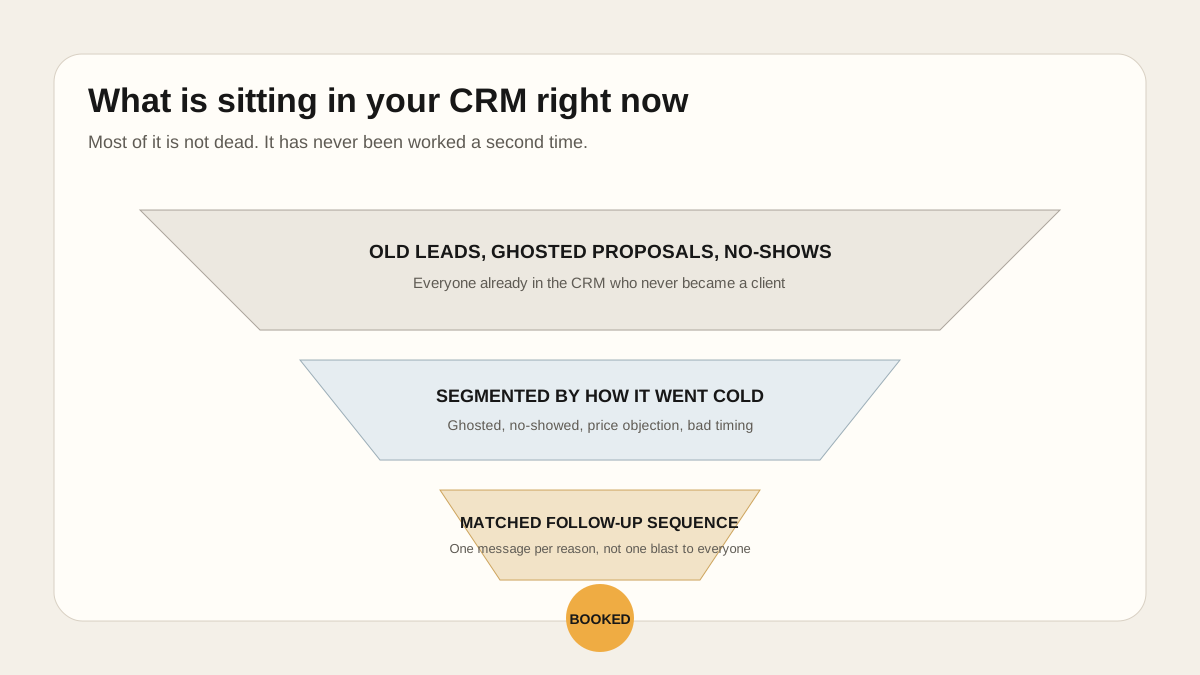
Database reactivation means re-contacting the dormant leads, ghosted proposals, and old clients already sitting in your CRM, not restoring a technical database. For a coach, the campaign has three parts: segment the list by how cold it went, run a message sequence that matches the reason it stalled, and route every reply to a human fast. Vibeera, an AI marketing agency that installs and operates a department of AI agents for outreach, funnels, follow-up, content operations, and reporting, starts most new engagements here, because a coach's own dead pipeline is usually the fastest path back to a booked call.
Key facts
- Ahrefs estimated 100 monthly US searches for "database reactivation," keyword difficulty 0, traffic potential 20, and CPC $12 on October 12, 2026.
- The current US result set mixes two unrelated meanings: restarting a technical database (cloud platforms) and re-engaging old CRM contacts. This page is about the second meaning only.
- Related demand sits in "speed to lead" (1,800/mo US, KD 0) and "win back campaign" (100/mo US, KD 0), both folded into this page rather than split into separate URLs.
- Vendor-reported recovery rates for dormant lists vary widely and are mostly unsourced; this page does not repeat them as fact.
Search "database reactivation" and you will find two unrelated answers mixed together: cloud platforms explaining how to restart a deactivated technical database, and marketers explaining how to re-contact old leads. If you run a coaching or consulting business, you want the second one. It has nothing to do with your software stack and everything to do with the list of names already sitting in your CRM.
What database reactivation means for a coaching business
Database reactivation is the practice of re-contacting dormant leads, ghosted proposals, and old clients already in your CRM, by email, text, or phone, to reopen the conversation and book a fresh call. It is not a new acquisition channel. You already paid to generate every one of these contacts once. The campaign's only job is to find out which of them are still worth a conversation.
Three groups usually make up the list: leads who inquired and went quiet, proposals that were sent and never answered, and people who booked a call and did not show up. Each group went cold for a different reason, which matters more than how long ago it happened.
Why most coaches never run this campaign
The list usually is not the problem. Three things keep it sitting untouched. First, time: a reactivation campaign competes with new-lead follow-up and client delivery, and old leads lose every time a calendar fills up. Second, a fear of looking needy or spammy, which usually comes from planning to send one generic blast rather than a message matched to why the person went quiet. Third, the CRM itself has usually rotted: stage fields are stale, duplicate contacts exist, and nobody is confident the list is even accurate enough to message.
The Vibeera Dead Pipeline Recovery Method
Vibeera uses a four-step Dead Pipeline Recovery Method before it touches any new campaign for a client. The sequence exists because skipping the first step is the single most common reason a reactivation attempt reads as spam and gets ignored or reported.
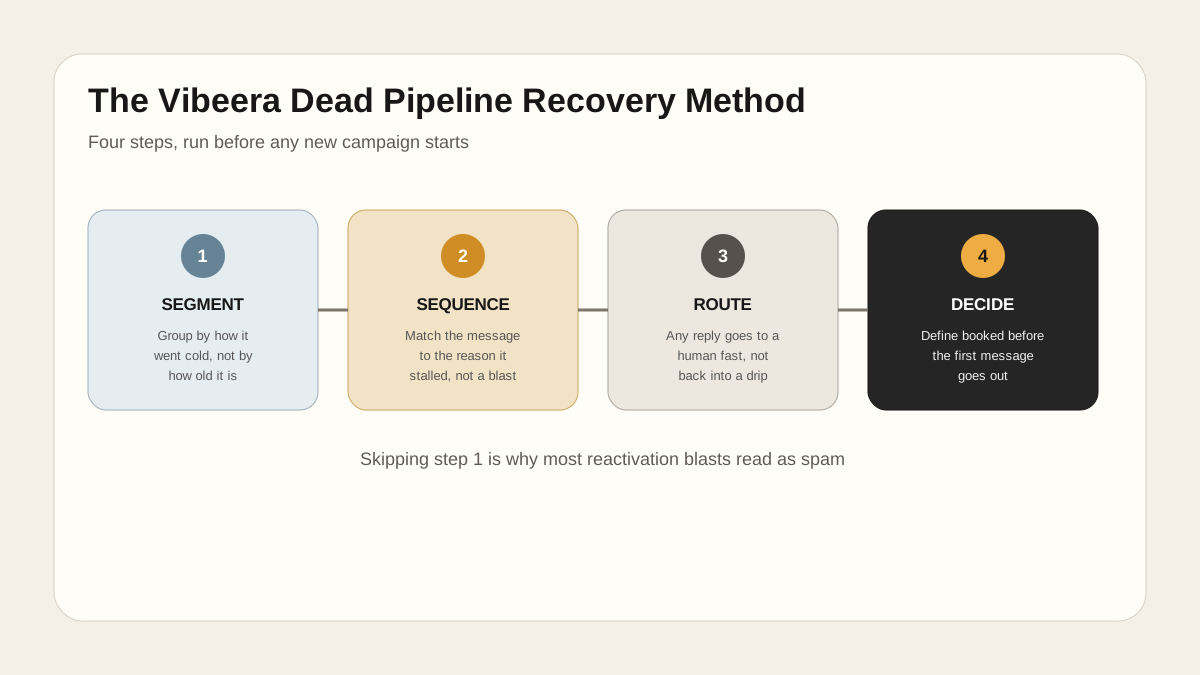
Step 1: Segment the list by how it went cold
Pull every contact who is not an active client and sort by the actual reason the relationship stalled, not by how long ago it happened: inquired and went quiet, proposal sent and never answered, booked and no-showed, or paused for a stated reason like timing or budget. A six-month-old no-show and a two-year-old no-show get the same message. A no-show and a price objection do not.
Step 2: Match the message to the reason it stalled
Write one short message per segment that names the real reason, not a generic "just checking in." A no-show gets acknowledgment and a new, lower-friction way to pick a time. A price objection gets a direct question about what changed, not a discount offered blind. A proposal that went quiet gets asked directly whether the priority is still live.
Step 3: Route every reply to a human within minutes
Any reply, positive or negative, should reach a person fast rather than wait in an inbox or loop back into an automated drip. A reactivated lead who replies and then waits two days for a response goes cold again, often for good.
Step 4: Decide what "booked" means before you start
Agree on the single accepted outcome, usually a scheduled call, before the first message goes out. Without that definition, a reply, a "maybe later," and an actual booked call get reported as the same result, and the campaign cannot be judged honestly at the 28-day mark.
A worked example
To make the method concrete: picture a coach with 400 contacts in a CRM who have never converted, roughly half inquiries that went quiet and the rest a mix of no-shows and stalled proposals. This is a hypothetical walk-through, not a reported Vibeera result or a benchmark to expect. The no-show segment gets a short message offering two new times. The quiet-inquiry segment gets a direct question about whether the original goal is still active. The stalled-proposal segment gets asked what changed since the proposal was sent. Replies from any segment route to a human the same day. The campaign is judged only against the booked-call definition agreed on before it started, and the segments that produced no reply are the honest input for the next cycle's message, not evidence the list is dead.
Reactivation checklist before you send anything
| Question | Why it matters | What to do first |
|---|---|---|
| Is the list segmented by reason, not just age? | A generic blast to a mixed list reads as spam to most of it | Tag each contact with the actual stall reason before writing copy |
| Does every contact have a lawful basis to be messaged? | Old contacts may have unsubscribed, bounced, or never consented to SMS | Clean the list against opt-outs and bounces before sending |
| Is "booked" defined the same way for every segment? | Without one definition, results cannot be compared across the campaign | Write the accepted outcome down before the first message goes out |
| Who answers a reply, and how fast? | A slow reply to an already-warmed lead loses the moment the campaign created | Name the person and the maximum response time in advance |
| What happens to non-responders? | A list that never gets touched again just goes cold a second time | Set the next review date before closing out this cycle |
Mistakes that kill a reactivation campaign
- One message to the whole list. It ignores the different reason each segment went cold and reads as a mass blast.
- Leading with a discount. Offering a lower price before knowing why someone stalled trains the list to wait for one next time.
- No lawful-basis check. Messaging contacts who unsubscribed, bounced, or never gave SMS consent risks spam complaints and carrier blocks, not just a wasted send.
- Treating a reply like a booking. A "maybe, let me think" is not the accepted outcome defined in step 4, and counting it as one hides whether the campaign actually worked.
- Running it once and stopping. A list that goes untouched again after one cycle returns to exactly the state that made it worth reactivating in the first place.
Who should run this, and how
A reactivation campaign can be run by the coach directly, by a hired contractor, on a self-run automation platform, or by an operator who runs it for you. The right choice depends on list size, available time, and whether the gap is the software or the weekly execution.
Comparing the operating cost: see how an operated AI department compares with hiring in-house for this kind of recurring follow-up work. Scope and cost: Vibeera's pricing is scoped on a call, with delivery in about 14 days once scoped. A reactivated lead that replies still has to be booked: see the hire-vs-outsource-vs-AI comparison for that step, with sourced cost ranges.| Option | What it requires from you | Best fit | Poor fit |
|---|---|---|---|
| Do it yourself | Your own time to segment, write, send, and answer replies every week | A small list, under a few dozen contacts, and spare hours | A list in the hundreds or a calendar with no spare hours |
| Hire a contractor or VA | Hiring, scripting, and ongoing management of someone else's daily output | You can write the message strategy yourself and just need hands | You cannot specify the segmentation and messaging rules yet |
| Self-run on GoHighLevel | Building and maintaining the workflow yourself, about $97 a month on its Unlimited plan as of 2026 | You already run GoHighLevel and have the hours to build the sequence | The software already exists but nobody operates it week to week |
| Vibeera, operated | Scoping the list, segments, and booked definition on a call; Vibeera runs the weekly execution | You have a real backlog and the gap is execution, not strategy | You have no existing pipeline yet or want a one-time blast only |
- Best fit: you already have a CRM with a real backlog of old leads, ghosted proposals, or no-shows, and the gap is someone to segment the list, write and run the sequence, and answer replies fast every week.
- Poor fit: you have no existing pipeline yet, your list is under a few dozen contacts, or you are looking for a one-time blast rather than an operated, ongoing follow-up system.
- Switching trigger: you keep meaning to reactivate the list and never start, or a past attempt was one generic blast that got no reply and the list has not been touched since.
Why speed still matters once someone replies
A reactivated lead that replies is, for a moment, exactly as warm as a brand-new inbound lead, and the same response-time research applies. A widely cited 2007 study of over 15,000 web leads and more than 100,000 call attempts across six companies found the odds of making contact were about 100 times higher when a call followed within 5 minutes than at 30 minutes, and the odds of qualifying the lead were about 21 times higher.
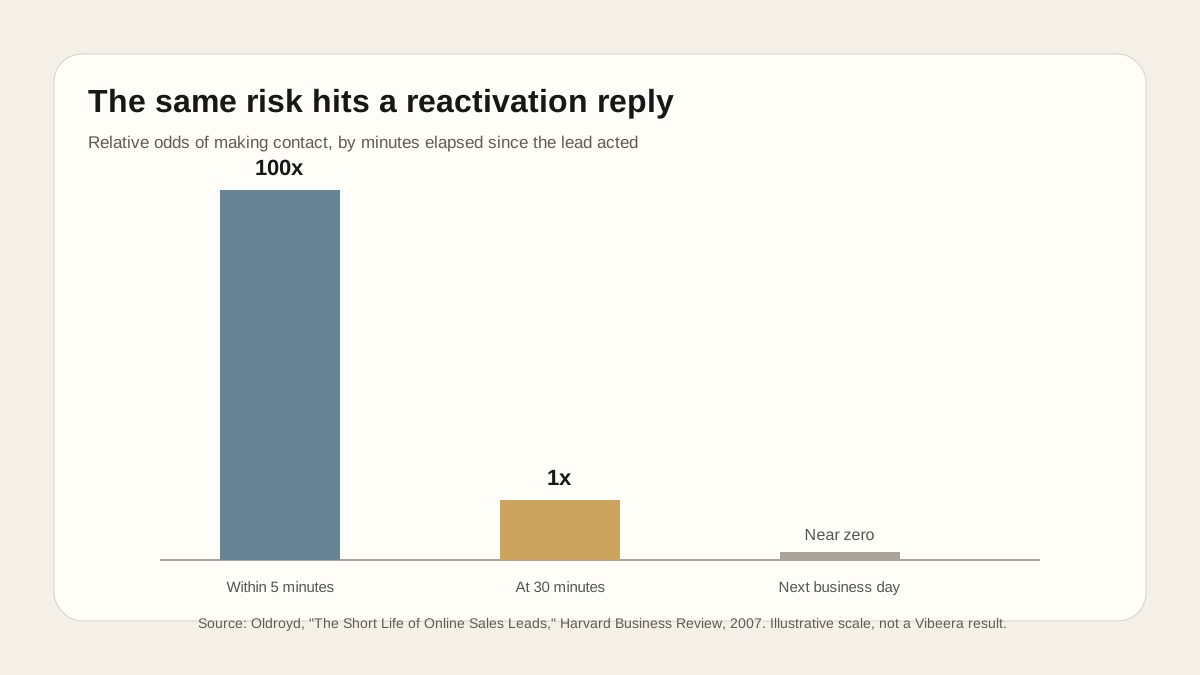
That study measured brand-new web leads, not reactivated ones, so treat the exact multiples as directional rather than a guarantee on your list. The mechanism still applies: step 3 of the method above, routing every reply to a human fast, exists because the reply is the moment the lead is warmest, and it does not stay that way for long.
Research method and evidence boundary
Ahrefs Keyword Explorer was checked October 12, 2026 for the United States. It estimated 100 monthly US searches, keyword difficulty 0, traffic potential 20, and CPC $12 for "database reactivation," with an AI Overview, a question box, and image and video results in the current SERP. "Speed to lead" (1,800/mo, KD 0, traffic potential 3,700) and "win back campaign" (100/mo, KD 0, traffic potential 450) were checked the same day and folded into this page rather than split into new URLs, since neither has a materially different buyer intent.
The GoHighLevel pricing figure (about $97 a month on its Unlimited plan as of 2026) is reused verbatim, with its existing "as of 2026" framing, from this site's own already-published, dated review at GoHighLevel for coaches, an honest review. No new competitor price is asserted. The 5-minute response-time figures are attributed to Oldroyd's 2007 Harvard Business Review study of InsideSales.com customer data; the original article is cited directly rather than a secondary summary. The FTC's CAN-SPAM Act compliance guide is cited for the opt-out and lawful-basis checklist item above. Vendor-reported dormant-list recovery percentages found during research were inconsistent and mostly unsourced, so this page does not state one as fact.
The Dead Pipeline Recovery Method, worked example, and checklist are Vibeera operator analysis informed by production marketing system work. No customer result, conversion rate, recovery percentage, implementation timeline, ranking, citation, pipeline, or revenue figure is implied or guaranteed.
The decision
Run a database reactivation campaign before building anything new if your CRM already holds a real backlog of old leads, ghosted proposals, or no-shows. Segment it by why it went cold, write one message per segment, route every reply to a human fast, and agree on what counts as booked before you start. Do it yourself or hand it to a contractor if the list is small and you have the hours; run it on a platform like GoHighLevel if you already have the tool and the time to operate it; bring in an operator like Vibeera when the backlog is real and the gap is weekly execution, not strategy.
Frequently asked questions
What is database reactivation?
Database reactivation is the practice of re-contacting dormant leads, ghosted proposals, and old clients already sitting in your CRM to reopen the conversation and book a fresh call. It is a marketing campaign, not a technical restart of a database system.
How do I start a database reactivation campaign?
Segment the list by how it went cold, write a separate message for each segment that names the real reason it stalled, send the sequence across email and text, and route any reply to a human within minutes rather than back into an automated drip.
How much revenue can database reactivation recover?
There is no reliable, independent benchmark for a coaching list specifically. Vendors selling reactivation services report a wide and largely unsourced range of recovery rates. Treat any percentage you see, including figures in this article, as a planning assumption to test against your own list, not a guarantee.
Is a database reactivation campaign the same as a win-back campaign?
They overlap. A win-back campaign usually targets past paying clients who churned. Database reactivation is broader: it also includes leads who never bought, proposals that went quiet, and no-shows. The same segmentation and sequencing method applies to both.
Is Vibeera a fit for database reactivation?
Vibeera is a fit if you already have a CRM with a real backlog of old leads, ghosted proposals, or no-shows, and the gap is someone to segment the list, write and run the sequence, and answer replies fast every week. Vibeera is a poor fit if you have no existing pipeline yet, your list is under a few dozen contacts, or you want a one-time blast rather than an operated, ongoing follow-up system.
Still have a dead pipeline sitting in your CRM?
Vibeera will map the segments, sequence, and booked definition before you build anything new.
Map the recovery before you build anything new ->