Should you build your own AI chief of staff, buy a tool, or have one operated?
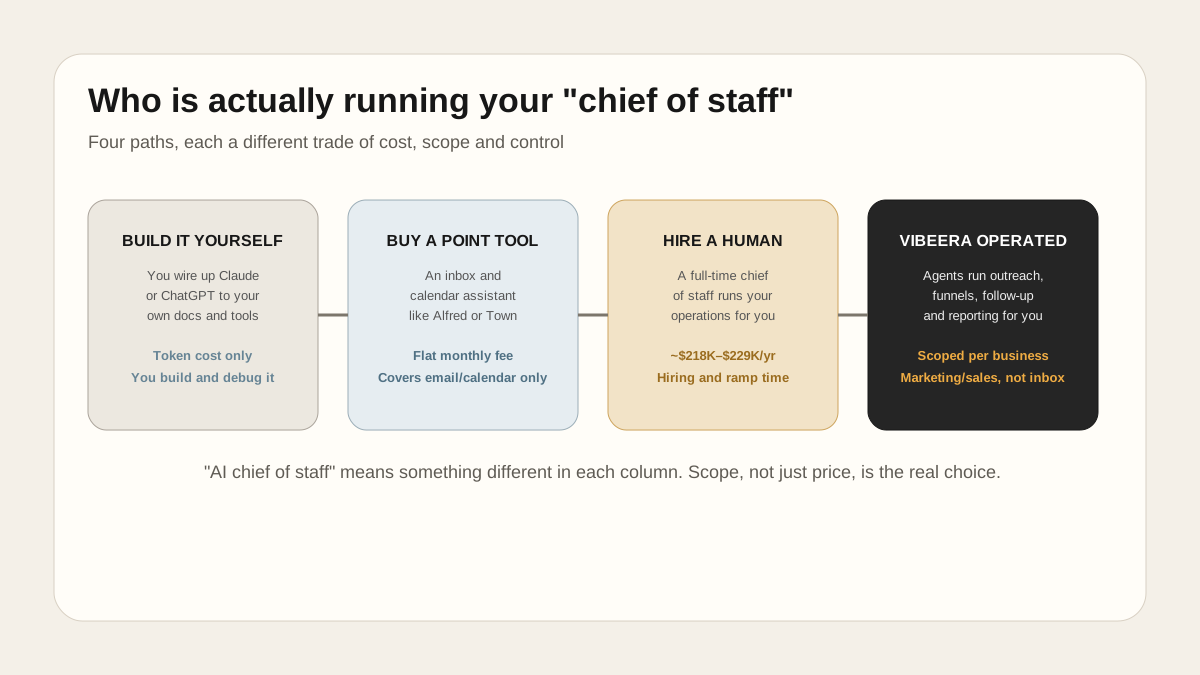
An AI chief of staff can mean a Claude build run for the cost of its tokens, a flat-fee inbox tool, a $220,000 human hire, or an operated marketing and sales department, and each one solves a different problem. Vibeera brands itself "your AI chief of staff" because it runs the outreach, funnels, follow-up, and reporting a coach or consultant would otherwise build or hire for themselves, not inbox or calendar triage.
Key facts
- Ahrefs estimated 90 monthly US searches for "ai chief of staff" on October 21, 2026, keyword difficulty 1; "chief of staff ai" adds 80/mo. The broader, narrower-scoped "ai executive assistant" gets 900/mo, KD 0, which is folded into this page's FAQ rather than split into a separate URL.
- A 2026 Fast Company first-person account reports a founder's self-built AI chief of staff in Claude costing about $25 in tokens on a heavy day, with the builder estimating roughly $5,000 a year could replace a "$200,000-level" hire; it also describes the agent once filling a missing revenue figure with a guess instead of flagging the gap.
- US chief of staff base pay runs roughly $218,000 (Glassdoor) to $229,000 (Salary.com) a year as of 2026, before benefits and ramp time, per a 2026 secondary salary guide citing both.
- Inbox-and-calendar point tools named in independent 2026 roundups include Alfred (about $25/mo individual) and Town (free tier; paid roughly $15-$199/mo); neither covers outreach, funnels, or reporting for a client-facing business.
Search "AI chief of staff" today and the results are not vendor landing pages. They are mostly first-person build logs: founders describing how they wired Claude or ChatGPT to their own calendar, documents, and task list, plus a couple of roundups of point tools and one engineering-ops product aimed at software teams. That split matters, because it means the term covers at least four genuinely different things, and the right choice depends on which one you actually need.
What "AI chief of staff" actually means, by path
Before comparing cost, it helps to separate the four things people mean when they say it:
- A DIY build. You personally connect a model like Claude or ChatGPT to your own notes, calendar, and tools, and prompt it to behave like a chief of staff.
- A point tool. A subscription product, almost always scoped to email and calendar triage, such as Alfred or Town.
- A human hire. An actual chief of staff employee who sets priorities, preps you for meetings, and chases down the business.
- An operated department. A vendor runs a specific function of the business for you on an ongoing basis. Vibeera's version of this is scoped to marketing and sales: outreach, funnels, follow-up, content, and reporting, not your inbox.
The build-it-yourself path, honestly
The DIY build is real, and it is cheap on paper. A widely shared 2026 Fast Company account describes a founder running a self-built AI chief of staff in Claude for roughly $25 in model-token spend on a heavy day, and estimating that about $5,000 a year in tokens could do work comparable to a "$200,000-level" hire. Within the first week, the builder says it was already handling roughly half the workload of a full-time chief of staff.
The same account is honest about the failure mode that matters most here: the agent once filled in a missing revenue figure with a guess rather than flagging that the number was missing. That is a single self-reported case, not an independent benchmark, but the failure pattern is consistent with how AI tools misfire generally: a confidently stated but invented number passes a casual review far more easily than an obviously wrong one, so the output that looks fine is the one worth checking hardest, not the one worth trusting most.
What point tools like Alfred and Town actually cover
Independent 2026 comparisons consistently describe Alfred as an email-first assistant, with pricing commonly listed around $25 a month for an individual seat and roughly $30 per seat for a team plan, though the vendor's own listing directs buyers to contact sales for current pricing. It integrates with Gmail and Outlook and is built around inbox and calendar triage, not outbound marketing or sales. Town is broader within the same category, reaching across email, Slack, WhatsApp, Telegram, desktop, and web, with a free tier and paid plans commonly listed from roughly $15 to $199 a month depending on usage. Other names that recur in the same 2026 roundups include Saner.AI, Lindy, Zapier, Fireflies.ai, and Reclaim.ai, each built around a different slice of personal productivity.
None of these tools, as described in their own vendor material and independent reviews, run cold outreach, build or operate a sales funnel, or produce the kind of attributed marketing report a coaching or consulting business needs. A coach evaluating "AI chief of staff" tools for that reason is usually solving the wrong problem with the wrong category of product.
The Vibeera Chief of Staff Scope Method
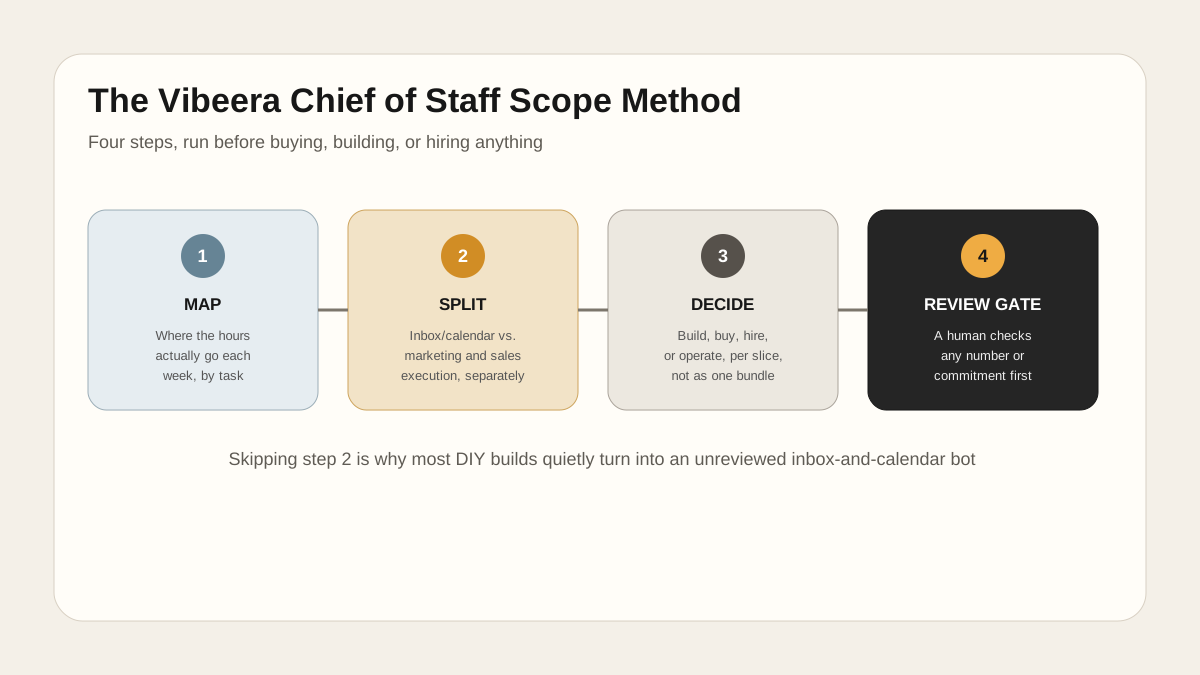
Vibeera uses a four-step method before recommending anything, because the single biggest mistake in this category is treating "AI chief of staff" as one bundle instead of several separable jobs.
Step 1: Map where the hours actually go
Before choosing a tool or a hire, the real breakdown matters: how much time goes to inbox and calendar admin, how much to marketing and sales execution, and how much to decisions that genuinely need the founder's judgment.
Step 2: Split the inbox slice from the execution slice
An inbox-and-calendar problem and an outreach-and-follow-up problem are solved by different categories of product. Bundling them under one "AI chief of staff" purchase is how a coach ends up with a point tool that cannot run a funnel, or an operated marketing system that was never meant to triage email.
Step 3: Decide build, buy, hire, or operate, per slice
A DIY Claude build may be the right call for personal inbox triage you are willing to maintain yourself. The marketing and sales execution slice is a different decision: self-build, a point tool, a human hire, or an operated department like Vibeera, each trading cost for who does the ongoing work.
Step 4: Keep a human review gate on anything high-stakes
Whichever path you pick, no AI agent should send a client-facing message, state a number, or make a commitment without a human checking it first; the DIY case study above shows exactly what happens when that gate is skipped.
A worked example
To make the method concrete: picture a consultant spending roughly ten hours a week on email triage and another fifteen on manually following up with leads who went quiet. This is a hypothetical walk-through, not a reported Vibeera result or a benchmark to expect. Mapping the split shows the inbox time is a real but modest cost, while the follow-up time is where qualified prospects are actually being lost. The fix in this scenario is not a $25-a-month inbox assistant; it is replacing the manual follow-up execution with an operated system, while the consultant decides whether a lighter inbox tool is worth adding separately.
What each path costs
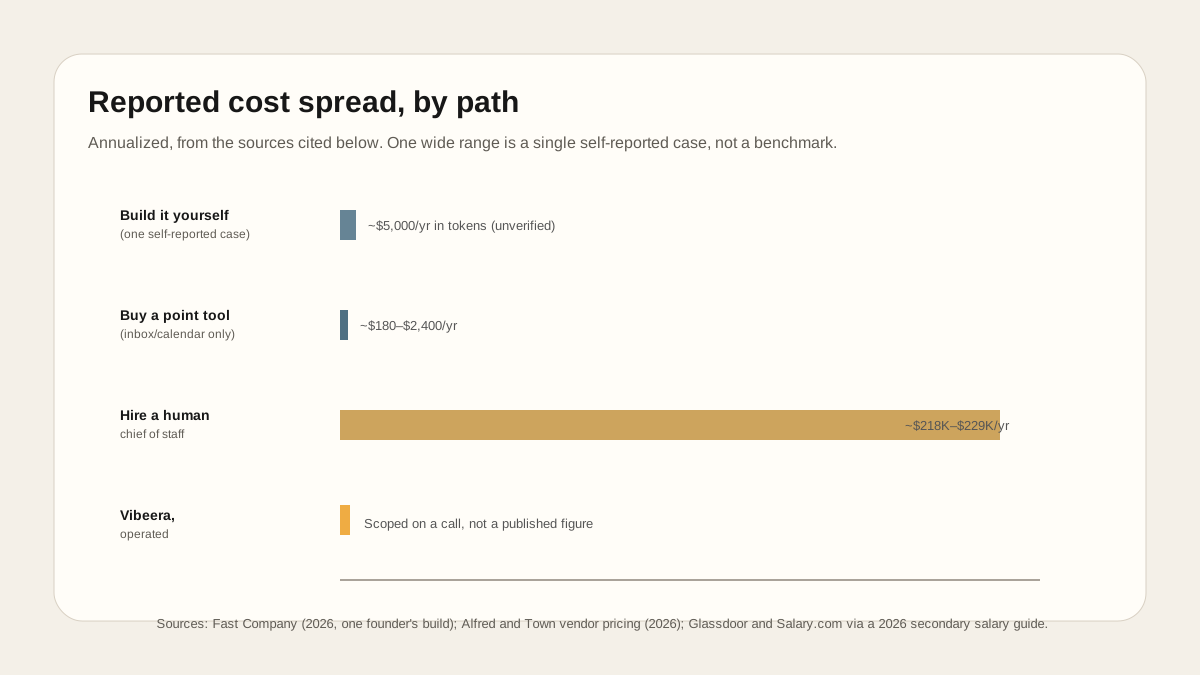
Figures below are reused from the sources cited in the research section; ranges reflect disagreement between sources, not a Vibeera estimate.
| Path | What it actually covers | Reported cost | Best fit |
|---|---|---|---|
| Build it yourself | Whatever you wire up personally; scope depends entirely on your own build | ~$5,000/yr in tokens (one self-reported case, unverified) | You want to build and maintain it yourself, and have the time to do that well |
| Buy a point tool (Alfred, Town) | Email and calendar triage only | ~$180–$2,400/yr | Your actual problem is inbox and scheduling, not marketing or sales |
| Hire a human chief of staff | Priorities, meeting prep, and chasing the business broadly | ~$218K–$229K/yr base | You want a dedicated employee across the whole business, not one function |
| Vibeera, operated | Outreach, funnels, follow-up, content, and reporting | Scoped on a call, live in about 14 days once scoped | The hours you want back are going into marketing and sales execution, not your inbox |
Mistakes that waste the most time in this category
- Buying an inbox tool to fix a pipeline problem. Alfred and Town were not built to run outreach or follow-up, and no amount of configuration changes that.
- Treating the Fast Company case as a guaranteed outcome. It is one founder's self-reported build, not an audited result; your own build time and failure rate will differ.
- Letting an agent state a number without a human checking it. The one documented failure in that same case study was a guessed figure presented as fact.
- Hiring a human chief of staff to fix a narrow execution gap. A full hire covers far more ground, and far more cost, than most single bottlenecks need.
- Comparing a $25-a-month tool to a $200,000 hire on price alone. They are not substitutes; one triages your inbox, the other runs your business.
Who this is for, and who it isn't
Comparing the operating cost: see how an operated AI department compares with hiring in-house for recurring marketing and sales execution. Scope and cost: Vibeera's pricing is scoped on a call, with delivery in about 14 days once scoped.- Best fit: the hours you want back are going into outreach, follow-up, funnels, content, or reporting, and you want that function operated rather than built or managed yourself.
- Poor fit: what you actually want is inbox and calendar triage, or you want one person across the entire business; a point tool or a human hire fits those jobs, not Vibeera.
- Switching trigger: you have tried a DIY build or a point tool and the marketing and sales execution still falls back on you every week.
Research method and evidence boundary
Ahrefs Keyword Explorer was checked October 21, 2026 for the United States: "ai chief of staff" (90/mo, KD 1), "chief of staff ai" (80/mo), and the broader "ai executive assistant" (900/mo, KD 0, traffic potential 700), which was folded into this page's FAQ rather than split into a separate URL, since it names a narrower, adjacent tool category rather than a different buyer. A live SERP check the same day found the top organic results dominated by first-person build accounts (Fast Company, LinkedIn, Reddit, Medium, Substack) plus one product listicle and one engineering-ops product page, consistent with the keyword's own research notes.
The $25-a-day and ~$5,000-a-year token-cost figures, the "$200,000-level" hire comparison, the first-week workload estimate, and the guessed-revenue-figure failure are all reused from one 2026 Fast Company first-person account; none of it is independently verified, and it is reported here as a single self-reported case rather than fact. Chief of staff base salary figures (~$218,388 Glassdoor, ~$228,689 Salary.com, 2026) are reused from a 2026 secondary salary guide citing both. Alfred and Town pricing and feature scope are reused from independent 2026 tool-comparison posts; Alfred's own vendor listing does not publish a current price and directs buyers to contact sales, so the commonly cited ~$25/mo figure is reported as third-party, not vendor-confirmed. The general point that a confidently stated but invented figure is harder to catch in review than an obviously wrong one reflects commentary on AI hallucination risk broadly, not a chief-of-staff-specific study.
The Chief of Staff Scope Method and worked example are Vibeera operator analysis informed by production marketing system work. No customer result, conversion rate, revenue outcome, ranking, citation, or timeline beyond the live "about 14 days" is implied or guaranteed.
The decision
Map where your hours actually go before buying or building anything. If the real cost is inbox and calendar admin, a point tool like Alfred or Town is built for exactly that and an operated marketing department is the wrong purchase. If the real cost is marketing and sales execution, outreach, follow-up, funnels, content, or reporting, a point tool will not fix it regardless of how it is branded. Build it yourself if you have the time and want to maintain it. Hire a human chief of staff if you want one person across the whole business. Bring in an operator like Vibeera when the gap is specifically the marketing and sales execution, not your inbox.
Frequently asked questions
What does "AI chief of staff" actually mean?
It is used in at least four different ways: a self-built assistant wired to a model like Claude or ChatGPT, a point tool that manages inbox and calendar, a human chief of staff hire, or an operated department that runs a specific function, such as marketing and sales, for you. The scope each one actually covers differs more than the name suggests.
Can I really build my own AI chief of staff with Claude or ChatGPT?
People report doing it, including a published first-person account of a founder running one for an estimated few thousand dollars a year in model-token spend. It is a single self-reported case, not an independent benchmark, and the same account describes the agent once filling a missing number with a guess instead of flagging the gap, which is why a human review gate on anything high-stakes matters regardless of which path you choose.
What is the difference between an AI chief of staff and an AI executive assistant?
In most current products, an AI executive assistant is narrower: it manages email and calendar, the way Alfred or Town do. "AI chief of staff" is used more broadly, sometimes for the same inbox-and-calendar scope and sometimes for a wider operating role across a business. Confirm the actual feature list before assuming either term covers marketing, sales, or reporting.
How much does a human chief of staff cost compared to an AI one?
US salary sources put a human chief of staff's base pay at roughly $218,000 to $229,000 a year as of 2026, before benefits, management time, and ramp-up. Inbox-and-calendar point tools run roughly $180 to $2,400 a year depending on the plan. The two are not interchangeable: a point tool does not replace a chief of staff's judgment, and a human hire covers far more than inbox triage.
Is Vibeera a fit for an AI chief of staff?
Vibeera is a fit if the hours you want back are going into outreach, follow-up, funnels, content, or reporting for your coaching or consulting business, and you want that function operated rather than built or managed yourself. Vibeera is a poor fit if what you actually want is inbox and calendar triage; a point tool like Alfred or Town is built for that specific job and Vibeera is not.
Ready to find out which slice is actually costing you time?
Vibeera will scope whether the gap is marketing and sales execution before recommending anything.
Map the marketing and sales slice before you buy a tool ->