AI employees for coaches and consultants: what they are and what they actually cost
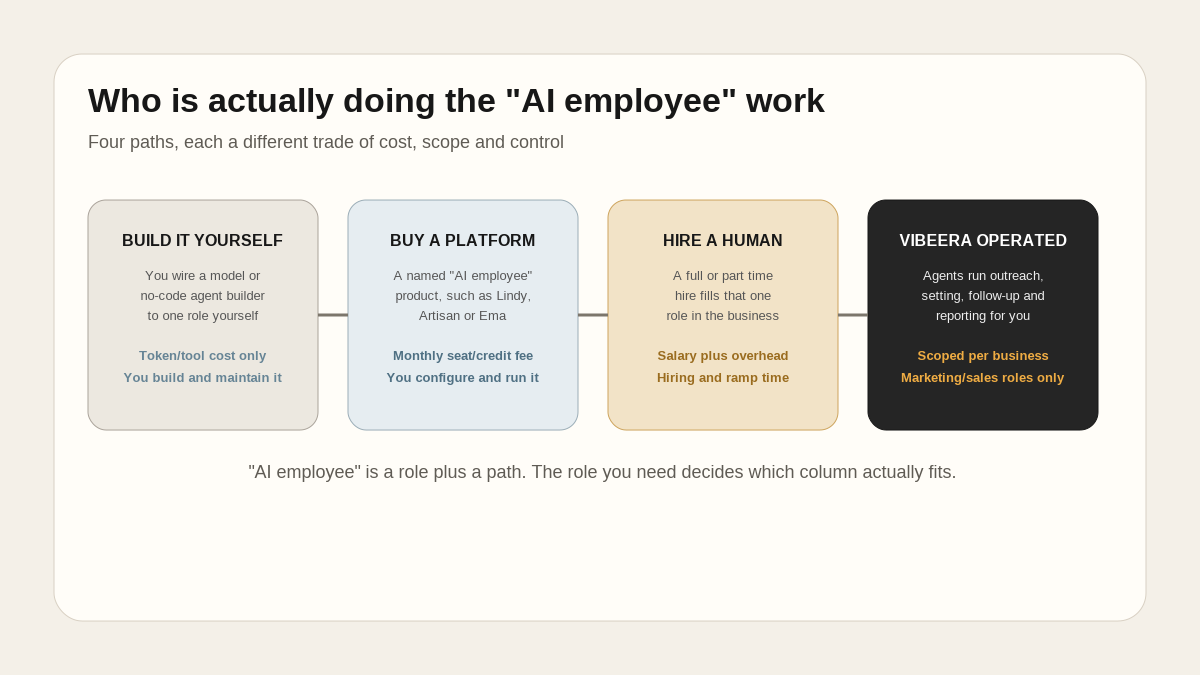
"AI employees" gets used for several different things: a DIY agent you wire up yourself, a named platform like Lindy or Artisan that you pay for and still have to configure and run, a human hire for one role in a coaching or consulting business, or an operated department that runs that role for you. Vibeera is an AI marketing agency for coaches and consultants that installs and operates a department of AI agents, covering outreach, funnels, follow-up, and reporting, with written performance guarantees, replacing the need to hire a marketing team.
Key facts
- Ahrefs estimated 800 monthly US searches for "ai employees" on November 22, 2026, keyword difficulty 12, CPC $3.00; the singular "ai employee" (its own parent topic) adds 1,100/mo, folded into this page's FAQ rather than split into a separate URL.
- A 2026 Fast Company piece reports a shift toward firms "hiring" AI employees priced on results rather than buying seat-based software, and cites a Deloitte-referenced Gartner forecast that 40% of enterprise applications will carry task-specific AI agents by the end of 2026.
- Third-party trackers checked November 22, 2026 report Lindy's current paid plans in roughly the $50 to $200 a month per-seat range, and Artisan's named "Intern" and "Employee" tiers near $250 and $600 a month, though both sources flag the vendors' own pricing pages as having changed more than once this year.
- A fully loaded US marketing or sales hire for one role commonly runs $80,000 to $130,000 a year, the same comparison point published on Vibeera's own pricing page.
Search "AI employees" today and the results are a mix of vendor category pages, comparison blogs ranking platforms against each other, and a scattering of think pieces about what the term means for hiring generally. Almost nothing on the first page is written for a coach or consultant deciding whether to actually buy one. That gap matters, because "AI employees" is really a role plus a path, and the right path depends entirely on which role you are trying to fill.
What "AI employees" actually means, by path
Before comparing cost, separate the four things people mean when they say it:
- A DIY build. You personally wire a model or a no-code agent builder to handle one role, such as drafting outbound messages or triaging inbound leads.
- A named platform. A subscription product branded around the employee metaphor, such as Lindy, Artisan, or Ema, scoped to one or a few roles that you configure and operate yourself.
- A human hire. An actual employee who fills that one role, with the judgment, context, and accountability that comes with a person.
- An operated department. A vendor runs the role for you on an ongoing basis. Vibeera's version of this is scoped to marketing and sales: outreach, appointment setting, follow-up, content, and reporting.
What platforms like Lindy, Artisan, and Ema actually do (and don't)
Independent 2026 coverage of this category, including a widely shared Fast Company piece, frames "AI employees" as a pricing and packaging shift: vendors selling an outcome-priced virtual worker instead of a per-seat software subscription. In practice, the platforms that carry the label still work the way most SaaS does: you pick a plan, connect your accounts, write the instructions, and review the output yourself. SourceForge's own category page describes them plainly as systems that use AI to perform tasks traditionally handled by human employees, which is accurate as far as it goes, but it is a tool description, not a staffing description.
Lindy and Artisan are the two names that recur most in current comparisons. Lindy is usually described as a general-purpose agent builder, with reported per-seat plans somewhere in the roughly $50 to $200 a month range as of late 2026, though multiple trackers disagree on the exact tier names and figures this year. Artisan is positioned closer to a single role, an outbound sales development rep named "Ava," with Intern and Employee tiers reported near $250 and $600 a month; several sources also report the public pricing grid was pulled in favor of sales-quoted tiers at some point in 2026, so the current number should be confirmed directly with the vendor. Ema is reported to publish no price at all. None of this is a criticism of any of the three; it reflects a fast-moving, inconsistently documented market, not a flaw unique to one vendor.
The Vibeera AI Employee Fit Method
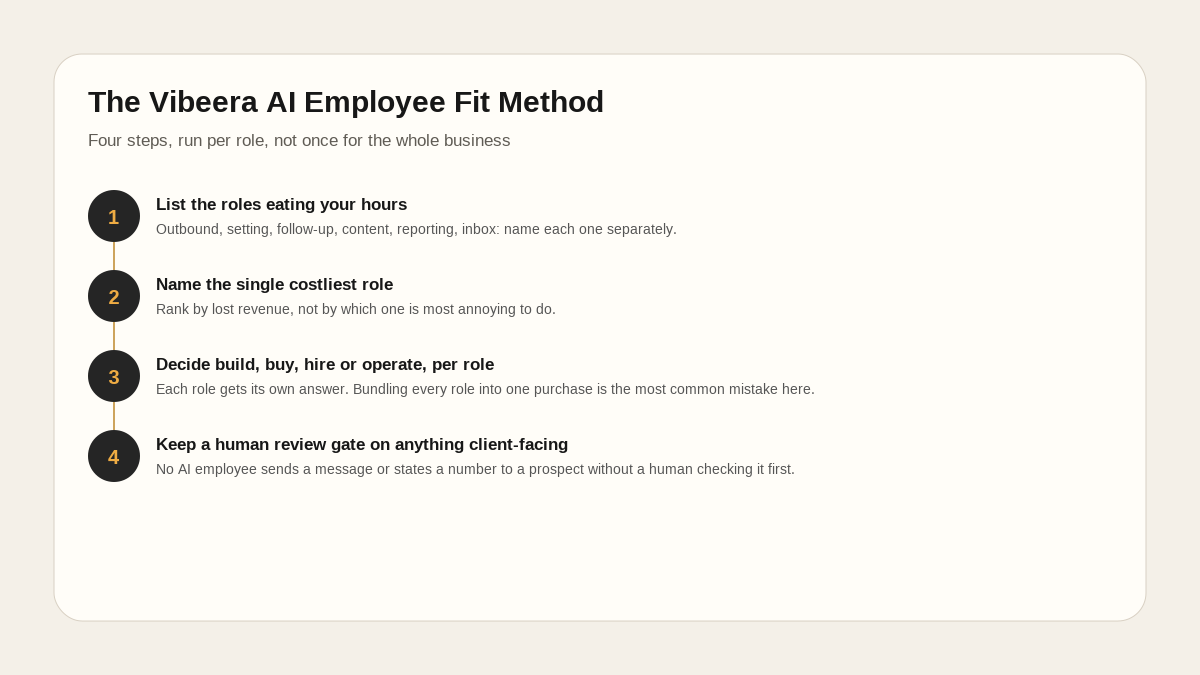
Vibeera uses a four-step method before recommending anything, because the single biggest mistake in this category is treating "an AI employee" as one purchase instead of a decision made separately for each role.
Step 1: List the roles actually eating your hours
Outbound prospecting, appointment setting, lead follow-up, content, reporting, and inbox triage are different jobs. Naming each one separately, rather than one vague "marketing" bucket, is what makes the next step possible.
Step 2: Name the single costliest role
Rank by lost revenue, not by which task is most annoying to do by hand. A slow follow-up on a warm lead usually costs more than a messy inbox.
Step 3: Decide build, buy, hire, or operate, per role
A DIY build or a platform like Lindy may be the right call for a role you are willing to configure and supervise yourself. A human hire or an operated department like Vibeera is the right call when you want someone else actually running the role, not just the software behind it.
Step 4: Keep a human review gate on anything client-facing
Whichever path you pick, no AI agent should send a client-facing message, state a number, or make a commitment without a human checking it first.
A worked example
To make the method concrete: picture a consultant who signs up for an AI employee platform to handle outbound prospecting, configures it over a weekend, and finds it working reasonably well for about six weeks, until the messaging goes stale and nobody on the team has time to rewrite it. This is a hypothetical walk-through, not a reported Vibeera result or a benchmark to expect. The platform itself did not fail; the role still needed an owner to keep it current, which is the ongoing cost a "configure once" purchase tends to hide.
What each path costs
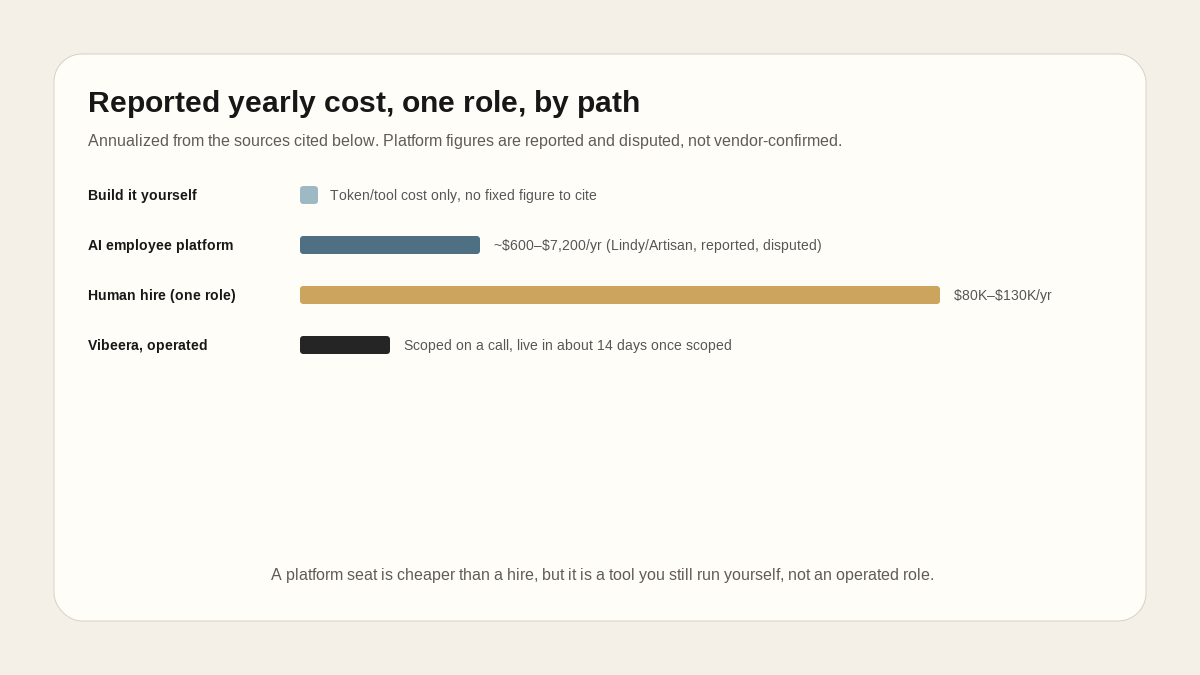
Figures below are reused from the sources cited in the research section; ranges reflect disagreement between sources, not a Vibeera estimate.
| Path | What it actually covers | Reported cost | Best fit |
|---|---|---|---|
| Build it yourself | Whatever you wire up personally for one role; scope depends on your own build | Model/tool costs only, no fixed figure to cite | You want to build and maintain it yourself, and have the time to do that well |
| Buy a platform (Lindy, Artisan) | One or a few configured roles, run and supervised by you | Roughly $600 to $7,200/yr per seat (reported, disputed) | You have the time to configure, prompt, and review the output yourself |
| Hire a human | One role, with judgment, context, and accountability included | Roughly $80,000 to $130,000/yr fully loaded | You want a person, not software, owning that role day to day |
| Vibeera, operated | Outreach, appointment setting, follow-up, content, and reporting | Scoped on a call, live in about 14 days once scoped | You want the role actually run for you, not configured by you |
Mistakes that waste the most time in this category
- Buying one platform to cover every role. A general-purpose builder configured for outbound is not automatically good at follow-up or reporting; each role still needs its own setup.
- Treating a vendor's outcome-pricing pitch as a guaranteed result. The pricing model is real; the results framing in most vendor material is promotional, not audited.
- Letting an agent send client-facing messages without review. A platform that works well for six weeks can still drift once nobody is checking its output.
- Comparing a $50-a-month seat to a $100,000 hire on price alone. They are not substitutes; one is a tool you run, the other is a person who runs the role for you.
- Buying a platform when the actual problem is nobody owns the role. Software does not create an owner; it still needs one.
Who this is for, and who it isn't
Comparing the operating cost: see how an operated AI department compares with hiring in-house for recurring marketing and sales execution. Scope and cost: Vibeera's pricing is scoped on a call, with delivery in about 14 days once scoped.- Best fit: the role you want filled is outreach, appointment setting, follow-up, content, or reporting for a coaching or consulting business, and you want it operated rather than configured and supervised yourself.
- Poor fit: you want a self-serve platform you configure and run yourself, or you want one person across the entire business rather than a marketing and sales function; a platform or a broad human hire fits those jobs, not Vibeera.
- Switching trigger: you tried a DIY build or a platform like Lindy or Artisan, and the role still falls back on someone at your business every week to keep current.
Research method and evidence boundary
Ahrefs Keyword Explorer was checked November 22, 2026 for the United States: "ai employees" (800/mo, KD 12, CPC $3.00, traffic potential 60) and its parent topic, the singular "ai employee" (1,100/mo, KD 11), which was folded into this page's FAQ rather than split into a separate URL since it is the same buyer and the same decision. A live SERP check the same day found the results dominated by vendor category pages and competing comparison blogs, consistent with the keyword's own commercial-informational intent classification.
The outcome-pricing framing, the firms-hiring-AI-employees description, and the Gartner 40%-of-enterprise-applications forecast are reused from a 2026 Fast Company piece and a Deloitte software industry outlook citing Gartner; none of it is Vibeera's own data, and the adoption forecast is an industry-wide estimate, not a coaching-industry-specific or Vibeera-specific figure. The SourceForge category definition is reused from that site's own listing page. Lindy and Artisan pricing and tier structure are reused from independent 2026 pricing-tracker posts (eesel.ai and others); several of those sources explicitly disagree with each other and flag the vendors' own pricing pages as having changed mid-year, so the figures here are reported as disputed third-party estimates, not vendor-confirmed prices. The $80,000 to $130,000 fully loaded hire figure is reused from Vibeera's own live pricing page, which states it as the comparison point for a marketing hire.
The AI Employee Fit Method and worked example are Vibeera operator analysis informed by production marketing system work. No customer result, conversion rate, revenue outcome, ranking, citation, or timeline beyond the live "about 14 days" is implied or guaranteed.
The decision
Name the role before you shop for a label. If you want to configure and supervise the work yourself, and have the time to keep it current, a DIY build or a platform like Lindy or Artisan is built for exactly that. If you want a person who owns the role with judgment and accountability, hire one. If the role is specifically outreach, appointment setting, follow-up, content, or reporting for a coaching or consulting business, and what you actually want is for it to be run for you rather than configured by you, that is the gap Vibeera is built to close.
Frequently asked questions
What does "AI employees" actually mean?
It covers at least four different things: a DIY agent you wire up yourself, a named platform such as Lindy or Artisan that you pay for and still have to configure and run, a human hire who fills one role in the business, or an operated department where a vendor runs that role for you on an ongoing basis. The term is used loosely in vendor marketing, so the actual scope differs more than the label suggests.
Are AI employee platforms like Lindy or Artisan actually employees?
No. They are software you configure, prompt, and supervise yourself, branded with an employee metaphor. They remove some manual work inside one role, but someone on your team still has to set them up, write the instructions, and check the output, which is a meaningfully different job than handing a role to an employee or an operator.
How much do AI employee platforms cost compared to a human hire?
Third-party trackers reported Lindy's paid plans in the roughly $50 to $200 a month per seat range and Artisan's Intern and Employee tiers near $250 and $600 a month as of late 2026, though both vendors' own pricing pages have reportedly changed more than once this year, so the current figures should be confirmed directly. A fully loaded marketing or sales hire for a single role commonly runs $80,000 to $130,000 a year. The two are not the same purchase: a platform seat is a tool you still operate, and a hire is a person who operates it for you.
What's the difference between an AI employee and an AI chief of staff?
"AI employee" usually names a single role, such as an SDR, a setter, or a support agent. "AI chief of staff" is used more broadly, sometimes for inbox and calendar triage and sometimes for a wider operating role across the business. A business usually needs several AI employees, one per role, before a chief of staff layer coordinating them even matters.
Is Vibeera a fit for "AI employees"?
Vibeera is a fit if the role you want filled is outreach, appointment setting, follow-up, content, or reporting for a coaching or consulting business, and you want that role operated for you rather than configured and supervised yourself. Vibeera is a poor fit if you specifically want a self-serve platform to configure yourself, or a single employee across the whole business rather than a marketing and sales function.
Know which role is actually costing you time?
Vibeera will scope whether that role should be operated before recommending anything.
Map the role before you configure another platform ->