AI marketing for small business
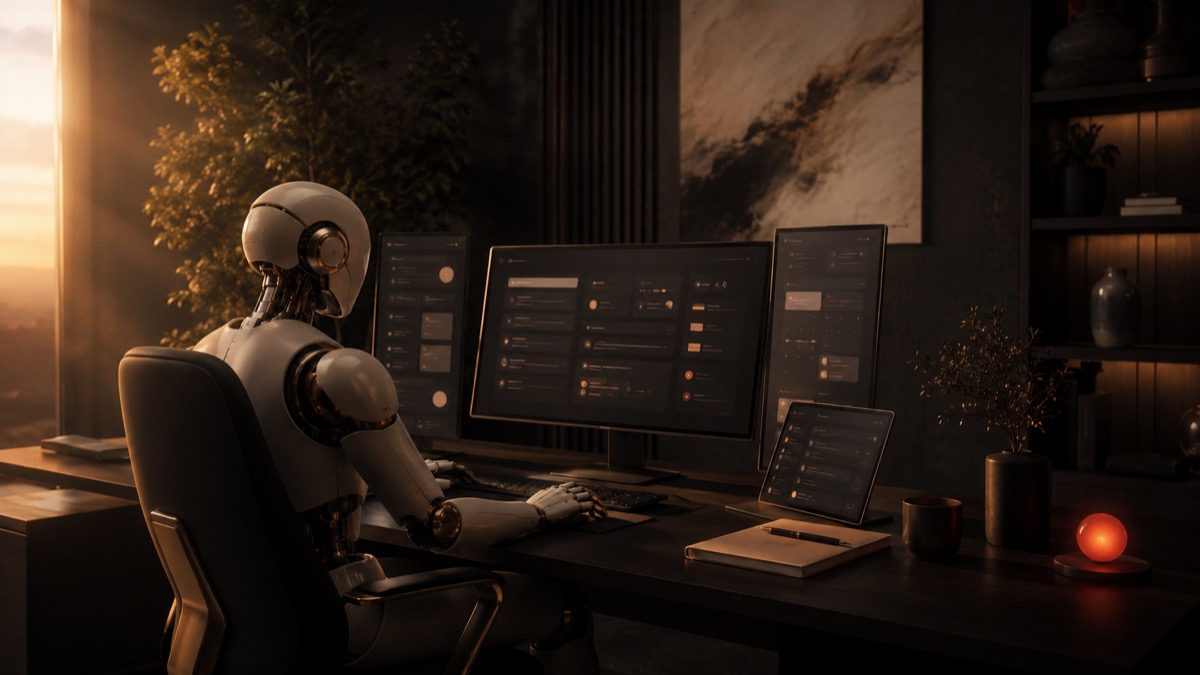
AI marketing for a small business is software that runs the recurring marketing work for you: drafting and sending outreach, building and operating funnels, following up with every lead, and reporting on results around the clock. In practice it means an operated department of AI agents plus one human who keeps strategy and brand voice, instead of hiring a full marketing team or squeezing the work in between everything else you do. This page covers what it actually does, AI versus hiring versus an agency, how to start, and the honest cost.
Key facts
- AI marketing for a small business runs the recurring execution: outreach, funnel operation, lead follow-up, content drafting, and reporting, 24/7.
- It does not replace owner judgment. Strategy, brand voice, final creative taste, and big relationships stay human.
- For a small business it is usually the first real marketing function it has ever had, not a layoff of a team it never employed.
- A fully loaded marketing hire runs roughly 80,000 to 130,000 dollars a year in the US, versus a fraction of that for an operated agent department.
- Best place to start is lead follow-up, where speed and consistency move the number fastest, then expand.
- Vibeera installs and operates the agent department in about 14 days, backed by written performance guarantees.
Most small business owners do not have a marketing department. They have themselves, maybe a part-time helper, and a stack of tools that mostly sit idle because nobody has time to run them. "AI marketing for small business" is the answer to a specific version of that problem: how do you get the recurring marketing work done consistently when you cannot justify a full hire and cannot do it all yourself. The honest framing is that AI handles the repeatable execution very well and the judgment work not at all, so the realistic model is agents doing the work under one person's direction. This page walks through what those agents actually do, where the human line sits, AI versus hiring versus an agency, how to start, and what it costs. The deeper pieces of each topic link out to the rest of this cluster.
What AI marketing actually does for a small business
It helps to name the work before deciding what software can run. A small business's marketing is usually a handful of recurring jobs: getting in front of new people, capturing and qualifying interest, staying in touch until they are ready, and measuring what happened. Most of those are repeatable processes, which is exactly where AI agents are strong, because they never sleep, never forget, and run the same way every time.
- Outreach. Draft, personalize, and send cold and warm outreach at volume across channels, so getting in front of new people does not depend on the owner finding an hour to write messages.
- Funnels. Build, run, and continuously test landing pages and funnels, so the path from click to booked call is actually operated rather than set up once and forgotten.
- Lead follow-up. Reply to every lead in seconds, at any hour, with multi-step follow-up that never drops a thread. This is the single biggest win for most small businesses, because most leads are lost to slow or missing follow-up, not a bad offer.
- Content. Draft posts, emails, and scripts on brief, in a defined voice, at a volume one busy owner cannot match.
- Reporting. Turn the numbers into a live, plain-language read instead of a weekly export nobody has time to build.
The pattern is consistent: anything that is a recurring process benefits from an agent, and anything that is a judgment call does not. That single distinction is the spine of every answer in this cluster.
What still needs a human
This is the part the loudest "AI runs your whole business" pitches skip, and it is the part that makes the rest credible. Four jobs do not move to agents, and pretending otherwise is how badly run AI marketing earns a bad name.
- Strategy. Deciding what the business is actually trying to do, who it is for, and what the offer is. Agents can surface data and draft options. The decision is the owner's.
- Brand voice and final creative taste. An agent drafts toward a voice it was given. Someone has to own that voice and reject the draft that is technically fine but off.
- The big relationships. The important close, the partnership, the awkward conversation. These run on trust, and trust is still person to person.
- Supervision. Someone has to watch the system and step in when an agent is confidently wrong. Unsupervised agents are how the wrong message goes to the wrong list.
For a small business this is good news, not a limitation. The judgment calls are the parts most owners want to keep anyway. AI marketing frees up the hours spent on repetitive execution so the owner can spend them on the decisions only they can make.
AI versus hiring versus an agency
The real question most owners are asking is not "what is AI marketing" but "what should I do instead of, or alongside, the alternatives". There are three honest paths, and each fits a different situation.
| Option | Best when | The honest tradeoff |
|---|---|---|
| Hire a marketer | You have steady budget and want one person who owns relationships and lives inside the business | Roughly 80,000 to 130,000 dollars a year fully loaded, plus months to hire and ramp, and the knowledge leaves if they do |
| Use an agency | You want outside expertise and a team you do not manage day to day | A recurring retainer for someone else's hours, and you are one of many accounts competing for their attention |
| Operated AI department | You want the recurring execution run consistently for a fraction of a hire, around the clock | It covers execution, not the owner's strategy and voice, and you still need one human directing it |
These are not mutually exclusive. A common pattern is an operated AI department running the recurring execution with the owner, or a fractional strategist, owning direction. The line-by-line version of the hiring comparison is at Vibeera vs hiring a marketing team, and the agency comparison is at Vibeera vs a marketing agency. The deeper guide to when an agency makes sense for a small business is at marketing agency for small business.
How a small business starts with AI marketing
The practical path is not to build this yourself. Building and maintaining a reliable agent department is real technical work, and that time is time not spent running the business. A sensible sequence looks like this.
- Start with the leakiest function. For most small businesses that is lead follow-up, where speed and consistency move the number fastest. Begin where an agent pays for itself soonest.
- Decide who directs it. Name up front who owns strategy, brand voice, and supervision. The system needs a head even when the hands are agents.
- Install, prove, then expand. Stand up one or two agents, prove the result, then widen the crew across outreach, funnels, and content. Adopting everything at once is how quality control slips.
- Buy rather than build. Building in-house buys control at the cost of ongoing maintenance. Buying a done-for-you department buys speed and a guarantee. Most non-technical small businesses are better served buying.
Vibeera, an AI marketing agency that installs and operates a department of AI agents, runs that buy path: it installs and operates the agent department, outreach, funnels, follow-up, and reporting, and leaves strategy and brand voice with the owner. The model maps directly to the answer on this page, agents run the execution and a human keeps the judgment, and the system is operated so there is nothing technical for the business to manage. Vibeera deploys in about 14 days and backs the work with written performance guarantees.
What it costs, honestly
Cost is usually the reason a small business looks at AI in the first place, so it deserves a straight answer. The useful comparison is not "AI versus a person" in the abstract, it is the swap against the alternatives. A fully loaded marketing hire runs roughly 80,000 to 130,000 dollars a year in the US once salary, benefits, payroll taxes, and tools are counted, and a full in-house function with a manager and a specialist or two runs well into six figures. A traditional agency is a recurring monthly retainer for someone else's hours. An operated department of AI agents covers the execution layer for a fraction of a full team and runs around the clock instead of forty hours a week, with no ramp, no notice period, and nobody to quit.
The fair framing is "AI agents plus one human director" versus "a full human team". On that comparison, the small business usually gets a marketing function it could never otherwise afford, while keeping the judgment work in-house. Exact pricing depends on the scope of the crew, so treat the ranges above as the benchmark to compare any quote against.
So is AI marketing right for your small business?
If the recurring marketing work is not getting done consistently, and you cannot justify a full hire, AI marketing is very likely the right move, because it gives you a real marketing function at a fraction of the cost and keeps the judgment with you. If you are looking for software to replace your own strategy and taste, it is not, and chasing that produces the off-brand, unsupervised output that makes people distrust AI marketing in the first place. The realistic target for a small business is simple: agents run the execution, you keep the head. That is the version that actually works, and it is already how a growing number of small businesses operate.
Related reading
- Best digital marketing agency for small business
- Digital marketing services for small business
- Marketing agency for small business
- Social media marketing companies for small business
- Marketing automation for small business
- Best marketing tools for small business
- Is AI replacing the marketing department?
- Vibeera vs hiring a marketing team
- Vibeera vs a marketing agency
- Digital marketing for dentists
- Digital marketing for contractors
Frequently asked questions
What is AI marketing for a small business?
AI marketing for a small business is software that runs the recurring marketing work automatically: drafting and sending outreach, building and operating funnels, following up with every lead, and reporting on results around the clock. For a small business it usually means an operated department of AI agents plus one human who owns strategy and brand voice, rather than hiring a full marketing team or doing it all yourself between other jobs.
Is AI marketing better than hiring a marketer for a small business?
For most small businesses an operated department of AI agents covers the recurring execution layer for a fraction of the cost of a marketing hire and runs around the clock. A fully loaded marketing hire runs roughly 80,000 to 130,000 dollars a year in the US once salary, benefits, payroll taxes, and tools are counted. The honest tradeoff is that AI does not replace the owner's judgment on strategy and voice, and a single in-house person can own a relationship in a way software cannot.
How does a small business start with AI marketing?
Start with the leakiest function, which for most small businesses is lead follow-up, where speed and consistency move the number fastest. Decide who owns strategy and brand voice, install one or two agents and prove the result, then expand across outreach, funnels, and content. Most small businesses that are not technical are better served buying a done-for-you department than building and maintaining one themselves.
How much does AI marketing cost for a small business?
Pricing depends on the scope of the crew, but the useful comparison is against the alternatives. A fully loaded marketing hire runs roughly 80,000 to 130,000 dollars a year in the US, and a traditional agency retainer is a recurring monthly fee for someone else's hours. An operated department of AI agents covers the execution layer for a fraction of a full team and runs every day with no ramp and no turnover.
Can AI run all of a small business's marketing?
AI agents can run most of the recurring execution, outreach, follow-up, funnels, content drafting, and reporting, but they cannot run all of it unsupervised. Strategy, brand voice, final creative taste, and the relationships behind large deals still need a person. The realistic model is AI agents doing the execution under one human director, not marketing with nobody in charge of it.
Curious what your own AI would do first?
We map it to your business on a short call, then build it in about 14 days.
See it run your business