Content marketing agency: what should it own?

A content marketing agency should own the operating path from buyer research to useful assets, editorial review, distribution, and measurable business decisions. Its product is not an article quota. It is a controlled system that assigns intent owners, protects evidence and authorship, connects every asset to a journey, and corrects weak work after publication.
Key facts
- Content marketing can support search, email, sales, partners, customer education, social distribution, and authority. A search ranking is one evidence state, not the whole job.
- Published, discovered, indexed, viewed, clicked, cited, booked, qualified, and won are separate states.
- Ahrefs estimated 14,000 monthly US searches, 30,000 global searches, keyword difficulty 11, traffic potential 179,000, and CPC $0.40 on August 15, 2026.
- The current US result set mixes directories, agency lists, local pages, service pages, and guides. The Content Operating Contract preserves a reason to visit.
A buyer can purchase writing and still lack a content marketing system. Someone must decide which buyer problem deserves an owner, what evidence makes the asset defensible, who approves claims, where the asset is distributed, how it connects to conversion, and what happens when the evidence says retain, improve, consolidate, or stop.
Start with a Content Operating Contract
Vibeera uses a Content Operating Contract: a written agreement that names the buyer decision, canonical owner, evidence pack, production roles, editorial approval, distribution routes, conversion path, lifecycle dates, and correction owner. It turns content from a delivery count into an accountable operating system.
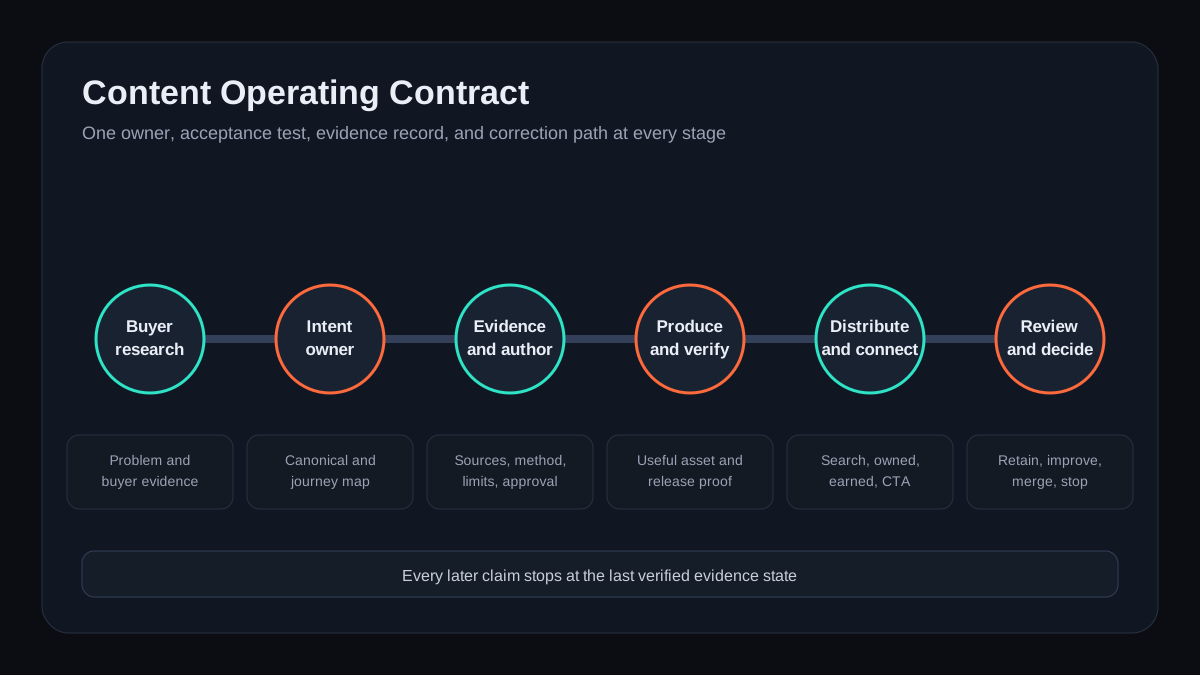
| Stage | Acceptance test | Owner evidence | Common failure |
|---|---|---|---|
| Buyer research | Is a real audience making a costly decision that the asset can help? | Search, sales, support, customer, and market records | Topic chosen for volume without a credible buyer path |
| Intent ownership | Does one canonical asset own a distinct question or decision? | Owner map, SERP pattern, existing pages, internal links | Adjacent pages compete or repeat the same answer |
| Evidence and authorship | Are claims sourced, limits visible, and expert judgment truthful? | Source pack, author input, method, approval record | Commodity summary or invented expertise |
| Production | Does the asset answer first, teach a usable process, and pass visual and technical QA? | Draft, visuals, schema, validator, rendered review | Quota shipping with no independent utility |
| Distribution and journey | Can the right audience find the asset and take the next relevant action? | Search eligibility, internal links, owned and earned routes, CTA | Publishing treated as distribution |
| Lifecycle | Did evidence justify retain, improve, consolidate, distribute, or retire? | Discovery, visibility, authority, conversion, pipeline, revenue | Pages stay live without a dated decision |
The public Content Operating Contract CSV is a reusable procurement and weekly review worksheet. It contains no Vibeera benchmark, customer result, or ranking promise.
Separate production from strategy and distribution
Writing is one capability inside the system. Strategy chooses what to own and why. Production turns evidence into an independently useful asset. Distribution earns discovery across the channels the audience uses. Measurement observes what happened. Lifecycle work changes the portfolio. A provider can be strong at one layer and weak at the others.
| Provider shape | Primary strength | Buyer still owns | Best fit |
|---|---|---|---|
| Writer or studio | Drafting and creative execution | Research, owners, proof, approvals, distribution, measurement | The operating system already exists |
| SEO agency | Search demand, retrieval, on-page, links, and organic measurement | Wider owned distribution, sales use, subject expertise, business acceptance | Search is the defined content constraint |
| Content marketing agency | Research, planning, production, distribution, and lifecycle coordination | Offer truth, subject access, approvals, sales context, commercial decisions | The full content system needs an operating owner |
| In-house team | Context, expertise access, brand continuity, cross-functional ownership | Hiring, methods, tools, capacity, specialist support | Stable demand justifies permanent capability |
Use an evidence ladder instead of one blended score
A content report becomes misleading when delivery, search visibility, authority, and pipeline are compressed into one success number. The agency should retain the evidence chain so every claim stops at the last verified state.
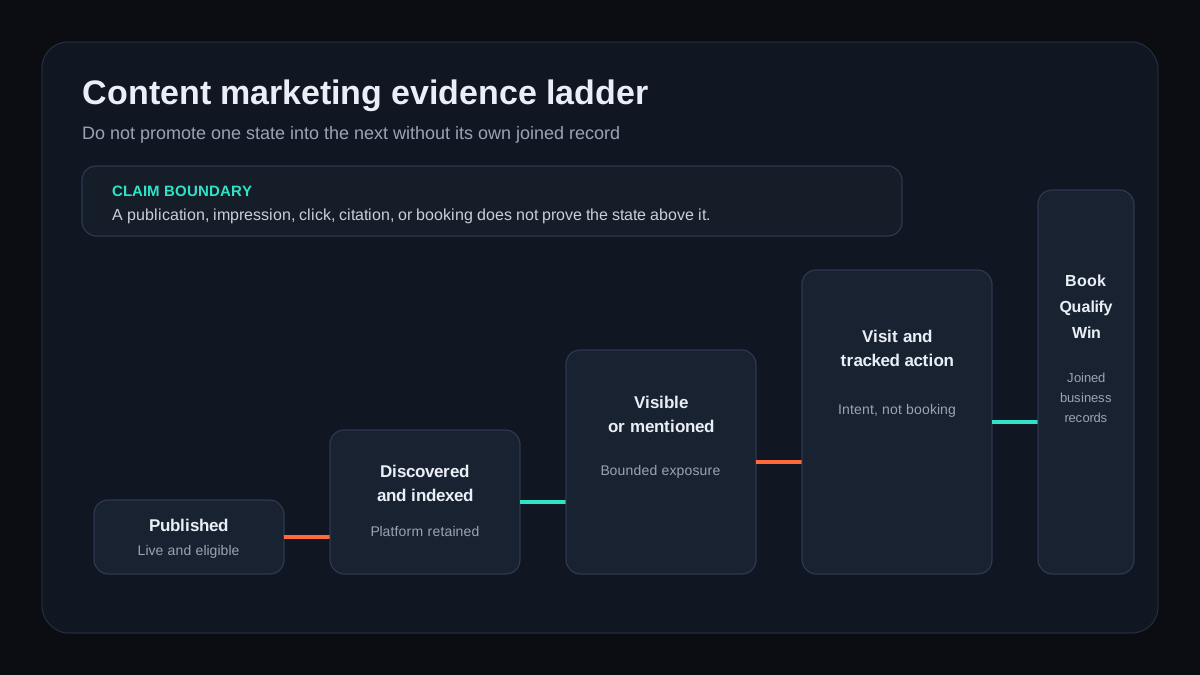
| Evidence state | What it proves | What it does not prove |
|---|---|---|
| Published and eligible | The approved asset is live, crawlable, measurable, and connected | Discovery, indexation, attention, authority, or demand |
| Discovered and indexed | A platform found and retained the preferred asset | Ranking, click, referral, or buyer value |
| Impression or mention | The asset or entity appeared on a bounded visibility surface | Recommendation, citation, visit, trust, or causation |
| Visit and CTA | A person reached the asset and performed a tracked action | Completed booking, fit, opportunity, or revenue |
| Booking and qualification | A joined person booked and the business accepted fit | Won revenue or content causation |
| Won revenue | A joined opportunity produced recorded revenue within the stated model | Universal channel causation or repeatability |
Decide which existing owner should support the journey
The content marketing owner is distinct from white-label fulfillment and search retrieval. It governs the complete editorial operating system. Existing Vibeera owners remain the better answer when the buyer's primary problem is narrower.
Agency fulfillment: choose white-label content marketing when a client-facing agency needs invisible delivery, authorship controls, and handoff acceptance. Search and retrieval: choose an AI SEO agency when crawl, indexation, search visibility, answer retrieval, and citation evidence are the primary constraint. Evidence repair: choose marketing analytics when content, channels, calendar, CRM, and revenue records cannot support a defensible decision.What the weekly operating loop should do
- Reconcile: align the owner map, research backlog, live inventory, distribution ledger, analytics, CRM, and authority records.
- Diagnose: name the earliest failed state and decide whether the asset needs improve, consolidate, link, distribute, build, or stop.
- Prioritize: score expected qualified pipeline, buyer intent, demand, information gain, SERP weakness, internal-link fit, publisher value, measurement readiness, and zero-click risk.
- Produce: build the answer, evidence, decision tool, visuals, metadata, links, and page-specific attribution through one release gate.
- Distribute: connect the asset through search, hubs, older pages, owned channels, partners, and approval-gated publisher routes.
- Decide: use dated evidence to retain, improve, consolidate, distribute, retire, or mark the result inconclusive.
Google's people-first content guidance asks whether content provides original information, research, analysis, or substantial added value. Google's SEO Starter Guide covers crawlable links, descriptive text, and useful content without prescribing a publishing quota. Google Analytics campaign URL documentation explains consistent UTM parameters. These are platform sources, not evidence that Vibeera or any agency produces a specific result.
Research method and evidence boundary
Ahrefs Keyword Explorer was checked August 15, 2026 for the United States. It estimated 14,000 monthly US searches, 30,000 global searches, keyword difficulty 11, traffic potential 179,000, CPC $0.40, and parent topic marketing agency with 55,000 US searches. It exposed 1,941 matching terms, 46 modeled questions, and 809 also-rank terms. These third-party estimates can change and do not establish Vibeera rankings, traffic, pipeline, or revenue.
The current Ahrefs result set included Clutch and Semrush directories, agency roundups, service pages, a local agency page, and paid ads. The modeled traffic potential is dominated by a broader local marketing page, so it is not a forecast for this owner. Directory and list results preserve strong commercial investigation intent, while broad parent intent and summary answers create high zero-click and intent-drift risk.
Vibeera compared content marketing agency, conversion rate optimization agency, go-to-market agency, revenue operations agency, lifecycle marketing agency, cohort pricing, LinkedIn outreach for coaches, and Circle ads in the same run. Content marketing had the strongest remaining demand and a distinct full-system owner. The other candidates had materially lower modeled demand, a weaker evidence path, or overlap with existing acquisition, analytics, growth, and operations owners. No Vibeera URL owned the research-to-distribution content operating system as its primary intent.
The Content Operating Contract, evidence ladder, provider comparison, and weekly loop are Vibeera operator analysis informed by production SEO, content, attribution, and publishing controls. No customer result, search lift, implementation timeline, citation, booking, pipeline, revenue, or causal effect is implied.
The decision
Hire a content marketing agency when a defined audience and credible offer exist, but research, intent ownership, production, distribution, or lifecycle management is the active constraint. Require a Content Operating Contract, truthful subject access, source and approval rules, a usable decision asset, explicit distribution ownership, separate evidence states, and a dated correction cadence. Choose a writer for narrow production, an SEO agency for a search-specific constraint, or an in-house team when stable volume and context justify permanent capability.
Frequently asked questions
What does a content marketing agency do?
A content marketing agency researches buyer problems, plans an editorial system, produces and reviews useful assets, distributes them, and measures what happens after publication. A complete operator also protects authorship, source quality, brand review, internal links, conversion attribution, and the correction loop.
How do I choose a content marketing agency?
Choose the agency whose operating contract names the buyer, intent owners, source and approval rules, production responsibilities, distribution owners, measurement states, and correction cadence. Reject a provider that promises volume or rankings without showing how evidence and qualified outcomes are accepted.
What should a content marketing agency report?
Report published and updated assets, discovery, crawl, indexation, impressions, rankings, clicks, distribution, relevant mentions, CTA actions, bookings, qualified meetings, pipeline, and revenue as separate states. Include the source, owner, limitations, and decision made from each state.
What is the difference between content marketing and SEO?
Content marketing creates and distributes useful assets for a defined audience and business decision. SEO helps the right assets become discoverable and understandable in search. They overlap, but content can support email, sales, social, partners, and customer education while SEO also includes technical retrieval, internal links, and search measurement.
When should I hire a content marketing agency?
Hire one when the offer, audience, expertise, and review capacity are credible but research, production, distribution, or measurement is the active constraint. Do not hire one to manufacture authority, replace missing subject expertise, or publish volume before ownership and conversion evidence are defined.
Map the content operating contract
Vibeera will map the buyer decision, owner URLs, evidence, production controls, distribution routes, and measurable conversion path.
Map the implementation