Marketing analytics agency: what should it actually prove?

A marketing analytics agency should make marketing decisions auditable: define the question, preserve source and campaign state, validate collection, join activity to CRM outcomes, expose missing data, and turn the last verified business state into a decision. Buy a measurement contract and operating cadence, not a prettier dashboard or an attribution model presented as causation.
Key facts
- The useful deliverable is a controlled source-to-outcome evidence chain with definitions, owners, tests, exceptions, and a decision cadence.
- Acquisition, behavior, bookings, attended meetings, qualified opportunities, and won revenue are separate states; report only to the last successful join.
- Ahrefs estimated 1,000 monthly US searches, keyword difficulty 2, traffic potential 1,200, and CPC $7 for marketing analytics agency on August 9, 2026. These are planning estimates, not Vibeera results.
- The stored US result set mixed service pages, directories, and guides; several ranking service pages had low URL-level authority, while an AI Overview increased zero-click risk.
Marketing analytics becomes valuable when it changes a decision without hiding uncertainty. A channel report can show traffic while the booking source is missing. A CRM can show a won deal while the originating landing page is unknown. An attribution platform can assign credit while the underlying event, identity, or revenue join is incomplete. A useful agency makes those boundaries visible and fixes the earliest broken state before debating model sophistication.
Start with a measurement contract
Vibeera uses a Measurement Acceptance Contract: a written definition of the business question, source systems, identifiers, accepted events, exclusions, owners, reconciliation tests, decision threshold, and evidence limit. It prevents a dashboard from becoming the product.
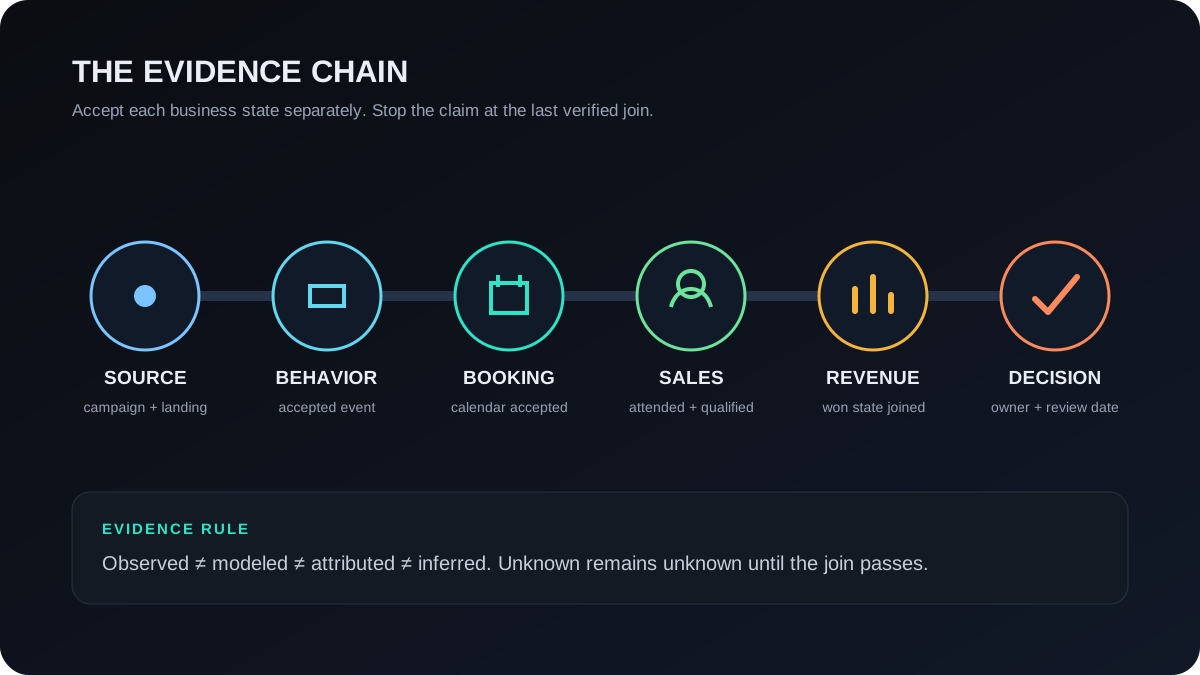
| State | Acceptance test | Evidence retained | What it does not prove |
|---|---|---|---|
| Source | Campaign naming is stable and the landing request preserves the expected parameters | Source, medium, campaign, content, landing URL, timestamp | Buyer intent or lead quality |
| Behavior | The agreed event fires once with the correct page and consent state | Event name, page, session context, test result | A booking or sale |
| Booking | Calendar acceptance preserves the original page and campaign context | Booking ID, event, invitee, source fields | Attendance or qualification |
| Sales | Stable identifiers join booking, contact, attendance, and disposition | Contact, meeting, owner, stage, reason | Won revenue |
| Revenue | Won amount and date join under a documented rule | Opportunity, amount, currency, close state | Incremental causal lift |
| Decision | The chosen action names its evidence, uncertainty, owner, review date, and rollback | Decision record and post-change result | A universal recommendation |
Fix collection and joins before choosing a model
Attribution models answer how credit is assigned within the data they receive. They cannot repair a missing event, inconsistent UTM naming, overwritten referrer, duplicate contact, untracked phone call, or a deal that never joins back to the booking. The agency should test the path in order and stop at the first failure.
- Define: specify the decision, metric, window, unit, owner, and acceptable evidence.
- Collect: implement the minimum events and campaign fields needed for that decision.
- Validate: test consent, duplicates, redirects, cross-domain handoffs, referrer loss, and provider failure.
- Join: connect page, session, booking, contact, opportunity, and revenue with stable identifiers where lawful and necessary.
- Reconcile: compare analytics, calendar, CRM, ad platforms, and finance under one time and status definition.
- Decide: choose one change, record the expected signal, and set a real review date.
A sophisticated model on weak collection creates precise-looking ambiguity. A simple last-verified-source view with explicit gaps can be more useful while the business repairs the chain.
Require tests for the failure paths
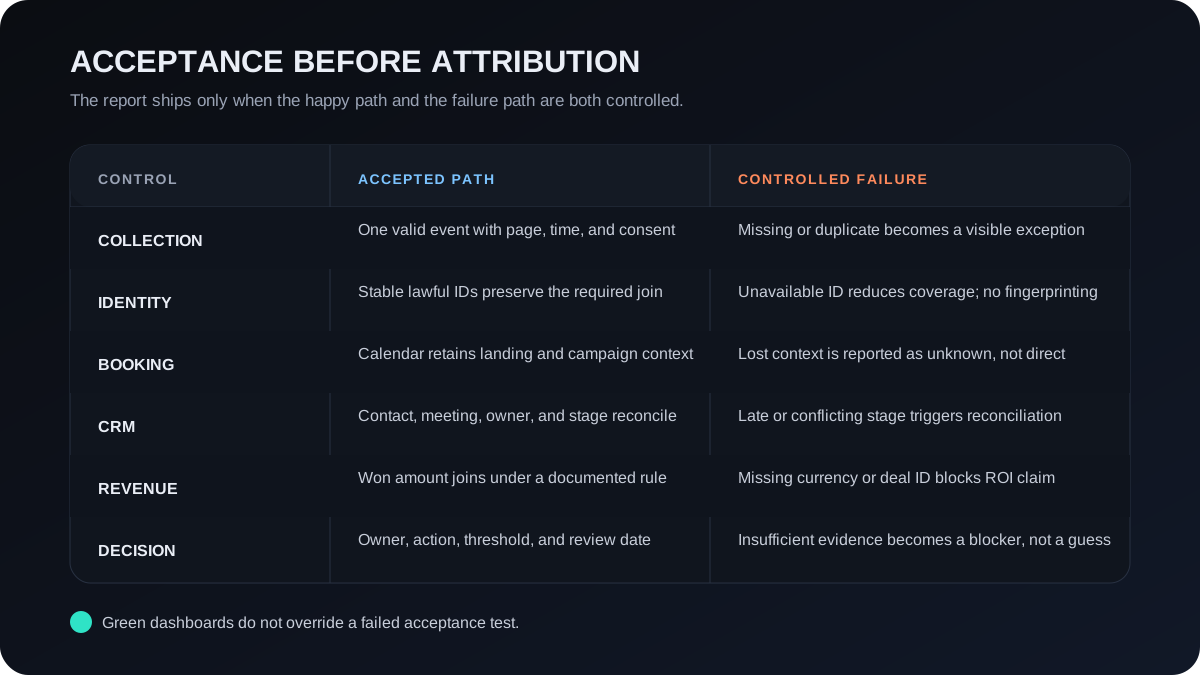
| Failure case | Expected behavior | Block the release when |
|---|---|---|
| Missing or malformed campaign values | Visible exception or controlled classification; no silent naming split | The report merges or invents the source |
| Duplicate event or retry | Idempotent count or documented deduplication rule | One action becomes multiple conversions |
| Cross-domain or calendar handoff | Original landing and campaign context remain joinable | The booking becomes direct or unknown without disclosure |
| Consent denied or identifier unavailable | Privacy choice is honored and coverage limits are reported | Collection bypasses consent or uses prohibited identification |
| CRM stage changed late | Status history and reporting window are reconciled | Reports silently freeze an outdated stage |
| Provider outage or schema change | Alert, bounded recovery, backfill rule, and post-check | Missing data is presented as zero activity |
Choose the operating model by the gap
| Option | You are buying | Your team still owns | Best fit |
|---|---|---|---|
| Analytics tool | Collection, storage, modeling, or visualization capability | Design, implementation, QA, interpretation, and action | A measurement owner already exists |
| Implementation specialist | A defined tracking or reporting build | Ongoing reconciliation and decisions | The scope and acceptance test are already clear |
| Analytics consultant | Diagnosis, architecture, governance, and guidance | Daily operation and repair | The internal team can execute the plan |
| Marketing analytics agency | Cross-system implementation, operation, quality control, and decision cadence | Business definitions, access approvals, strategic judgment | No accountable measurement operator exists |
| Internal analyst or team | Dedicated context and direct control | Hiring, tools, standards, specialist support | Stable workload and management capacity justify it |
Ask for decisions, not dashboard inventory
A weekly review should answer five questions: what changed, which state is earliest in the chain, whether the change is real or a reporting artifact, what action is justified, and when the evidence will be checked again. Reports should separate observed, modeled, attributed, and inferred values. Unknown must stay unknown until a valid join exists.
- Definitions, owners, source systems, and time windows are fixed before the chart is read.
- Data freshness, coverage, exclusions, thresholding, modeled values, and restatements are visible.
- The report keeps traffic, leads, bookings, attendance, qualification, pipeline, and revenue distinct.
- Every recommendation becomes a completed change, approval-ready artifact, evidence-dated review, or precise blocker.
- The agency can reproduce the query or logic and explain how the client can retain the evidence.
Research method and evidence boundary
Ahrefs Keyword Explorer was checked August 9, 2026. It estimated 1,000 monthly US searches, 1,800 global searches, keyword difficulty 2, traffic potential 1,200, global traffic potential 1,600, and CPC $7 for marketing analytics agency. Related estimates included 400 US searches for analytics marketing agency and 350 for marketing data integration. Ahrefs estimates can change and do not establish Vibeera rankings, traffic, conversions, or market causation.
The stored US result set checked the same day included Artefact, Forthea, Gartner, Vidi, Olive & Company, Visionlabs, Noble Studios, Omniscient Digital, and Mountains-to-Sea. It mixed service pages, guides, and a retired directory listing, and included an AI Overview. Several service pages ranked with low URL-level authority, creating a plausible path for a distinct evidence-contract owner while the AI Overview increases zero-click risk. This is a ranking hypothesis, not a promise.
Ahrefs Content Gap compared Vibeera with Artefact, Forthea, and Olive & Company on August 9, 2026. It reported 538 US keywords where Vibeera had no ranking and at least one competitor ranked in the top ten. The set included substantial brand, location, and unrelated noise, so it was used for market discovery rather than copied into a publishing queue.
Current first-party documentation was checked August 9, 2026. Google Analytics campaign URL documentation describes UTM campaign parameters and naming consistency. Google Analytics attribution documentation describes available attribution models and their credit-assignment role. Google Analytics modeled key-event documentation explains that modeled data may be used where outcomes cannot be observed directly. HubSpot attribution-report documentation describes contact, deal, and revenue attribution reports and their subscription requirements. Platform documentation explains platform behavior; it does not prove a Vibeera result.
The Measurement Acceptance Contract, evidence chain, acceptance matrix, operating comparison, and review rules are Vibeera operator analysis informed by production measurement work. No customer result, cost saving, conversion benchmark, implementation timeline, ranking, pipeline, revenue, or causal-lift claim is implied.
Acquisition owner: apply the evidence chain across buyer signal, offer, channel, landing path, sales acceptance, and revenue. Performance evidence owner: apply the measurement contract to accepted conversions, loss limits, and media-to-qualified-pipeline decisions. Growth experiment owner: connect the trusted evidence chain to one lifecycle constraint, bounded test, guardrails, and a scale, revise, or stop decision. Demand evidence owner: preserve separate creation, capture, sales-acceptance, pipeline, and revenue states inside the trusted evidence chain. Content operating owner: connect buyer research, evidence, editorial production, distribution, and lifecycle decisions to this measurement contract.The decision
Hire a marketing analytics agency when the expensive problem is not access to charts but the absence of a trusted evidence chain and accountable decision loop. Require a written measurement contract, stable identifiers, failure-path tests, privacy boundaries, CRM and revenue reconciliation, reproducible logic, and decisions tied to the last verified business state. If the provider cannot state what is observed, modeled, attributed, inferred, or missing, it is not yet proving the business case.
Frequently asked questions
What does a marketing analytics agency do?
A marketing analytics agency designs and operates measurement across acquisition, websites, campaigns, CRM, calendars, pipeline, and revenue. It should define metrics, validate collection, preserve identifiers, reconcile systems, explain missing data, and turn evidence into controlled decisions.
How is a marketing analytics agency different from an analytics tool?
A tool stores, models, or visualizes data. An agency is accountable for the measurement design, implementation, data quality, business joins, exception handling, interpretation, and recurring decision loop. Software can support the work but does not own the measurement contract.
Can a marketing analytics agency prove ROI?
It can prove ROI only to the extent that cost and attributable revenue are joined under a stated rule and time window. That is an accounting result, not automatically a causal estimate of incremental lift. Missing identifiers, offline stages, modeled events, and untracked touchpoints must remain visible.
What should a marketing analytics agency report?
Report collection health, source integrity, campaign and landing-page activity, CTA events, bookings, attendance, qualification, opportunity value, won revenue, reconciliation gaps, definitions, and the last verified join. Keep observed, modeled, attributed, and inferred values separate.
When should a small business hire a marketing analytics agency?
Hire one when decisions are blocked by conflicting dashboards, broken tracking, missing CRM joins, unreliable campaign naming, unknown funnel leakage, or no accountable measurement owner. Do not buy an advanced model before the basic events and business states are trustworthy.
Map the evidence gap before adding another dashboard
Vibeera will map the decision, source systems, joins, acceptance tests, evidence boundary, and operating owner for your marketing system.
Map the implementation