Customer acquisition agency: what should it own?

A customer acquisition agency should own a controlled path from a named buyer problem to qualified pipeline and joined revenue evidence. The useful product is not traffic, leads, or calendar volume in isolation. It is a tested acquisition system with an accepted offer, channel controls, a measurable landing path, sales handoff, CRM truth, and a recurring correction loop.
Key facts
- The core deliverable is an accepted buyer-signal-to-revenue path with named owners, tests, exceptions, and review dates.
- Response, lead, booking, attendance, qualification, opportunity, and won revenue are separate evidence states.
- Ahrefs estimated 250 monthly US searches, keyword difficulty 1, traffic potential 200, and CPC $8 for customer acquisition agency on August 10, 2026. These are planning estimates, not Vibeera results.
- The stored US results mixed agency service pages, lists, a marketplace, community discussion, and video. That creates moderate zero-click risk and a reason to publish a useful acceptance contract instead of another vendor list.
The category matters because many providers own only a visible slice of acquisition. An ad agency can buy reach. A lead vendor can deliver records. An appointment setter can fill a calendar. A funnel team can improve a landing path. An analytics provider can report activity. A customer acquisition agency should connect those states, expose the first failure, and remain accountable for the operating decision without claiming control over outcomes it cannot prove.
Start with a Customer Acquisition Acceptance Contract
Vibeera uses a Customer Acquisition Acceptance Contract: a written definition of the buyer, problem, offer, channel, landing path, accepted lead, booked meeting, attended meeting, qualified opportunity, won revenue, source join, owner, exception, and evidence limit. The contract prevents a lead count from being mistaken for customer acquisition.
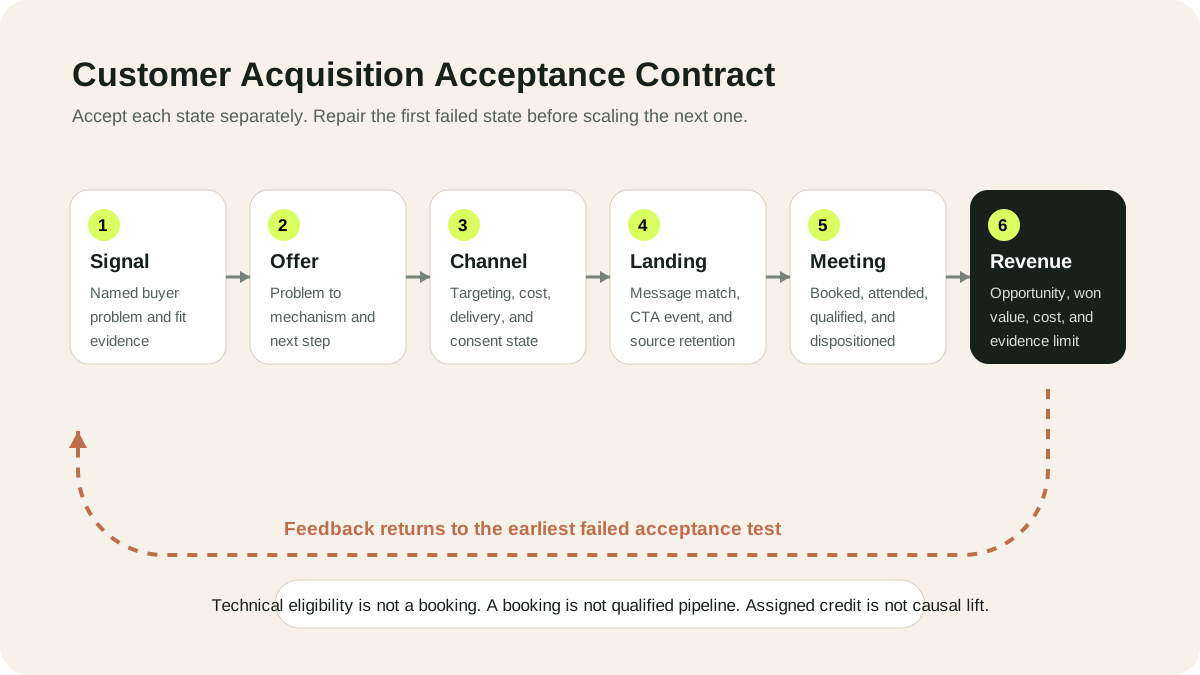
| State | Acceptance test | Evidence retained | What it does not prove |
|---|---|---|---|
| Buyer signal | A named segment expresses a specific costly problem in current first-party or market evidence | Source, date, language, segment, limitation | Willingness to buy this offer |
| Offer | The mechanism, scope, exclusions, and next step match the problem without unsupported claims | Offer version, page, approval, objections | Channel demand or sales conversion |
| Channel | Targeting, delivery, consent, spend, and suppression behave under the approved rules | Audience rule, message, cost, delivery, opt-out | Lead quality |
| Landing path | Message match, CTA, page-specific campaign fields, consent, and booking handoff pass tests | Landing URL, UTM state, event, booking ID | Attendance or qualification |
| Sales handoff | Attendance, qualification, disposition, owner, and response time use fixed definitions | Contact, meeting, stage, reason, history | Won revenue |
| Revenue | Won value and acquisition cost join under a documented window and rule | Opportunity, value, currency, cost, source join | Incremental causal lift |
Customer acquisition is wider than lead generation
Lead generation is one input to acquisition. It creates or captures potential demand. Acquisition continues through buyer acceptance, sales acceptance, and a joined commercial outcome. That wider scope changes what the agency must diagnose. A high response rate can coexist with poor fit. A full calendar can coexist with low attendance. Qualified opportunities can stall because the offer, proof, price, timing, or sales process is wrong.
Lead generation owner: see the signal-to-qualified-meeting controls when sourcing and engagement are the primary gap. Funnel owner: inspect the page-to-booking path, handoff, and failure tests when conversion architecture is the primary gap.| Provider | Natural stopping point | Choose it when | Additional owner required |
|---|---|---|---|
| Media or channel specialist | Reach, clicks, responses, or platform conversions | The offer and downstream path are already accepted | Landing, sales, CRM, and revenue reconciliation |
| Lead generation agency | Accepted lead or qualified meeting | Sourcing and engagement are the constraint | Sales acceptance and revenue join |
| Sales funnel agency | Landing-page conversion and handoff | Traffic exists but the conversion path fails | Demand creation and commercial follow-through |
| Marketing analytics agency | Trusted measurement and decision evidence | Systems disagree or outcomes cannot be joined | Execution against the diagnosis |
| Customer acquisition agency | Controlled system through qualified pipeline and joined revenue | No one owns cross-functional correction | Client approvals, live sales judgment, and delivery capacity |
Repair the first failed state
The most expensive agency behavior is scaling a later state while an earlier one is unaccepted. More spend does not repair weak buyer fit. More creative does not repair a vague offer. A faster landing page does not repair channel mismatch. More booked calls do not repair weak qualification. A new attribution model does not repair missing CRM history.
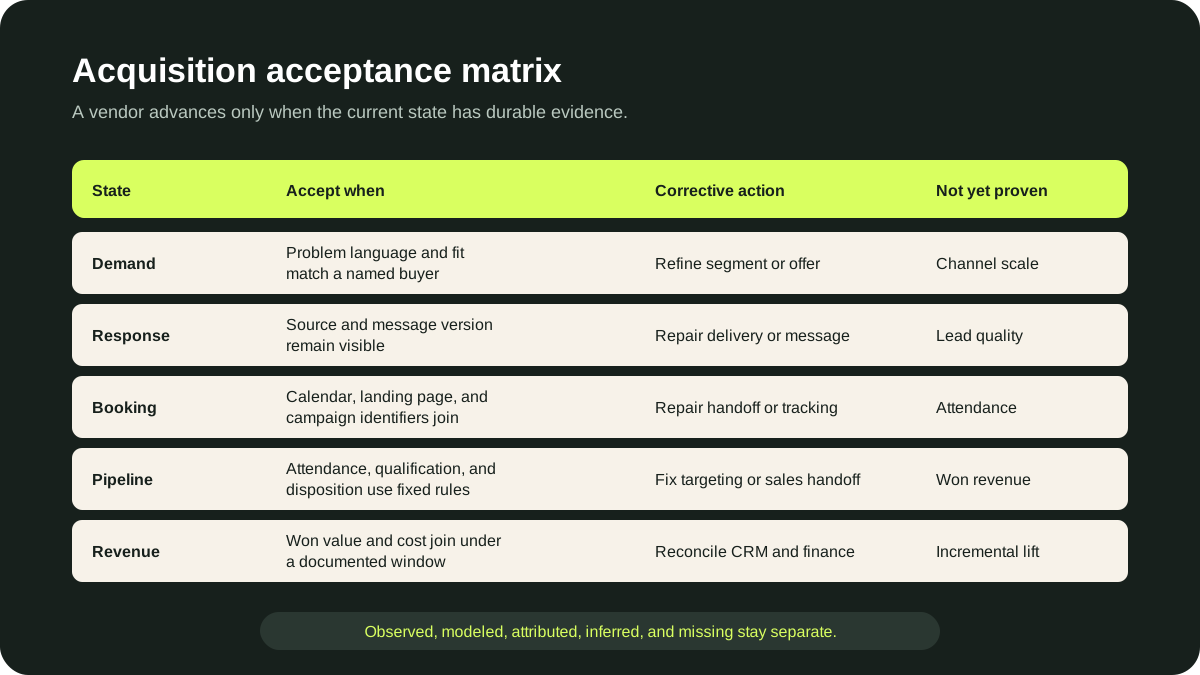
| Observed failure | First investigation | Do not assume | Controlled next action |
|---|---|---|---|
| Low response or click rate | Audience, delivery, message, offer, and measurement integrity | The channel is dead | Change one accepted variable and preserve a comparison window |
| Responses but few accepted leads | Problem fit, qualification rule, targeting, and expectation set in the message | Sales is failing | Code rejection reasons and correct the earliest repeated cause |
| Bookings but low attendance | Calendar fit, confirmation, reminders, time zone, and promise continuity | Demand is strong | Repair the handoff and track attendance separately |
| Attendance but low qualification | Target definition, form logic, sales acceptance, and offer scope | More calls will solve it | Tighten fit rules without hiding the lost volume |
| Qualified pipeline but few wins | Sales process, decision criteria, proof, price, competition, and delay reasons | Marketing caused the loss | Join dispositions and fix the dominant verified constraint |
| Revenue exists but source is unknown | Campaign retention, booking fields, contact merges, stage history, and offline joins | Direct traffic caused the sale | Repair future joins and report current history as unknown |
What the agency should operate each week
- Reconcile: compare channel, site, calendar, CRM, and revenue under the same window and definitions.
- Locate: identify the earliest state that failed its acceptance test.
- Explain: separate observed evidence from a diagnosis and state the remaining uncertainty.
- Change: implement one controlled correction with an owner, rollback, and expected signal.
- Review: use a genuine evidence date based on buying cycle and data latency.
- Retain: keep campaign, page, booking, contact, opportunity, and revenue identifiers joinable where lawful and necessary.
A useful review does not end with a recommendation list. Every item becomes completed with proof, prepared for approval, scheduled to an evidence-dependent date, or blocked by a precise condition. That operating discipline matters more than the number of dashboards or channels in the proposal.
Demand a measurement path before launch
Campaign fields should be deliberate and consistent. The landing page should preserve its source context into the booking. The CRM should distinguish lifecycle stages and retain history. Offline outcomes should be joined only under platform and privacy requirements. If a join fails, the report should stop at the last verified state instead of filling the gap with an assumption.
Google Analytics campaign URL documentation describes the available UTM parameters and recommends consistent naming. Google Ads offline conversion documentation explains how later offline outcomes can be imported using supported identifiers and consent-aware customer data. HubSpot lifecycle-stage documentation explains how contacts and companies move through marketing and sales stages and how stage history can be tracked. Platform documentation defines platform behavior; it does not prove a Vibeera outcome.
Research method and evidence boundary
Ahrefs Keyword Explorer was checked August 10, 2026. It estimated 250 monthly US searches, 600 global searches, keyword difficulty 1, traffic potential 200, global traffic potential 200, CPC $8, and parent topic customer acquisition marketing agency for customer acquisition agency. Matching terms included the exact query, the parent-topic variant, location variants, and ecommerce variants. Ahrefs estimates can change and do not establish Vibeera rankings, traffic, bookings, or revenue.
The stored US result set checked the same day mixed a Reddit discussion, agency service pages, agency lists, a marketplace, a general guide, and video. Examples included M&C Saatchi Performance, Belkins, Martal, Business of Apps, Chalifour Consulting, Callbox, and Your Growth Partner. The mix supports a distinct operational buying guide, while definitions, lists, and community answers create moderate zero-click risk. The Acceptance Contract, failure matrix, and source-to-revenue boundary preserve a reason to visit. This is a ranking hypothesis, not a promise.
Ahrefs Content Gap compared Vibeera with mcsaatchiperformance.com, martal.ca, and callboxinc.com on August 10, 2026. It reported 2,220 US keywords where Vibeera had no ranking and at least one competitor ranked in the top ten. High-volume rows included unrelated, branded, employment, technology, and broad lead-generation noise, so the set was used for market discovery rather than copied into a queue. Ahrefs Organic Competitors returned no modeled results for Vibeera on the same date, which limits domain-level overlap conclusions.
The Acceptance Contract, evidence ladder, failure-path analysis, operating cadence, and buying comparison are Vibeera operator analysis informed by production marketing-system work. No customer result, conversion rate, cost saving, implementation timeline, ranking, pipeline, revenue, or causal-lift claim is implied. Search estimates and competitor positions are third-party observations. Current first-party platform documentation outranks those estimates for platform behavior, and Vibeera production evidence will outrank both for Vibeera decisions.
The decision
Hire a customer acquisition agency when the expensive gap is cross-functional ownership: buyer research, offer, channel, landing path, sales handoff, and revenue evidence are operated by different people and no one corrects the first failed state. Require an Acceptance Contract, failure-path tests, page-to-CRM joins, fixed lifecycle definitions, honest evidence limits, a weekly correction loop, and a recoverable exit. If the provider reports activity without showing which accepted commercial state changed, it is not yet proving customer acquisition.
Frequently asked questions
What does a customer acquisition agency do?
A customer acquisition agency designs and operates the path from buyer research and offer positioning through channel execution, landing pages, lead handling, booking, sales handoff, CRM measurement, and recurring optimization. Its scope should state which business outcome it owns and where client approval is required.
How is a customer acquisition agency different from a lead generation agency?
Lead generation can stop at contacts, responses, or leads. Customer acquisition continues through acceptance of the landing path, qualification, sales handoff, opportunity, cost, and won-revenue evidence. A provider may offer both, but the contract and measurement boundary should make the difference explicit.
What should a customer acquisition agency report?
Report spend or effort, reach, response, accepted leads, bookings, attendance, qualification, opportunities, won revenue, source and landing-page joins, rejection reasons, missing data, and the first failed state. Keep observed, modeled, attributed, inferred, and missing values separate.
How do I choose a customer acquisition agency?
Ask for its buyer and offer research method, channel rules, acceptance tests, failure paths, sales handoff, CRM join, evidence limits, operating cadence, and exit plan. Reject a provider that promises customers while reporting only activity, leads, or screenshots.
Can a customer acquisition agency guarantee results?
No agency controls every part of demand, competition, pricing, sales judgment, delivery capacity, or buyer timing. A credible agency can guarantee agreed work, controls, response times, tests, and reporting. It should not present an activity target or attribution rule as guaranteed incremental revenue.
Map the first failed acquisition state
Vibeera will map the buyer signal, offer, channel, landing path, sales handoff, CRM join, acceptance tests, and accountable operator.
Map the implementation