Growth marketing agency: what should it actually operate?

A growth marketing agency should operate a disciplined experiment system across acquisition, activation, retention, and revenue. The useful product is not a stream of ideas or channel activity. It is a joined operating loop that names the current constraint, defines one test, protects the baseline, preserves lifecycle evidence, and turns each result into a clear scale, revise, or stop decision.
Key facts
- Growth marketing is a cross-lifecycle operating job. Customer acquisition is one part of it, not the complete scope.
- A credible agency separates observations, hypotheses, interventions, and business outcomes instead of labeling every movement a win.
- Ahrefs estimated 2,900 monthly US searches, 6,200 global searches, keyword difficulty 30, traffic potential 1,400, and CPC $0.50 for growth marketing agency on August 11, 2026.
- The current US result set includes an AI Overview, service pages, guides, lists, a community discussion, LinkedIn, and People Also Ask. A reusable acceptance system preserves a reason to visit.
The label is broad enough to hide several different services. Some providers are paid-media teams using growth language. Some are lifecycle, product, content, analytics, or conversion specialists. Others coordinate the whole path. The buyer should therefore purchase an operating contract, not a category name.
Start with an Experiment Acceptance System
Vibeera uses an Experiment Acceptance System: a written record of the lifecycle constraint, evidence, hypothesis, eligible cohort, primary change, guardrails, owner, review date, outcome, uncertainty, and decision. It prevents activity from being mistaken for learning and movement from being mistaken for causation.
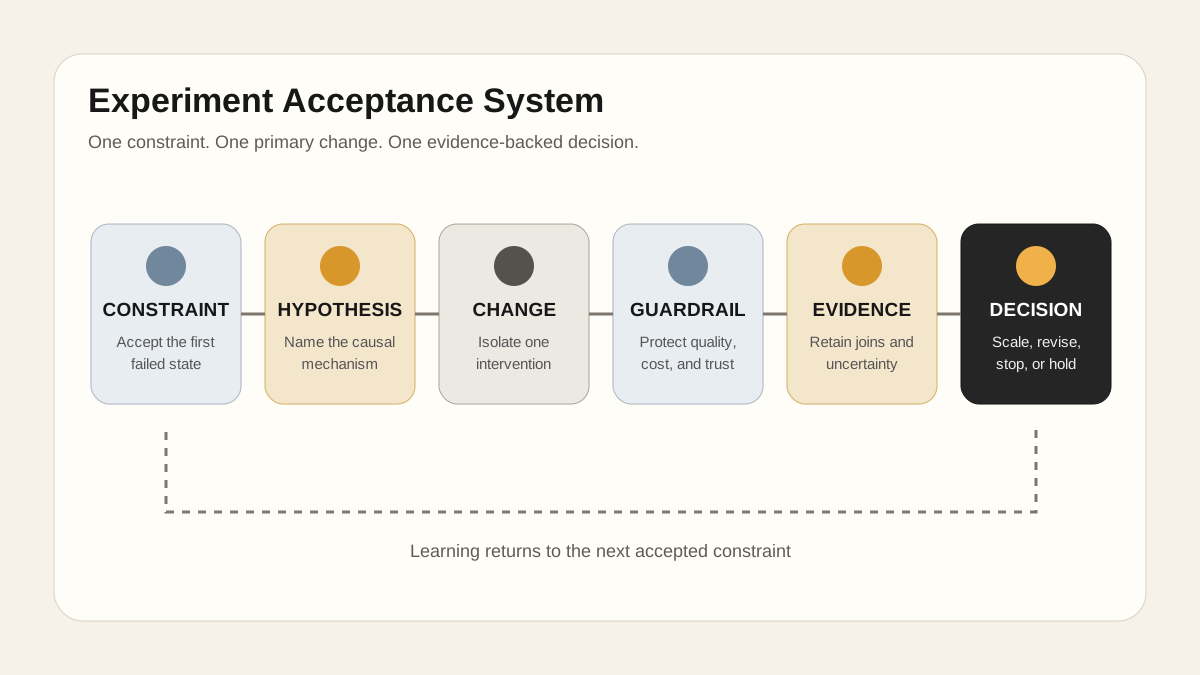
| Control | Acceptance question | Evidence retained | Failure prevented |
|---|---|---|---|
| Constraint | Which lifecycle state is limiting the qualified business outcome now? | Window, segment, source, baseline, missing data | Optimizing a visible but secondary metric |
| Hypothesis | Why should this change affect that state? | Mechanism, assumptions, expected leading signal | Random activity presented as strategy |
| Change | What one primary intervention will be evaluated? | Version, owner, launch time, cohort, rollback | Uninterpretable bundles of simultaneous changes |
| Guardrail | What must not deteriorate while the target metric moves? | Quality, consent, cost, capacity, complaints, retention | Local optimization that damages the wider system |
| Evidence | Did the planned signal move under an adequate window? | Observed values, joins, exclusions, confounders | Screenshot-led victory claims |
| Decision | Should the team scale, revise, stop, or keep the result inconclusive? | Decision, reason, next owner, next evidence date | Endless tests with no operating consequence |
Growth marketing is wider than acquisition
Acquisition answers how a qualified buyer enters the commercial path. Growth marketing may also address whether that buyer activates, receives value, remains, expands, refers, or exposes a different constraint. The wider remit is useful only when the agency can join those states without claiming ownership of product, sales, or delivery decisions it cannot control.
Acquisition owner: use the narrower buyer-signal-to-revenue path when demand, qualification, and sales handoff are the main problem. Performance owner: use the media-to-qualified-pipeline evidence contract when acquisition is active but platform conversions and commercial outcomes are being confused. Demand owner: use the creation-to-sales-acceptance system when market education and qualified intent are the central constraint. Measurement owner: repair source-to-decision evidence when the systems disagree before adding more experiments.| Lifecycle state | Useful question | Example leading evidence | Business evidence kept separate |
|---|---|---|---|
| Acquisition | Are the right buyers entering the path? | Qualified visits, accepted leads, response quality | Attended meetings, opportunities, won revenue |
| Activation | Does the buyer reach the first meaningful value state? | Accepted setup, completed onboarding, first use | Retention or expansion |
| Retention | Does delivered value continue for the intended cohort? | Repeat use, milestone completion, risk reason | Incremental causal effect of one campaign |
| Expansion | Does a verified need justify more scope or value? | Usage depth, request, fit, capacity | Revenue until the opportunity and payment join |
| Referral | Did a satisfied customer make a traceable introduction? | Permission, referral source, accepted introduction | New customer until the later states complete |
Find the first constraint before choosing a channel
A channel is not a growth strategy. Paid media can amplify a working offer or expose its weakness faster. Content can create discovery or fail to earn a click. Automation can remove delay or scale the wrong decision. Conversion work can improve a page while lead quality remains poor. The agency should diagnose the earliest accepted failure before it prescribes output.
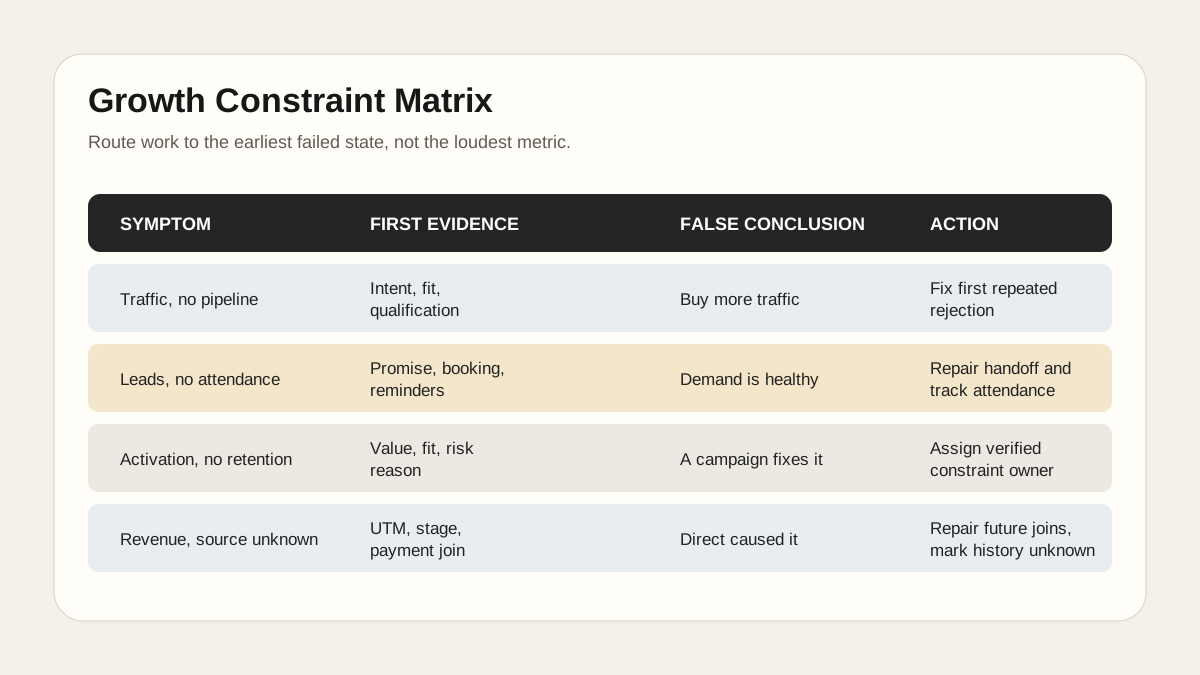
| Observed symptom | First evidence to inspect | Do not conclude | Controlled next action |
|---|---|---|---|
| Traffic without accepted pipeline | Intent, message match, qualification, source join | More traffic will solve it | Correct the earliest repeated rejection reason |
| Leads without attendance | Promise continuity, booking fit, reminders, capacity | Lead volume proves demand quality | Repair handoff and retain attendance separately |
| Trials without activation | Expectation, setup friction, first value state, support | Acquisition is the only problem | Test one activation barrier with a fixed cohort |
| Activation without retention | Delivered value, fit, onboarding depth, risk reasons | A new campaign fixes product or delivery | Code the verified failure and assign the right owner |
| Revenue with unknown source | Campaign fields, contact merge, stage history, payment join | Direct or organic caused the sale | Repair future joins and mark current history unknown |
What the agency should operate each week
- Reconcile: align lifecycle, channel, site, calendar, CRM, delivery, and revenue evidence to one window and definition set.
- Locate: name the earliest state that failed its acceptance test and the evidence that supports that diagnosis.
- Prioritize: rank the constraint by expected qualified pipeline, customer value, urgency, confidence, effort, risk, and reversibility.
- Design: write one primary change, eligible cohort, guardrails, owner, rollback, and genuine review date.
- Implement: make the approved change and verify that the intended version is live before observation begins.
- Decide: scale, revise, stop, or retain an inconclusive result with its limitations and next evidence gate.
Choose by operating model, not the agency label
| Model | Natural strength | Your team still owns | Best fit |
|---|---|---|---|
| Channel specialist | Deep execution in one acquisition or lifecycle channel | Cross-channel priority, product, sales, and revenue truth | The constraint is known and narrow |
| Growth consultant | Diagnosis, portfolio design, and executive decision support | Implementation, QA, and recurring operation | A capable internal team needs direction |
| Growth marketing agency | Cross-functional experiment operation and evidence | Offer, product, sales judgment, delivery, and approvals | No one owns the experiment system |
| In-house growth team | Context, speed, and direct organizational control | Hiring, management, tools, methods, and capacity | Stable scale justifies a permanent function |
Demand a measurement path before launch
Campaign fields should remain consistent from the landing page into booking and CRM. Lifecycle stages need explicit definitions and history. Experiments need a baseline and eligible cohort. Offline outcomes should be joined only under current platform, consent, and privacy requirements. When an identifier or stage is missing, stop the claim at the last verified state.
Google Analytics campaign URL documentation describes UTM parameters and consistent campaign naming. Google Ads experiment guidance describes controlled comparison and experiment setup inside Google Ads. HubSpot lifecycle-stage documentation explains marketing and sales stage history. Google Ads offline conversion documentation explains supported later-outcome imports. These sources define platform behavior, not Vibeera performance.
Research method and evidence boundary
Ahrefs Keyword Explorer was checked August 11, 2026 for the United States. It estimated 2,900 monthly US searches, 6,200 global searches, keyword difficulty 30, traffic potential 1,400, global traffic potential 1,800, traffic value $2,900, CPC $0.50, and parent topic growth marketing agency. It exposed 707 matching terms and 21 modeled questions. These are third-party planning estimates and can change. They do not establish Vibeera rankings, traffic, pipeline, or revenue.
The August 9 stored US result set contained an AI Overview, service landing pages, guides, agency lists, a Reddit discussion, LinkedIn, People Also Ask, and a directory. Growth Division ranked first among conventional results with a service page. Ahrefs showed other first-page URLs with zero to fifteen URL Rating and some with one to three referring domains, while established domains also competed. The mixed result set supports a service and decision owner, but the AI Overview, lists, and community answer create moderate to high zero-click risk.
Vibeera reviewed seven adjacent seeds in the same session: marketing automation consultant, GoHighLevel agency, revenue operations agency, B2B marketing operations, AI content marketing agency, lifecycle marketing agency, and marketing attribution agency. Automation, platform, revenue operations, analytics, lifecycle, and content intents were routed to existing owners or held because their current parent topic, traffic potential, overlap, or original-evidence path was weaker. The growth-agency owner was the only distinct candidate that cleared the combined pipeline, intent, demand, SERP, internal-link, and information-gain gate.
The Experiment Acceptance System, Growth Constraint Matrix, lifecycle boundary, and operating cadence are Vibeera operator analysis informed by production marketing-system work. No customer result, conversion rate, growth rate, cost saving, implementation timeline, ranking, citation, pipeline, revenue, or causal lift is implied. The page is independently useful as a procurement and operating checklist, while Vibeera's offer bridge is the accountable operated layer.
The decision
Hire a growth marketing agency when the offer and delivery can support demand, several lifecycle teams affect the outcome, and no one operates a disciplined experiment portfolio. Require an Experiment Acceptance System, a named constraint, one primary change, guardrails, preserved lifecycle joins, honest evidence limits, and a decision cadence. Choose a channel specialist when the problem is narrow, a consultant when your team can implement, or an in-house function when stable scale justifies permanent ownership.
Frequently asked questions
What does a growth marketing agency do?
A growth marketing agency identifies the highest-value lifecycle constraint, designs a bounded experiment, coordinates the required channel and product work, preserves source and outcome evidence, and makes a scale, revise, or stop decision. Its remit can include acquisition, activation, retention, referral, and revenue when the contract defines each boundary.
How is a growth marketing agency different from a digital marketing agency?
A digital marketing agency often organizes work by channel or deliverable. A growth marketing agency should organize work around a measurable lifecycle constraint and an experiment portfolio. Either label can describe a good provider, so the deciding evidence is the operating contract, ownership, measurement, and correction cadence rather than the name.
How is a growth marketing agency different from a customer acquisition agency?
Customer acquisition focuses on the path from buyer signal to accepted customer and joined revenue. Growth marketing can continue into activation, retention, expansion, referral, and product-led behavior. Use the narrower acquisition owner when demand and sales handoff are the main constraint, and the broader growth owner when several lifecycle stages need coordinated experimentation.
What should a growth marketing agency report?
Report the constraint, baseline, hypothesis, primary change, eligible cohort, guardrails, implementation status, result, uncertainty, confounders, lifecycle effect, and decision. Keep traffic, leads, activation, retention, pipeline, and won revenue as separate evidence states.
When should I hire a growth marketing agency?
Hire one when the offer has credible demand, the product or service can fulfill it, and the expensive bottleneck is cross-functional experimentation that no current owner can run. Do not hire one to hide an unproven offer, broken delivery, absent sales capacity, or missing source data behind more activity.
Map the growth constraint before adding activity
Vibeera will map the lifecycle state, experiment controls, evidence joins, approval boundaries, and accountable operating layer.
Map the implementation