Marketing operations agency: what should it actually operate?

A marketing operations agency should make the revenue system reliable: turn approved strategy into executable campaigns, preserve customer and source state between tools, route exceptions to people, verify delivery, and join activity to CRM outcomes. Buy an accountable operating layer with acceptance tests and retained evidence, not a bundle of platform administration, reports, or isolated automations.
Key facts
- The useful scope connects intake, campaign production, lifecycle automation, CRM state, measurement, exception handling, and a recurring repair loop.
- Every production handoff needs an owner, acceptance test, failure state, rollback path, and evidence record.
- Ahrefs estimated 100 monthly US searches, keyword difficulty 0, traffic potential 150, and CPC $7 for marketing operations agency on August 4, 2026. These are planning estimates, not Vibeera results.
- The live result set mixed service pages, directories, a guide, community discussion, and low-page-authority agency pages, creating a plausible path for a distinct reliability-led owner without promising rank.
Marketing operations is often described as the technical work behind marketing. That description is too narrow. The operating problem is whether an approved idea can move through campaign production, delivery, customer state, sales handoff, and evidence without becoming ambiguous. A broken form, missing source value, duplicate workflow, unowned reply, or unreconciled CRM stage can invalidate the business story even when every platform dashboard looks active.
Vibeera uses an Operating Reliability Contract: the written agreement for what enters the system, what state should change, what counts as accepted, who handles exceptions, what can be reversed, and which evidence is retained. It turns a vague managed service into a testable operating scope.
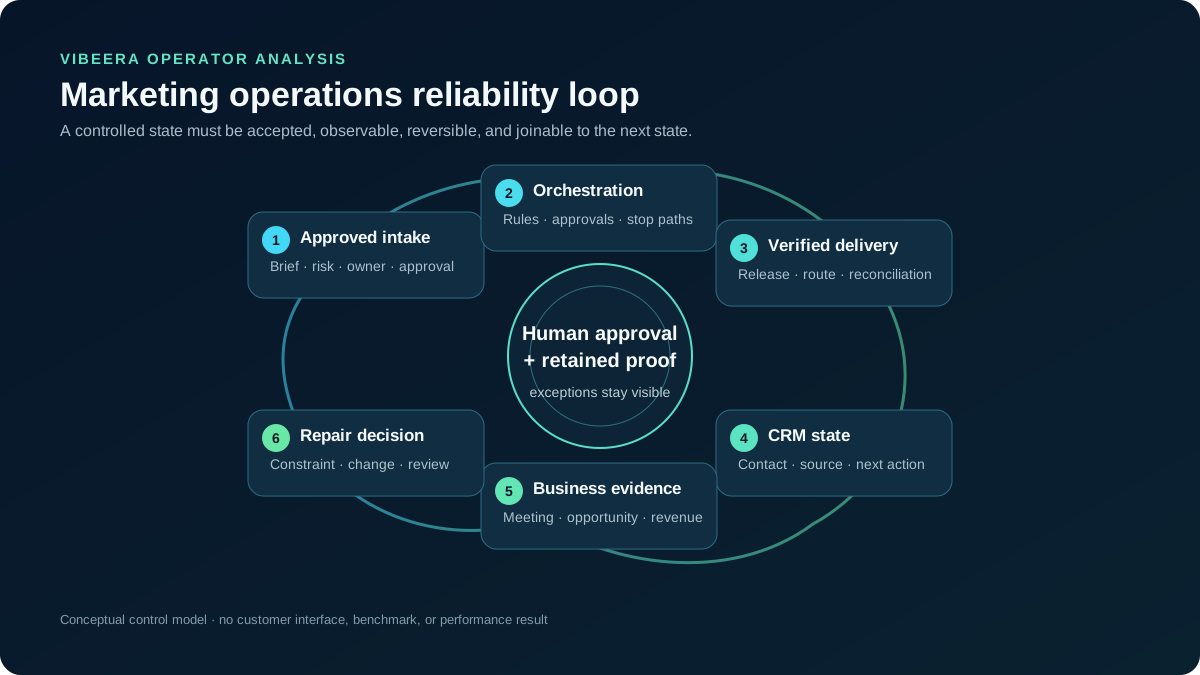
Define the operating contract before the tool list
A tool list tells you what an agency can access. It does not tell you what the agency is accountable for. Define the controlled states first, then select the minimum systems required to operate them.
| Controlled state | Acceptance test | Exception owner | Evidence retained |
|---|---|---|---|
| Approved intake | Audience, offer, claim, channel, owner, deadline, and risk are explicit | Marketing owner | Brief version and approval record |
| Production-ready campaign | Destination, tracking, consent, creative, routing, and rollback pass QA | Campaign operator | Release checklist and tested artifacts |
| Customer lifecycle state | Contact, source, consent, status, owner, and next action remain joinable | Lifecycle operator | Stable IDs and state history |
| Sales handoff | Context, qualification rule, response time, capacity, and escalation are accepted | Revenue owner | Booking, attendance, qualification, and disposition |
| Business evidence | Activity joins to the last verified meeting, opportunity, or revenue state | Measurement owner | Definitions, query, window, and limitations |
| Repair decision | Constraint, change, owner, risk, expected signal, and review date are recorded | Operating lead | Decision log and rollback result |
The contract prevents silent scope gaps. If an agency deploys forms but another team owns CRM routing, name the handoff format, test, response time, and exception path. If the provider reports leads but cannot join them to attended and qualified meetings, the measurable scope stops at leads.
Workflow implementation: turn triggers, state, decisions, actions, exceptions, and evidence into a testable production contract.Operate a lifecycle, not a collection of automations
Individual automations can pass in isolation while the lifecycle fails. The same person can exist under two identifiers. A retry can duplicate a message. A calendar can accept a booking without preserving the campaign. A sales outcome can be written to a field that reporting never reads. Marketing operations must test the joined journey and the failure paths between components.
- Intake: accept only work with an owner, approved claim, target state, required access, and decision date.
- Orchestrate: translate the request into deterministic routes, human approvals, stop conditions, and reversible changes.
- Observe: retain delivery, state transition, exception, and source evidence without collecting unnecessary data.
- Reconcile: compare the source system, destination system, CRM, analytics, and real customer journey.
- Repair: isolate the earliest broken state, correct it, retest production, and record the result.
- Learn: change strategy only from an agreed evidence level, with limitations and alternative explanations visible.
AI can assist recurring analysis and routing, but production safety should not depend on a model returning the same answer every time. Claims, permissions, spend, audience changes, external messages, and sensitive exceptions remain explicit human decisions.
Test exceptions before they become customer incidents
A happy-path demo proves only that one input produced one expected output. Production acceptance should include duplicates, missing fields, late events, revoked access, provider timeouts, inconsistent identifiers, changed consent, full calendars, unqualified leads, cancellations, retries, and rollback.
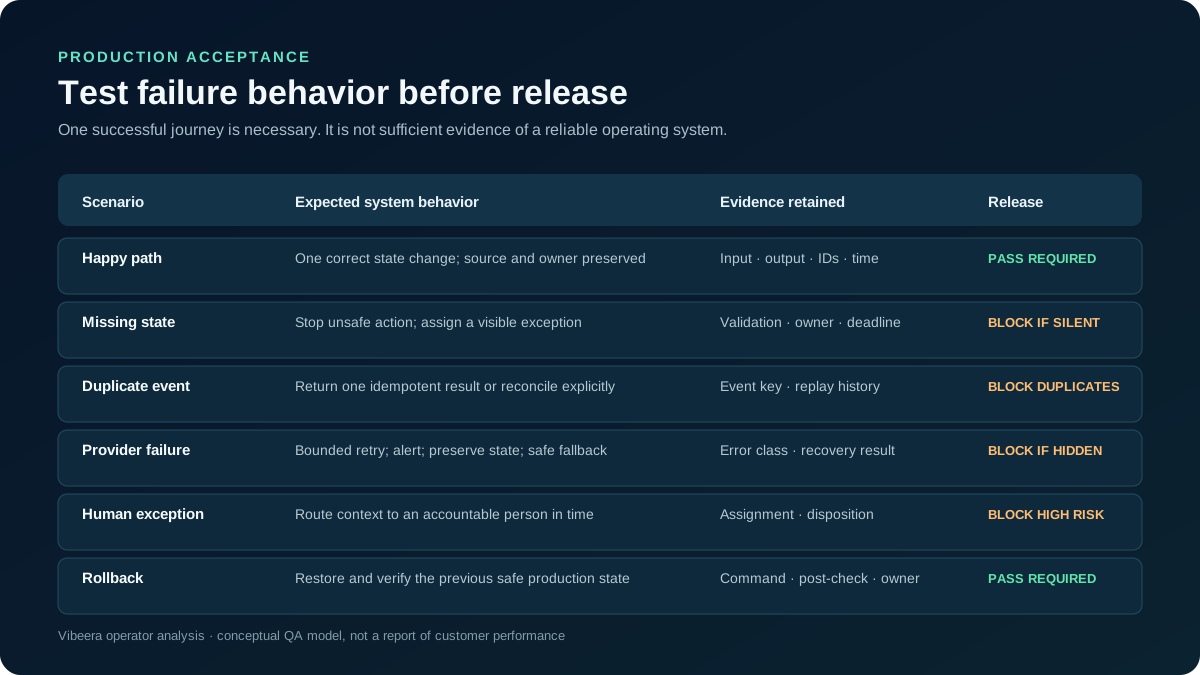
| Test | Expected behavior | Evidence | Release rule |
|---|---|---|---|
| Valid journey | One accepted state transition with correct source and owner | Input, output, timestamp, stable IDs | Required, but not sufficient |
| Missing or invalid state | No unsafe action; visible exception with owner | Validation result and queue record | Block if action proceeds silently |
| Duplicate or retry | Idempotent result or controlled reconciliation | Event key and replay history | Block duplicate customer action |
| Provider failure | Bounded retry, alert, fallback, and no data loss | Error class and recovery result | Block if failure is invisible |
| Human exception | Context reaches an accountable person before the deadline | Assignment and disposition | Block high-risk autonomous action |
| Rollback | Previous safe state can be restored and verified | Rollback command and post-check | Required for material release |
Keep system health separate from commercial outcomes
Marketing operations can prove that a campaign deployed, a message delivered, a form submitted, a booking recorded, or a CRM state changed. Those are valuable operating states. They do not automatically prove a qualified meeting, opportunity, revenue, or causal lift.
| Evidence level | Question it can answer | Boundary |
|---|---|---|
| Configuration | Is the intended rule or integration present? | Not proof it ran correctly |
| Delivery | Did the production event reach the expected destination? | Not proof of buyer quality |
| Lifecycle | Did a known contact move through defined states? | Not proof of sales qualification |
| Sales | Was the meeting attended and opportunity qualified? | Not proof of won revenue |
| Revenue | Can a won amount be joined under a stated rule? | Not causal lift without valid design |
| Causal | Did the change create the observed difference? | Requires a defensible comparison and limitations |
Report only to the last successful join. If source and booking are joined but qualification is not, report a source-aware booking, not a qualified pipeline result. If CRM stage history exists but invoice or won-value logic is incomplete, report opportunity movement, not revenue.
Evidence implementation: preserve source, landing page, booking, contact, opportunity, and revenue states without turning correlation into causation. Analytics operating owner: require a measurement contract, source-to-outcome joins, failure-path tests, evidence limits, and a decision cadence. Funnel operating owner: apply the control contract to source, promise, capture, qualification, routing, nurture, booking, and sales disposition.Choose agency, consultant, internal operator, or software by the gap
| Model | You are buying | Your team still owns | Best fit |
|---|---|---|---|
| Software | Workflow, data, analytics, or communication capability | Architecture, configuration, operation, QA, exceptions, and decisions | A capable operator already exists |
| Consultant | Diagnosis, design, governance, and implementation guidance | Daily operation and production accountability | The team can execute a clear plan |
| Internal operator | Dedicated context and direct managerial control | Hiring, tools, coverage, standards, and specialist depth | Stable workload and management capacity |
| Marketing operations agency | A team, operating system, and accountable recurring delivery | Strategy approvals, access boundaries, customer judgment, and business decisions | Cross-system execution lacks an owner |
| Full marketing agency | Strategy and channel or creative delivery, sometimes including operations | Any lifecycle or evidence states excluded from scope | Demand creation or specialist production is the primary constraint |
Do not infer operating depth from category labels. Ask each provider to map one real journey, name the systems and people, show its acceptance criteria, explain exception and rollback behavior, and state the last business stage it can verify.
A 12-question buying checklist
- Which business states and systems are inside the scope?
- What is explicitly excluded, and who owns each excluded handoff?
- Which claims, audiences, spend, permissions, and messages require human approval?
- How are source, campaign, contact, booking, opportunity, and revenue identifiers preserved?
- What are the happy-path and exception acceptance tests?
- How are duplicates, retries, partial failures, and provider outages handled?
- What can the agency change without approval, and what access is least privilege?
- Where are logs, state history, approvals, and release evidence retained?
- How is rollback performed and verified?
- What does the weekly review inspect, decide, and record?
- Which metric definitions and attribution limits are fixed in advance?
- How can the client transfer operation or leave without losing essential records?
Research method and evidence boundary
Ahrefs Keyword Explorer was checked August 4, 2026. It estimated 100 monthly US searches, 300 global searches, keyword difficulty 0, traffic potential 150, and cost per click of $7 for marketing operations agency. The visible matching-term set included marketing operations agency for SaaS, SaaS marketing operations agency, digital marketing agency operations, and marketing agency operations. The reported parent topic was nomad marketing, which appears brand-led and limits parent-topic usefulness for this decision. Ahrefs estimates can change and do not establish Vibeera rankings, traffic, conversions, or market causation.
The live result set checked the same day mixed agency service pages, a directory, an educational guide, and community discussion. Visible results included Klectic Media, CRMT, LeadFox, Digitopia, Spear Marketing Group, and other operators. Ahrefs' stored SERP sample also showed several ranking pages with low URL-level authority. The ranking-path hypothesis is that an explicit reliability contract, exception matrix, evidence ladder, and buyer checklist serve the commercial decision more completely. It is not a ranking or traffic promise.
Current first-party documentation was checked for system behavior. Google Analytics campaign URL documentation explains manual campaign parameters for identifying referring campaigns, while Google Analytics event documentation explains event measurement. HubSpot workflow-details documentation describes reviewing workflow action logs and enrollment history, subject to product access and retention limits. Platform documentation explains platform behavior; it does not prove a Vibeera outcome.
The Operating Reliability Contract, lifecycle sequence, acceptance matrix, evidence ladder, buying model, and checklist are Vibeera operator analysis informed by live production controls. No customer result, cost saving, staffing reduction, conversion benchmark, ideal tool stack, implementation timeline, ranking, pipeline, or revenue claim is implied.
The decision
Choose a marketing operations agency when the expensive problem is unreliable execution between strategy, campaigns, customer state, sales, and evidence. Require a written operating contract, named exception owners, production acceptance tests, least-privilege access, rollback, stable joins, and a recurring repair decision. If a proposal cannot show what state it controls and how failure becomes visible, it is not yet an operating system.
Frequently asked questions
What does a marketing operations agency do?
A marketing operations agency translates approved strategy into reliable campaign, automation, CRM, analytics, and reporting operations. It should define handoffs, test production behavior, route exceptions, preserve evidence, and run a recurring repair loop, not merely administer tools.
How is marketing operations different from a marketing agency?
A conventional marketing agency may focus on strategy, creative, media, or channel delivery. Marketing operations focuses on the system that makes work executable and measurable across teams and tools. One provider can do both, but the scope and acceptance criteria should be explicit.
When should a company hire a marketing operations agency?
Hire one when campaigns repeatedly stall at handoffs, source data disappears, automation exceptions go unseen, CRM states are unreliable, reports cannot be reconciled, or the internal team lacks an accountable operator. Do not outsource a problem that has not first been defined.
What should a marketing operations agency report?
Report system health and business state separately: accepted work, deployment and delivery, exception volume, repair time, source preservation, lifecycle movement, bookings, attended meetings, qualified opportunities, won revenue, and the last verified join. Activity alone is not commercial proof.
Which tools should a marketing operations agency manage?
Only the tools required by the agreed operating model. These may include the CRM, marketing automation, analytics, forms, calendars, data routing, consent and preference systems, reporting, and work management. The agency should justify each tool by a controlled business state, not by feature count.
Can AI replace marketing operations?
AI can assist classification, drafting, quality checks, routing, summaries, and recurring analysis. People should approve strategy, claims, audiences, permissions, spend, sensitive customer actions, and high-risk exceptions. The production system still needs deterministic tests, access controls, logs, and rollback.
Map the operating gap before adding more tools
Vibeera will map the controlled states, handoffs, approvals, exceptions, CRM joins, and evidence boundary before operation begins.
Map the implementation