Marketing automation audit: find what is failing before you add more

A marketing automation audit is a structured test of whether the system is producing the intended customer and revenue outcome without losing data, misfiring triggers, bypassing human judgment, or hiding failures. Audit six layers in order: outcome, data and consent, trigger and routing behavior, human approvals and exceptions, measurement and revenue joins, and operating ownership. Record evidence, assign severity, name the repair owner, and verify the fix before adding more automation.
Key facts
- Start with the business outcome and the live customer journey. A clean-looking workflow can still be wrong if it optimizes the wrong state or hands off to nobody.
- Test production behavior with safe, controlled evidence. Do not create a real contact when that would fire live sales, Slack, email, or WhatsApp workflows without approval.
- Separate defects by consequence: stop-ship, high, medium, and observation. Every repair needs an owner, acceptance check, and retained proof.
- Ahrefs showed US volume 150, global volume 400, KD 0, Traffic Potential 80, and a low page-authority SERP for this query on August 1, 2026.
Most audits begin with a list of workflows, fields, and integrations. That inventory is useful, but it can miss the central question: does the system move the right person to the right next state, with the right evidence and control? A workflow can be enabled, error-free, and still be commercially or operationally wrong.
Vibeera uses a Signal-to-System audit. It starts at the business and customer outcome, follows the live signal through the system, and ends with a verifiable downstream state. The method does not assume that more automation is better. It identifies where automation should run, where a person must decide, and where the safest action is to stop.
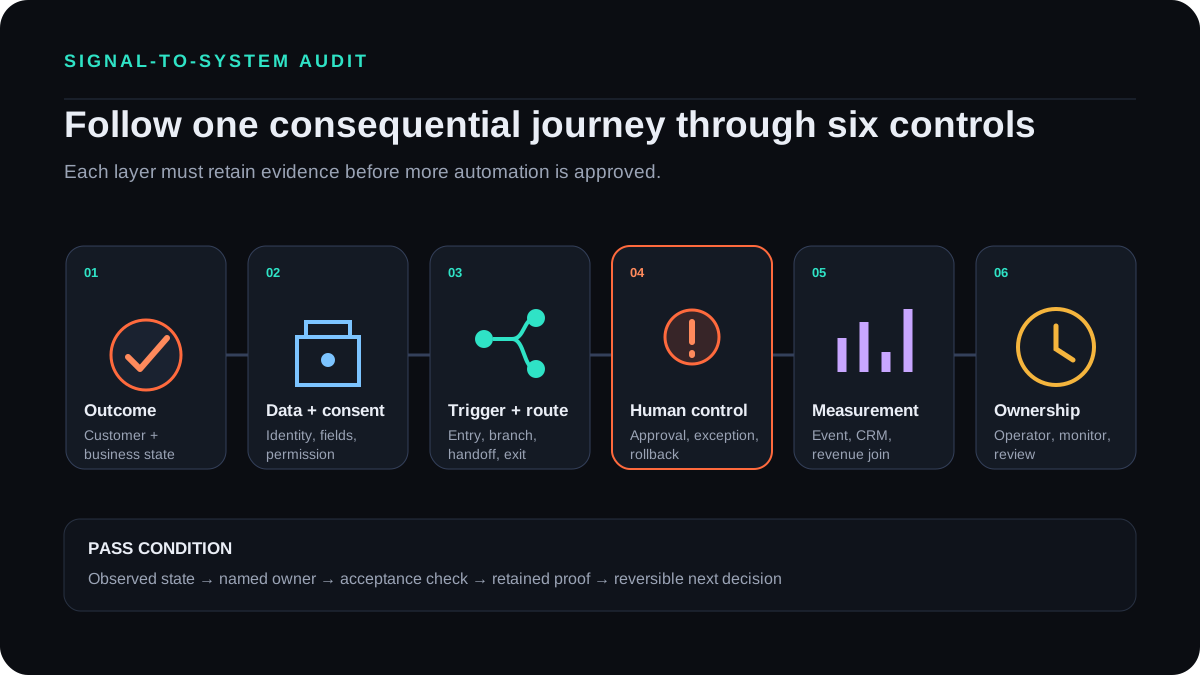
The six-layer Signal-to-System audit
| Layer | What to test | Minimum retained evidence |
|---|---|---|
| 1. Outcome contract | Target customer state, business state, exclusions, capacity, and stop condition | Owner-approved outcome and current journey |
| 2. Data and consent | Source, identity, field mapping, deduplication, permission, retention, and suppression | Field map, consent source, sample records, and policy boundary |
| 3. Trigger and routing | Entry, timing, branching, retries, collision rules, exit, and downstream handoff | Versioned workflow plus safe branch tests |
| 4. Human control | Approval, escalation, exception, override, and rollback for consequential actions | Named decision owner and tested exception path |
| 5. Measurement join | Events, campaign keys, page, booking, CRM stage, qualification, pipeline, and revenue | Source-aware test across the available join |
| 6. Operating ownership | Access, monitoring, documentation, change control, incident response, and review cadence | Owner, alert, runbook, review date, and rollback condition |
Audit in this order. If the outcome contract is wrong, a detailed field or trigger review can only make the wrong system more efficient. If the data and permission boundary is not trustworthy, downstream performance analysis is unreliable. If nobody owns exceptions, a passing test does not make the system operable.
Strategy owner: define the business outcome, automation boundary, ownership, and exception model before building workflows.Run a 30-minute triage before the deep audit
- Name one consequential journey. Choose a path such as new inquiry to qualified meeting, abandoned checkout to recovery, or booked call to attended meeting.
- Draw the expected state changes. Record the page or source, customer action, system event, message, owner handoff, CRM state, and final evidence.
- Inspect recent live examples. Compare a successful path, a failed path, and an exception. Remove sensitive values from the audit record.
- Check the danger points. Look for consent, wrong-recipient, duplicate action, collision, stale data, missing owner, access, payment, and irreversible-action risk.
- Test the safest observable segment. Use previews, logs, authenticated health endpoints, or sandbox records before any live contact.
- Open a defect register. Record evidence, consequence, reach, detectability, owner, acceptance check, rollback, and next review.
This triage is not a full audit. It reveals whether the system needs an immediate stop, a bounded repair, or deeper inspection. It also prevents a team from spending days documenting a workflow that is already failing at the first handoff.
Test behavior, not screenshots
A screenshot proves what an interface looked like at one moment. It does not prove the current trigger, downstream action, field value, recipient, or CRM state. Prefer live system evidence, logs, source-aware previews, controlled tests, and exact repository or configuration versions. Preserve the test time and environment.
| Audit question | Weak evidence | Stronger evidence |
|---|---|---|
| Did the lead enter? | Workflow is enabled | Timestamped entry with source and stable contact key |
| Did routing work? | Branch looks correct | Expected owner or queue received the controlled case once |
| Was consent respected? | A consent field exists | Permission source, time, purpose, suppression behavior, and exception result |
| Did the CTA convert? | Click event increased | CTA event joined to booking, qualification, and CRM state where available |
| Was the repair successful? | No visible error | Acceptance test passed end to end and rollback remains available |
Do not create a test contact casually. In a live CRM, a single synthetic record can start email, SMS, WhatsApp, ad audience, sales, or internal notification workflows. Map the downstream effects first, obtain approval when a real person or external system may be affected, and define cleanup before execution.
Workflow owner: design entry, state, handoff, exception, and measurement paths before implementing the automation.Prioritize by consequence, not convenience
Teams often fix the easiest issue first because the queue is visible. An audit should instead combine consequence, reach, detectability, reversibility, and time sensitivity. A small consent failure or wrong-recipient path can outrank a high-volume reporting gap.
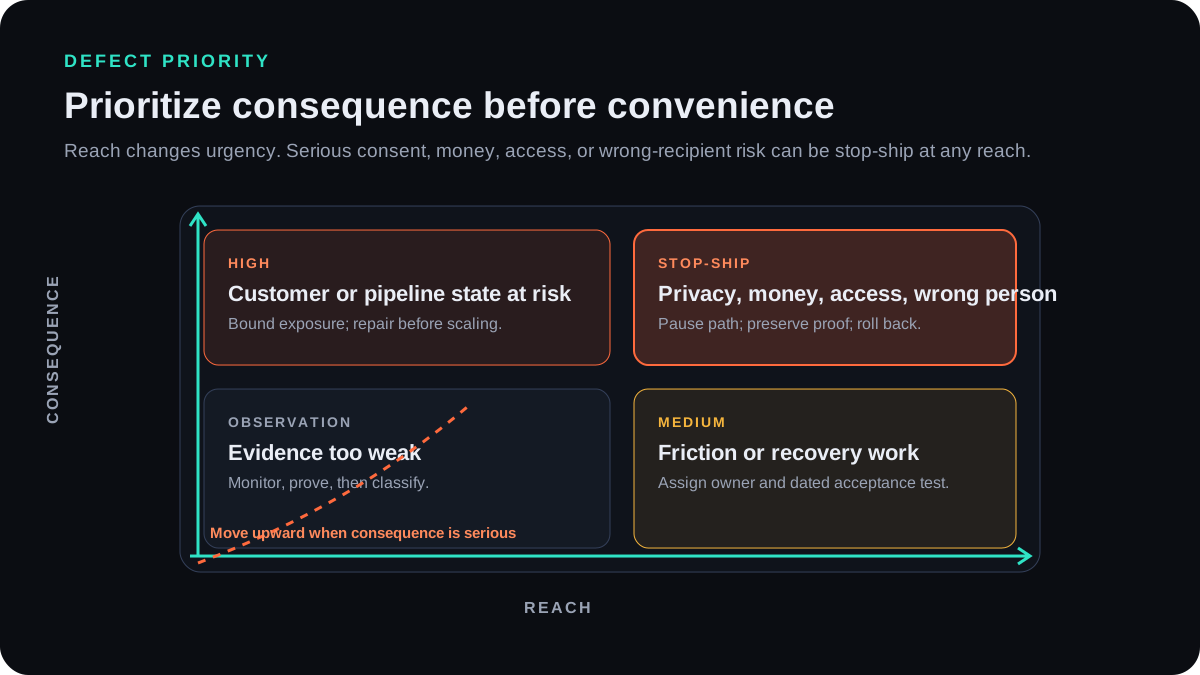
| Severity | Decision rule | Required response |
|---|---|---|
| Stop-ship | Privacy, consent, money, access, wrong-person action, or irreversible harm is possible | Pause the affected path; preserve evidence; assign incident owner and rollback |
| High | Qualified demand, customer state, sales handoff, payment, or attribution can be materially corrupted | Bound the exposure; repair before scaling; verify the complete journey |
| Medium | The path works but creates delay, manual recovery, inconsistent experience, or weak observability | Schedule an owned repair with a dated acceptance test |
| Observation | No current failure is proven, but evidence or control is too weak for confidence | Add monitoring or evidence; do not report a defect as fact |
Use a repair contract
Every repair should be small enough to verify and complete enough to change the business state safely. Record the defect, evidence, affected journey, suspected mechanism, consequence, owner, implementation boundary, acceptance check, rollback, deployment time, and next review. Keep the diagnosis separate from the chosen fix.
Copyable repair contract
- Observed state: [timestamped live behavior and source].
- Expected state: [customer, system, owner, and CRM outcome].
- Impact boundary: [people, records, workflows, money, permission, and time window].
- Repair: [smallest owned change], excluding [unapproved adjacent work].
- Acceptance: [controlled test and downstream state that must pass].
- Rollback: [reversible action, owner, and trigger].
- Evidence: [version, logs, event, CRM state, checked date, and limitation].
A repair is not done when a workflow saves successfully. It is done when the expected end state is observed, the dangerous exception remains contained, and the owner can reverse or operate the change.
Audit the measurement and revenue join
Marketing automation often reports delivery, opens, clicks, form fills, or task creation. Those are useful operational states, but they are not automatically qualified pipeline. Preserve stable landing-page and campaign identifiers through the CTA, booking, CRM, qualification, opportunity, and revenue stages. If the join breaks, report each stage separately.
For an organic owner page, the complete evidence chain is: published, discovered, crawled, indexed, impressions, rankings, CTR, internal-link flow, relevant authority, identifiable AI referral or citation, CTA click, booking, qualified meeting, and won revenue. A successful IndexNow or indexing request is a queue notification, not proof of indexation. A CTA event is not a booking.
Attribution owner: preserve source and landing-page keys through booking, qualification, pipeline, and revenue.Choose who should run the audit
An internal operator can run the audit when the system is documented, access is controlled, and commercial ownership is clear. A platform specialist is useful for configuration depth. A consultant is useful when the business problem or operating model is unclear. An operated team is useful when diagnosis, repair, integration, monitoring, and weekly correction need one accountable owner.
Evaluate the auditor on production-safety discipline, ability to trace customer and system state, evidence quality, consent and access awareness, CRM and analytics joins, repair ownership, and willingness to state limitations. Avoid an audit that begins with a predetermined software migration or converts a generic checklist into a claim about the live system.
Consultant decision: compare diagnosis, implementation, operation, evidence, and handoff before selecting support. Operating-owner decision: require controlled states, acceptance tests, visible exceptions, rollback, and a recurring evidence-led repair loop.Research method and evidence boundary
Ahrefs was checked on August 1, 2026. The primary query showed 150 US searches, 400 global searches, KD 0, Traffic Potential 80, parent topic marketing automation kpis at 200 US volume, 12 matching terms, and one visible question. The SERP included People Also Ask and sitelinks, but Ahrefs did not report an AI Overview. These are third-party estimates and current SERP signals, not a forecast of Vibeera traffic, rankings, meetings, or revenue.
The market scan reviewed Braze's six-step audit and KPI guide, Walker Sands' system-audit checklist, Keap's current software-audit guide, and Demand Spring's platform-audit service on August 1, 2026. These current live commercial and editorial pages informed coverage gaps only. Their methods and outcomes do not establish Vibeera causation.
The Signal-to-System sequence, six-layer evidence contract, production-safety boundary, severity matrix, and repair contract are Vibeera operator analysis. No client result, saving, conversion rate, timeline guarantee, or revenue claim is implied.
The decision
Audit before adding more automation when the system's live outcome, data boundary, handoffs, exceptions, attribution, or ownership is uncertain. Start with one consequential journey, follow the signal end to end, retain evidence at every state change, and repair the highest-consequence failure first. Scale only after the corrected path passes its acceptance check.
Frequently asked questions
What is a marketing automation audit?
A marketing automation audit tests whether the live system produces the intended customer and business outcome. It reviews goals, data and consent, triggers and routing, approvals and exceptions, integrations, measurement, and operating ownership. The output is an evidence-backed defect and repair register, not only a software inventory.
How often should marketing automation be audited?
Run a focused check after every material workflow, data, integration, permission, offer, or CRM-stage change. Run a broader operating audit on a fixed cadence appropriate to risk and volume. High-consequence paths such as consent, payments, lead routing, and customer messaging need tighter monitoring than low-risk drafts.
What should a marketing automation audit include?
Include the intended outcome, entry and exit conditions, field mapping, consent, deduplication, trigger timing, routing, suppression, human approvals, exception handling, integration behavior, analytics events, campaign identifiers, CRM stages, qualification, revenue joins, access, documentation, and a named operator.
How do I test marketing automation safely?
Map every downstream action before creating a test record. Prefer previews, dry runs, sandbox environments, authenticated health checks, and reversible tests. If a test can contact a person, change permissions, spend money, or trigger a live team workflow, obtain approval and define cleanup before running it.
Which marketing automation problems are most urgent?
Treat consent or privacy failures, wrong-person messages, duplicate sends, broken handoffs, unauthorized actions, missing payment or booking state, and corrupted attribution as urgent. Prioritize by consequence, reach, detectability, reversibility, and time sensitivity rather than by how easy the fix is.
How do I measure whether an automation repair worked?
Define an acceptance check before changing the workflow. Retain the pre-change evidence, version, owner, deployment time, controlled test result, downstream event and CRM state, and rollback condition. A successful message or event proves only that step; verify the complete handoff and business-state join.
Audit the system before adding another workflow
Vibeera will map one consequential journey, surface its failures, and define the safest repair and measurement path.
Map the implementation