AI marketing consultant: scope, costs, and hiring guide

An AI marketing consultant diagnoses where AI can improve a marketing workflow, chooses priorities, designs the operating model, and defines how the change will be tested and governed. Hire one when the uncertainty is what to build or how to sequence it. Hire an implementer or operated team when the plan is already clear and the real bottleneck is sustained execution.
Key facts
- Buy a decision and an accepted operating design, not a workshop, tool list, or impressive demo.
- Make advice, implementation, operation, measurement, and handoff separate contract responsibilities.
- Compare total cost to the usable business state reached, including internal time and post-project ownership.
- Ahrefs showed US volume 350, global volume 700, KD 0, Traffic Potential 150, and CPC $5 for this query on July 29, 2026.
The expensive failure is rarely choosing the wrong AI model. It is buying advice that never becomes an owned workflow. A useful consultant connects a diagnosed business constraint to a specific operating change, an implementation owner, acceptance tests, and a measurable handoff. If those links are missing, the engagement can produce thoughtful documents while the marketing system remains unchanged.
What an AI marketing consultant should actually do
The consultant's first job is diagnosis. That means examining the current workflow, customer journey, data, systems, constraints, decision rights, and commercial baseline before recommending tools. The next job is prioritization: selecting a small number of changes whose value can be tested without confusing AI activity with a business outcome.
A credible engagement can include workflow mapping, use-case scoring, operating design, vendor or model selection, data and integration requirements, security and approval controls, implementation planning, evaluation design, team enablement, and handoff. It should also state what the consultant will not own.
Provider selection: compare evidence, operating ownership, controls, measurement, and fit before comparing tool stacks.Choose the provider by the unresolved problem
Consultant, implementer, and operated team are not quality levels. They solve different ownership problems. The correct choice depends on what remains uncertain after the purchase.
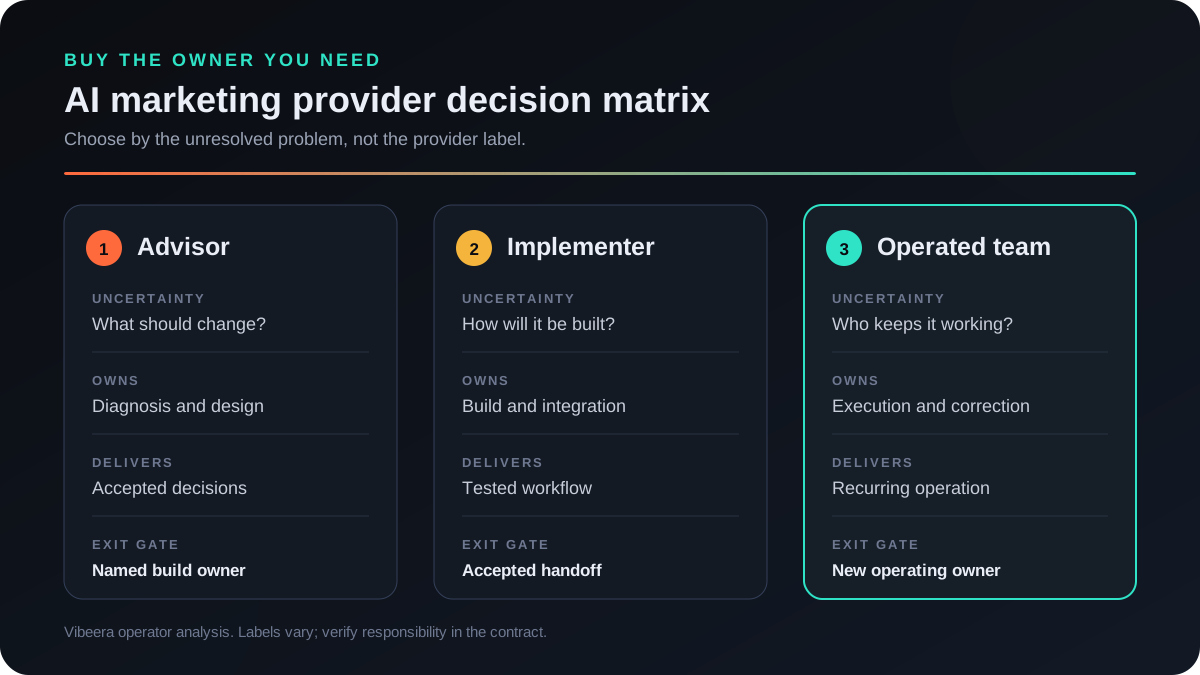
| Provider | Use when | Primary deliverable | Exit condition |
|---|---|---|---|
| AI marketing consultant | The priority, operating design, or governance is unclear | Evidence-backed decisions and an accepted plan | A named owner can implement the design |
| AI implementer | The target workflow is known, but the system does not exist | Configured, integrated, tested workflow | The system passes acceptance and handoff |
| Operated AI marketing team | The system must run, improve, and handle exceptions continuously | Recurring execution with monitoring and accountability | The business changes owner or operating model |
| Internal team | The business already has capability, capacity, and authority | Owned change inside normal operations | The workflow meets its business standard |
Some firms offer all four modes. That can reduce handoff loss, but only if the contract distinguishes diagnosis from implementation and recurring operation. A provider that recommends the exact system it sells has a commercial incentive. That does not invalidate the recommendation, but it makes transparent alternatives, assumptions, and acceptance criteria more important.
The six-stage path from advice to operation
Every stage should end in a decision that the next owner can accept. The handoff is not a final presentation. It is a controlled transfer of context, access, evidence, unresolved risks, and operating responsibility.
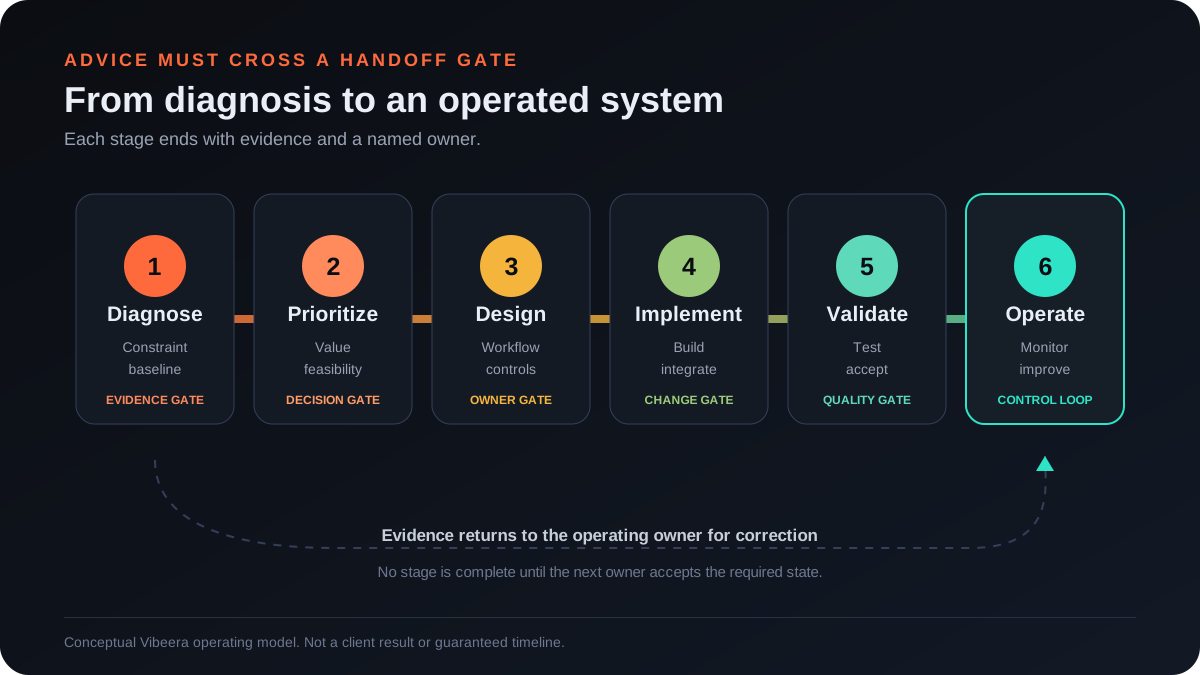
- Diagnose. Name the business constraint, current workflow, evidence, baseline, data quality, owners, and failure cost.
- Prioritize. Score candidate changes on value, feasibility, risk, time to evidence, dependency, and reversibility.
- Design. Specify inputs, decisions, tools, human approvals, outputs, error paths, audit records, and measurement.
- Implement. Assign the build owner, connect only approved systems, test with representative cases, and document changes.
- Validate. Run acceptance tests for normal, edge, stale-data, unavailable-tool, and unsafe-action cases.
- Operate. Name the person or team that monitors quality, handles exceptions, approves consequential actions, and improves the workflow.
If the consulting scope ends after stage three, the implementation owner must be named before the project starts. If the provider owns stages four to six, service levels, access boundaries, incident handling, change control, and the commercial reporting join belong in the agreement.
What should be in the statement of work?
A strong scope is specific enough that both sides can tell whether the engagement is complete. It does not need to predict every technical decision, but it should prevent the advisory phase from becoming an open-ended series of meetings.
- Business outcome: the commercial or operational state the work is intended to improve.
- Baseline: current process, volume, quality, cost, cycle time, and downstream measurement that are actually available.
- Included workflows: exact channels, systems, teams, markets, and stages of the customer journey.
- Deliverables: decisions, specifications, prototypes, configured systems, tests, training, and runbooks.
- Decision rights: who recommends, approves, implements, operates, changes access, and stops a workflow.
- Controls: privacy, security, platform policy, claim review, data retention, approval, and escalation requirements.
- Acceptance: test cases, evidence, defects, remediation, sign-off owner, and definition of done.
- Handoff: credentials, source files, configuration, prompts, evaluation sets, documentation, and support period.
- Measurement: task quality plus the path from landing page and CTA to booking, qualified meeting, opportunity, and revenue.
- Exclusions: work, systems, channels, data cleanup, licenses, ongoing operation, and outcomes outside the fee.
How AI marketing consulting is priced
There is no useful universal price because the same label can describe a short diagnostic, a transformation program, a build project, executive advisory, or ongoing operation. Exact ranges without matched scope can create false precision. Compare proposals by the business state they are responsible for reaching.
| Pricing model | Best fit | Question to ask |
|---|---|---|
| Fixed-fee diagnostic | Bounded discovery and prioritization | Which decisions and artifacts are accepted at the end? |
| Fixed-fee project | Defined design or implementation | What counts as a change request or failed acceptance? |
| Day or hourly rate | Specialist input with flexible demand | Who controls the work queue and total exposure? |
| Retainer | Ongoing advisory or improvement | What operating cadence, capacity, and response are included? |
| Operated service | Recurring execution and ownership | Which results, controls, service levels, and exclusions are contractual? |
Total cost includes the consulting fee, licenses, integration work, data preparation, internal stakeholder time, training, remediation, and the team that will run the system afterward. A cheaper plan that cannot be implemented is more expensive than a narrower engagement that reaches an accepted operating state.
Vibeera pricing: compare an operated AI marketing department with a consulting-only engagement and internal hiring.Eight questions to ask before hiring
- What evidence will you inspect before recommending a use case? Look for customer, workflow, CRM, analytics, financial, system, and operational evidence rather than a generic maturity survey.
- What will be different when the engagement is accepted? The answer should describe a usable state, not just workshops or documents.
- Which alternatives will you compare? This can include process repair, deterministic automation, software, internal training, implementation help, or no change.
- Who owns implementation and operation? Ask for named roles, not an implied handoff to “the team.”
- How do you test quality and unsafe failure? Request representative examples, acceptance thresholds, escalation, and remediation.
- How will access and data be controlled? Confirm least privilege, approved environments, retention, vendor boundaries, audit evidence, and offboarding.
- How will business impact be joined? Keep task completion separate from leads, bookings, qualified meetings, opportunities, and won revenue.
- What do we own afterward? Confirm source files, configurations, prompts, evaluation sets, documentation, accounts, and migration support.
Red flags in an AI consulting proposal
- The proposal begins with a preferred tool and never diagnoses the current workflow.
- The scope promises efficiency or revenue without a baseline, measurement join, method, or limitation.
- A prototype or generated answer is treated as proof that the workflow is reliable.
- The provider cannot name the implementation owner, operating owner, or acceptance authority.
- Security, privacy, platform rules, human approvals, and failure handling are deferred until after the build.
- The handoff omits source, configuration, tests, documentation, access transfer, or support.
- The plan automates a broken process without first deciding whether the process should exist.
From an AI strategy to an operated marketing system
Strategy should tell the operator what to do next. A useful path might start with a measurable workflow such as lead response, content production, campaign reporting, or lifecycle follow-up. The design then separates deterministic steps from model decisions, assigns human approval by consequence, connects only necessary tools, and records enough evidence to improve the system safely.
For model-managed workflows, the agentic AI in marketing control architecture shows how to define tools, instructions, approval gates, stop conditions, evaluation, and rollback. For stable triggers and routing, an automation operator may be the better owner. For positioning and sensitive judgment, see what AI marketing still needs a human for.
Planning artifact: use the evidence brief, plan-to-operator loop, and 30/60/90-day gates to make the consulting handoff executable.How Vibeera differs from a consulting-only engagement
Vibeera can diagnose and map the system, but the offer bridge is ongoing operation. The goal is not to leave the business with a strategy deck and a list of tools. It is to install and operate the recurring marketing execution across outreach, funnels, follow-up, content, and reporting under defined approvals and human supervision.
That model is appropriate when the problem continues after the design: campaigns still need monitoring, content still needs evidence and review, leads still need routing and follow-up, exceptions still need decisions, and measurement still needs reconciliation. If the business already has a capable implementation and operating team, a consulting-only engagement may be sufficient.
Compare operating models: see how Vibeera differs from a conventional marketing agency across ownership, capacity, controls, and cost structure. When recurring operation is the gap: use the reliability contract, acceptance matrix, evidence ladder, and buyer checklist to scope an accountable operator.Research method and evidence boundary
Ahrefs was checked on July 29, 2026. The query ai marketing consultant showed US volume 350, global volume 700, KD 0, Traffic Potential 150, and CPC $5. The same parent topic included ai marketing consulting, which showed US volume 200, global volume 300, KD 21, and CPC $6. Ahrefs reported 42 matching terms across the seed set. These are third-party estimates and demand signals, not a forecast of rankings, clicks, meetings, or revenue.
The live first page included consulting service pages, practitioner sites, a Reddit result, a freelancer marketplace, and a local result. The two leading service pages explained readiness, strategy, and implementation, but the visible pages did not give buyers a complete consultant-versus-operator decision matrix, staged acceptance handoff, or a contract-ready ownership checklist. That SERP gap informed this page; it does not prove that every competitor lacks those materials elsewhere.
Current first-party platform documentation was checked through OpenAI's practical guide to building agents for its distinction between model, tools, instructions, and workflow execution. OpenAI is a platform vendor with a commercial interest and an enterprise-heavy perspective. The provider matrix, six-stage handoff, scope checklist, cost comparison, and hiring questions are Vibeera operator analysis. They are not client results, pricing promises, legal advice, or guarantees.
The hiring decision
Hire an AI marketing consultant when diagnosis, prioritization, architecture, governance, or sequencing is the main uncertainty. Make the engagement end in an accepted decision and an implementable operating design. If recurring execution, monitoring, exception handling, and improvement are the real bottlenecks, buy implementation or operation explicitly rather than hoping advisory work will turn into ownership by itself.
Frequently asked questions
What does an AI marketing consultant do?
An AI marketing consultant diagnoses where AI can improve a marketing workflow, prioritizes use cases, designs the operating model, and defines requirements, controls, measurement, and handoff. The consultant may advise or implement, but ongoing ownership should be explicit in the contract.
When should you hire an AI marketing consultant?
Hire an AI marketing consultant when the main uncertainty is what to automate, how to govern it, which systems to connect, or how to sequence a change. If the problem is sustained execution after the plan is clear, an implementer or operated team may be a better fit.
What should an AI marketing consulting scope include?
The scope should name the business outcome, current baseline, included workflows and systems, deliverables, decision rights, security and approval controls, acceptance tests, implementation owner, measurement plan, handoff date, support period, and exclusions.
How is an AI marketing consultant different from an AI marketing agency?
A consultant is usually hired for diagnosis, prioritization, design, and advisory support. An agency or operated team is usually hired to build, run, monitor, and improve recurring marketing work. Some providers do both, so compare ownership and acceptance criteria rather than labels.
How do you evaluate an AI marketing consultant?
Evaluate the consultant on the quality of the diagnosis, evidence behind priorities, clarity of the operating design, testable deliverables, security and governance, implementation realism, knowledge transfer, and whether the work reaches an accepted business state. Do not treat activity or an AI demo as revenue proof.
Turn the diagnosis into an operated system
Vibeera will map the workflow, ownership, controls, implementation, and measurement before recommending the operating model.
Map the implementation