AI marketing plan: build one you can actually run

An AI marketing plan should turn verified business evidence into a small set of prioritized actions, named owners, human approval points, and measurable decisions. Use AI to structure research, expose assumptions, draft options, and maintain the operating board. Keep people responsible for business truth, priorities, claims, budget, access, exceptions, and the choice to scale, change, or stop.
Key facts
- Start with an evidence brief, not a one-line prompt. The plan can only be as current and specific as the business, customer, channel, and measurement inputs supplied.
- Separate an AI-generated draft from an approved operating plan. Every channel, claim, budget, automation, and access change needs a named decision owner.
- A useful plan connects each priority to a 30-day action, an acceptance check, an attribution key, and a scheduled decision.
- Ahrefs showed US volume 100, global volume 250, KD 33, Traffic Potential 150, and CPC $9 for this query on July 31, 2026.
Most AI plan tools solve the blank-page problem. They can organize goals, audiences, channels, and tactics in minutes. That is useful, but a formatted document is not yet an operating plan. The difficult work begins when the business must verify the inputs, choose what not to do, assign responsibility, connect systems, approve risk, and decide from live evidence.
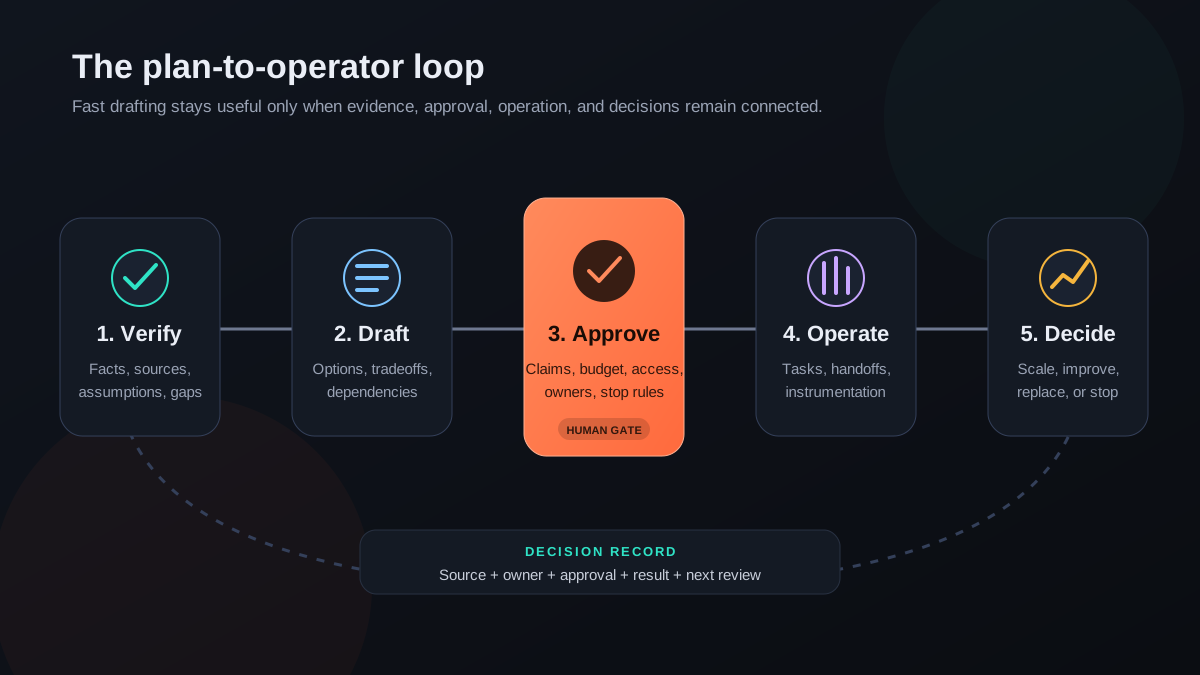
Vibeera calls the conversion from draft to operation the plan-to-operator loop. It keeps the speed of AI-assisted planning while making assumptions, decisions, handoffs, and evidence visible.
Start with the evidence brief
Do not ask a model to infer the business from a website and a goal. Create one brief that distinguishes facts from estimates, assumptions, and missing evidence. This reduces confident but unusable recommendations and gives reviewers a source record.
| Input | What to record | Evidence and limitation |
|---|---|---|
| Business outcome | The target state, decision window, capacity, and economic constraint | Owner-confirmed objective; not a forecast |
| Offer | Buyer problem, promised state, exclusions, proof, price model, and sales process | Current offer and approved claims |
| Buyer | Roles, trigger, failed alternatives, objections, language, and qualification | CRM, calls, support, research; sample limits stated |
| Journey | Where demand starts, pages and assets used, handoffs, follow-up, and leakage | Live systems outrank an old journey map |
| Performance | Traffic, response, conversion, pipeline, revenue, cost, and time window | First-party source plus attribution boundary |
| Constraints | Budget, people, data, access, policy, privacy, geography, and sales capacity | Named owner and checked date |
| Measurement | Event names, URL tags, CRM stages, qualification, and decision cadence | Join availability and known gaps |
For every important input, store the source class, checked date, method, and limitation. Current CRM, analytics, customer language, and controlled tests should carry more weight than a general benchmark. A competitor result may suggest a mechanism worth testing. It does not prove the same outcome will occur for your business.
Use AI as a planner, not the approver
AI is useful for organizing a large evidence pack, identifying contradictions, generating structured options, drafting a hypothesis register, and maintaining versioned work. The approval boundary should follow consequence. Reversible, reviewable drafts can move quickly. Actions that affect truth, money, permissions, reputation, privacy, or a person require an accountable owner.
| AI can prepare | A person must decide | Retained evidence |
|---|---|---|
| Evidence summaries and missing-input questions | Which sources are trusted and sufficient | Source list, dates, exclusions, limitation note |
| Audience and problem hypotheses | Who the business will target or exclude | Decision owner and supporting customer evidence |
| Positioning and message options | Factual claims, proof, voice, and risk | Approved claim set and rejected variants |
| Channel and workflow options | Budget, access, automation, and policy exposure | Scope, permission, stop condition, operator |
| Experiment and content briefs | Priority, acceptance test, and release | Version, reviewer, result, and next decision |
| Performance summaries | Commercial interpretation and scale or stop decision | First-party metrics, attribution method, limitations |
Build the plan-to-operator loop
- Verify: assemble the evidence brief and label facts, estimates, assumptions, contradictions, and unknowns.
- Draft: ask AI for no more than three coherent plan options, each with tradeoffs, dependencies, risks, and excluded work.
- Approve: choose the priority, budget, claims, channels, owners, access, acceptance checks, and stop conditions.
- Operate: turn the approved option into a detailed 30-day board with tasks, handoffs, instrumentation, and review dates.
- Decide: compare retained evidence with the acceptance checks, then scale, improve, replace, or stop the work.
The loop is intentionally smaller than an annual plan. It prevents a speculative document from becoming a long queue of unowned activity. A useful plan states what will not be attempted during the current decision window.
A copyable plan brief
Use this brief as the input contract between the business, the model, and the operator. Replace every bracketed field. Mark unknowns instead of inventing them.
AI marketing plan input contract
- Target state: [business outcome] by [decision date], within [capacity and budget].
- Offer: [buyer], [problem], [promised state], [proof], [exclusions], [sales path].
- Current evidence: [first-party sources, windows, values, attribution method, limitations].
- Constraints: [people, systems, data, access, policy, privacy, market, sales capacity].
- Decision rights: AI may [draft/research/check]; people approve [claims/budget/access/publish/stop].
- Required output: three options, tradeoffs, assumptions, 30-day board, acceptance checks, and evidence needed for the next decision.
- Forbidden output: invented proof, unsupported benchmarks, guaranteed results, hidden dependencies, or autonomous external actions.
Turn 90 days into three evidence gates
A 90-day direction is long enough to connect planning, implementation, and learning. It should not lock the business into ninety days of unchanged activity. Use three gates with increasingly stronger evidence.
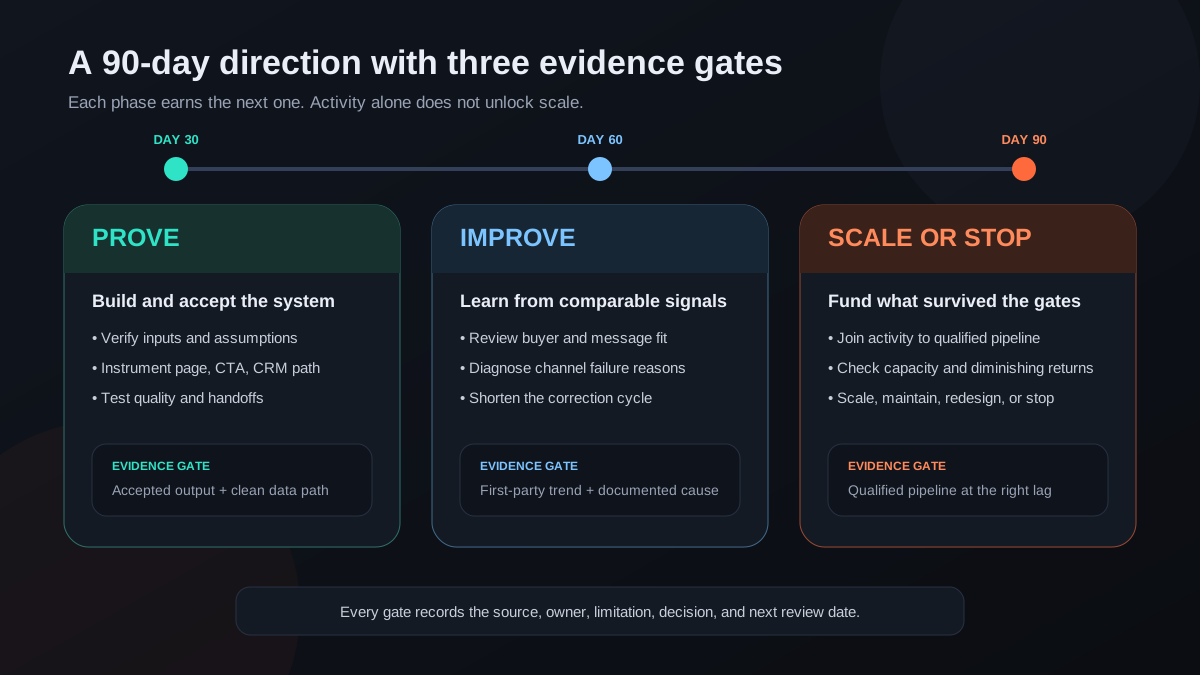
| Window | Operating goal | Minimum evidence gate | Decision |
|---|---|---|---|
| Days 1-30 | Prove the inputs, workflow, instrumentation, and quality | Accepted output, functioning handoff, clean event and CRM path | Fix the system, narrow the plan, or continue |
| Days 31-60 | Improve the message, audience, channel, and cycle time | Comparable first-party signals and documented failure reasons | Keep, replace, or deepen the hypothesis |
| Days 61-90 | Scale only what survived the earlier gates | Qualified pipeline evidence appropriate to the channel and time lag | Scale, maintain, redesign, or stop |
Do not require revenue proof before a channel has had enough time to create it, but do not substitute activity for revenue either. Use a staged evidence chain and keep each claim at the level the data supports.
Measure the full chain
Each priority needs a landing page or asset owner, page-specific campaign keys, a CTA event, a booking or response record, qualification, opportunity, pipeline, and revenue state where applicable. Preserve those identifiers through the CRM. Without the join, report traffic, clicks, bookings, and business outcomes separately.
For organic and AI discovery, add crawlability, indexation, impressions, position, click-through rate, identifiable AI referrals, relevant crawler access, citations where the provider exposes them, and buyer self-report. One generated answer is a sample, not a stable ranking.
Attribution guide: connect marketing activity to qualified meetings and revenue without upgrading correlation into causation. Coach funnel implementation: turn one offer into a measured video, application, booking, follow-up, and CRM control loop. Automation strategy: turn the approved plan into bounded workflows, ownership, and exception paths. Audit before expansion: test one consequential automation journey through six evidence and control layers before adding more workflows.Choose a tool by operating fit
Current results include instant generators, templates, and integrated planning workspaces. A generator is useful when the main problem is structure. A platform that already holds customer and performance data may reduce manual context work. A consultant is useful when the priority is unclear. An operated service is useful when the plan exists but nobody owns execution, integration, quality, exceptions, and weekly correction.
Compare tools on input quality, source traceability, privacy, collaboration, export, integration, version history, approval controls, and operator ownership. Do not choose from output polish alone.
Research method and evidence boundary
Ahrefs was checked on July 31, 2026. The query showed 100 US searches, 250 global searches, KD 33, Traffic Potential 150, CPC $9, an AI Overview, discussions, and People Also Ask. Ahrefs estimated about 41 referring domains may be needed to compete in the top ten. These are third-party estimates and SERP signals, not a forecast of Vibeera traffic, rankings, meetings, or revenue.
The market scan reviewed HubSpot's AI marketing plan, Venngage's generator, and Smart Insights' practitioner analysis on July 31, 2026. The first two are current commercial pages. The third is transparent practitioner analysis from 2024 and may not reflect every current model or platform. They informed the problem framing only.
The plan-to-operator loop, input contract, control boundary, evidence gates, and operating board are Vibeera operator analysis. No client result, saving, conversion rate, timeline guarantee, or revenue claim is implied.
The decision
Use AI to accelerate planning when you can supply reliable context and keep decisions accountable. Choose a generator for structure, an integrated platform for context-rich planning, a consultant for diagnosis, or an operated team for sustained execution. Whatever the model, require verified inputs, visible assumptions, a human approval boundary, a 30-day board, and evidence strong enough to support the next decision.
Frequently asked questions
How do I create an AI marketing plan?
Build a verified evidence brief covering the business outcome, offer, buyer, current journey, channel baseline, constraints, and measurement. Ask AI to structure options and surface missing inputs. A person then approves priorities, claims, budget, access, owners, acceptance checks, and the first 30-day operating board.
What inputs does an AI marketing plan need?
Useful inputs include the target business state, current performance window, buyer language, offer and exclusions, sales capacity, channel and asset inventory, CRM stages, analytics definitions, budget constraints, approval rules, and known evidence gaps. Record each source, checked date, and limitation.
What should AI decide in a marketing plan?
AI can propose structures, summarize evidence, compare options, draft channel hypotheses, identify missing fields, and maintain a decision log. People should decide product truth, strategic priority, budget, factual claims, sensitive audiences, access, policy or legal risk, exceptions, and whether to scale or stop.
Which platform helps create an AI marketing plan?
A generator can help produce a first draft, while an existing CRM or marketing platform may use more of your current business data. Choose by input quality, traceability, collaboration, export, privacy, integration, and who will operate the plan. No platform removes the need for evidence and accountable decisions.
How do I measure an AI marketing plan?
Measure the complete chain: accepted work, distribution, discovery, qualified visits, CTA actions, bookings, qualified meetings, opportunities, pipeline, and won revenue. Preserve landing-page and campaign keys through the CRM, and keep correlation separate from joined attribution.
Should an AI marketing plan cover 30 or 90 days?
Use a 90-day direction with a detailed first 30-day operating board. The first month should test the evidence, workflow, and measurement. The second can improve what passed. The third can scale, replace, or stop work based on retained evidence rather than the original forecast.
Turn the plan into an operated system
Vibeera will map the evidence, priorities, approvals, workflows, attribution, and first 30-day operating board.
Map the implementation