VSL funnel for coaches: build the whole conversion system

A VSL funnel for coaches is a conversion system, not a video page. The useful build connects one specific coaching offer to a focused video sales letter, a qualified application, the correct calendar, source-aware follow-up, CRM stages, and a weekly evidence review. Start with the buyer decision and the measurement chain. Then script and produce the video around the objections that block that decision.
Key facts
- The core path is traffic source to landing page, video engagement, application, booked call, attended call, qualified opportunity, and won revenue.
- The video should make one offer and one next action easier to evaluate; it should not attempt to replace qualification, sales, or delivery proof.
- AdvLaunch recorded 126 impressions, two clicks, and average position 5.3 for its coach VSL owner in the latest cross-property baseline. That is portfolio demand evidence, not Vibeera performance or page-level revenue attribution.
- The live exact-query SERP checked August 2, 2026 was narrow and implementation-led, leaving room for Vibeera's operated funnel, follow-up, and attribution angle without copying the AdvLaunch article.
Many coach VSL projects begin with the wrong production question: how long should the video be, which camera should be used, or which script template is popular? Those decisions come after the operating design. First define the buyer, the offer, the qualification rule, the next action, the follow-up owner, and the evidence needed to decide whether the funnel is working.
Vibeera uses a Decision-to-Revenue control loop. The video is one decision surface inside the loop. The system is useful only when each handoff has an owner, an acceptance check, an exception path, and a measurable business state.
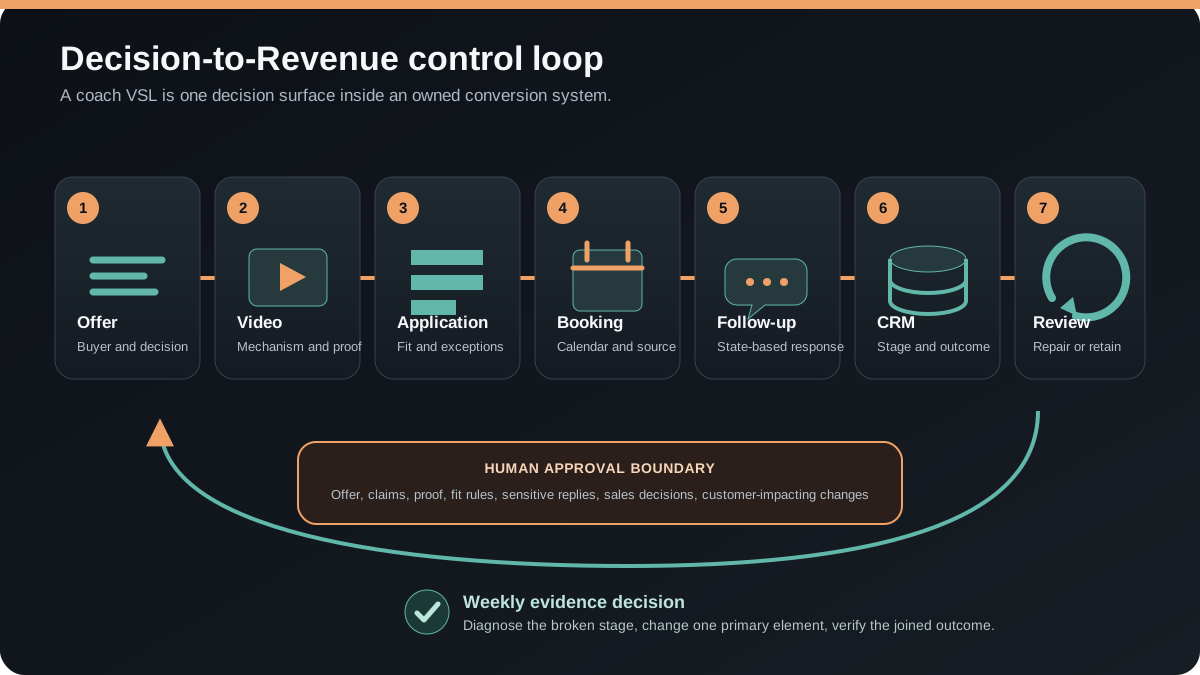
Design the buyer decision before writing the video
A VSL should help one specific buyer make one specific next decision. Write that decision in plain language before outlining scenes. If the offer serves multiple audiences or solves several unrelated problems, choose the highest-value owner journey and create separate campaign entry points only when the intent and evidence are genuinely distinct.
| Decision input | Write before scripting | Failure it prevents |
|---|---|---|
| Buyer | Role, current situation, costly problem, urgency, exclusions | A broad message that nobody recognizes as theirs |
| Offer | Outcome, mechanism, scope, effort, boundary, next step | A video that creates interest but cannot set an accurate expectation |
| Proof | Approved examples, method evidence, source, date, limitation | Unsupported promises or proof the coach cannot defend |
| Qualification | Fit questions, rejection reasons, exception owner, capacity | Calendar volume that consumes sales time without buyer fit |
| Measurement | Events, stable IDs, CRM states, review window, decision rule | Optimizing plays or clicks while qualified pipeline stays unknown |
The offer bridge is not a hidden pitch. It is the logical next action for a reader who recognizes the problem and accepts the mechanism. If the next step is a mapping call, state what will be mapped and who should not book.
Plan the operating inputs: define verified inputs, human approvals, owners, evidence, and 30/60/90-day decisions before production.Use a six-part VSL structure without turning it into a formula
- Recognition: name the buyer's current situation and the decision they are trying to make.
- Failure diagnosis: explain why the current approach keeps breaking without blaming the buyer.
- Named mechanism: show the sequence, constraint, or operating model that changes the result.
- Evidence: use only approved proof, real process detail, sourced facts, or a clearly labeled demonstration.
- Fit boundary: state who benefits, who does not, what effort is required, and what the offer does not solve.
- Next action: ask for one application or booking action and explain what happens next.
This sequence is a production aid, not a claim that six sections cause a particular conversion rate. The script still has to match the offer, the buyer's level of awareness, the traffic source, and the proof available. Remove any sentence that the coach cannot verify in a real sales conversation.
Choose the application and calendar path deliberately
A calendar is not a qualification system. If the offer requires a defined stage, ability to implement, geography, budget, decision authority, or a specific problem, collect only the questions needed to route the buyer honestly. Explain why the information is needed and avoid unnecessary sensitive data.
| Path | Use when | Operating requirement |
|---|---|---|
| Video to calendar | Fit is easy to understand and sales capacity can absorb the calls | Correct calendar, time-zone handling, reminders, source preservation, no-show process |
| Video to application to calendar | Fit and capacity need screening before scheduling | Visible criteria, fair rejection path, human exception owner, fast routing |
| Video to application to manual review | The decision is high value, sensitive, limited, or operationally complex | Response-time promise, privacy boundary, review owner, accepted and declined follow-up |
| Video to purchase | The offer, price, terms, delivery, refund, and support expectations are clear | Accurate checkout, consent, confirmation, access, support, and payment evidence |
Keep the video, application, calendar, and sales script consistent. A mismatch between the promise in the video and the criteria in the application creates low trust even when every page works technically.
Appointment-setting owner: connect qualification, routing, reminders, exceptions, attendance, and CRM truth around the calendar.Build follow-up as part of the funnel
Not every qualified viewer will apply or book immediately. Define follow-up by observed state: started the video, reached the next action, began an application, submitted, booked, cancelled, no-showed, attended, or became unresponsive. Message only when the business has an appropriate basis and the channel rules allow it.
AI can help summarize replies, select an approved response branch, schedule reminders, and flag exceptions. Human review remains necessary for sensitive circumstances, complaints, disputed claims, unusual buyer questions, strategic accounts, and any response where the system is uncertain. The control boundary should be written before automation is switched on.
Measure the last joined business state
Google Analytics documents events as measurements of interactions such as page loads, video plays, link clicks, and purchases. Those events are useful but remain different business states. Join them to the application, booking, contact, meeting, opportunity, and revenue records before making a pipeline claim.
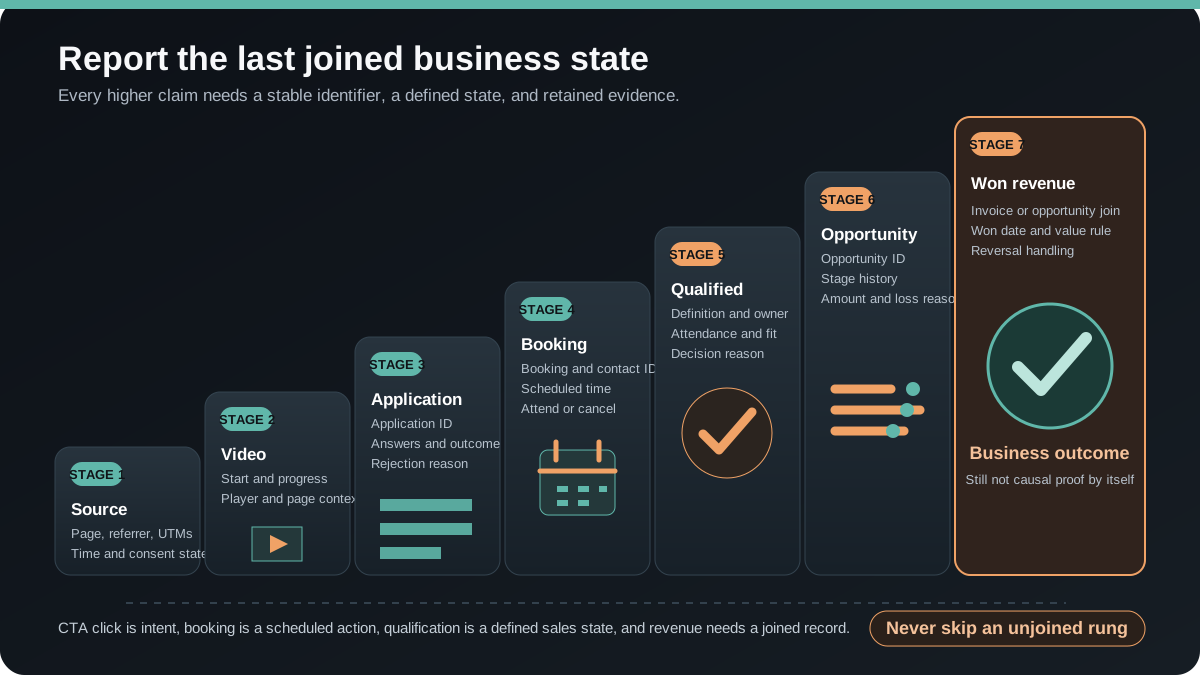
| Stage | Minimum evidence | Useful decision |
|---|---|---|
| Source and landing | Landing page, referrer, UTMs, click ID where permitted, time | Which entry paths deserve a closer look |
| Video engagement | Start, meaningful progress points, completion, player and page context | Where comprehension or relevance may break |
| Application | Application ID, answers, source, outcome, rejection reason | Whether the message attracts the intended buyer |
| Booking and attendance | Booking ID, contact ID, scheduled time, attendance, cancellation | Whether routing and follow-up convert intent into conversation |
| Qualification and opportunity | Definition, owner, stage history, amount basis, loss reason | Whether the funnel creates commercially relevant demand |
| Won revenue | Opportunity or invoice join, won date, value rule, reversal handling | Whether to retain, expand, change, or stop the system |
Use watch behavior as a diagnostic, not the goal. A retention dip can identify a section to inspect; it does not explain the cause by itself. YouTube's official audience-retention documentation similarly describes where viewers keep watching, rewatch, skip, or stop, and notes that the data needs interpretation.
Attribution implementation: preserve first and converting touch, stable IDs, qualification, opportunity, and revenue evidence without overstating causation. Webinar operating owner: connect promotion, registration, attendance, follow-up, sales routing, and revenue evidence around a live buyer decision. Broader agency buyer guide: evaluate source-to-close scope, leak controls, failure-path acceptance, CRM evidence, and recurring repair across funnel formats.Run a weekly repair loop
- Verify delivery. Confirm the page, video, application, calendar, reminders, tracking, CRM writeback, and privacy controls work.
- Inspect stage movement. Compare source quality, video progress, applications, bookings, attendance, qualification, pipeline, and revenue.
- Sample journeys. Trace a small set of recent buyers and non-buyers through the retained IDs and messages.
- Classify the defect. Separate offer, message, proof, traffic, qualification, routing, sales, delivery, and measurement problems.
- Change one primary element. Record the hypothesis, owner, start date, expected signal, risks, and review window.
- Keep or reverse. Decide from the agreed business stage rather than from a pleasing dashboard movement.
A VSL with low applications may have a message problem, a traffic problem, an offer problem, a trust problem, or a broken form. A VSL with many calls and few qualified opportunities may need a tighter fit boundary or a different acquisition promise. Diagnose the stage before rewriting the whole asset.
Research method and evidence boundary
The strongest first-party portfolio signal is AdvLaunch's live Search Console baseline, verified in the cross-property register on July 30, 2026: its VSL funnel for coaches owner recorded 126 impressions, two clicks, and average position 5.3. Vibeera has no current page owning the same intent. This is topic and format evidence only. The source property's landing-page-to-booking join remains incomplete, so the data does not prove that the AdvLaunch page caused a meeting or sale.
The exact-query live SERP was checked August 2, 2026. It included the AdvLaunch implementation guide and another coach-specific VSL funnel article, while broader results mixed funnel builders and general video-sales-letter guidance. The visible results commonly explained video structure and booking, but did not provide Vibeera's complete control boundary, application routing, source-aware follow-up, evidence ladder, and CRM lifecycle. No ranking promise follows from that gap.
Current first-party platform documentation was checked August 2, 2026: Google Analytics events documentation explains interaction measurement, YouTube audience-retention documentation explains video-level retention signals, and Google Ads conversion-tracking documentation describes website conversion identifiers and implementation constraints. Platform documentation explains platform behavior. It does not prove a Vibeera outcome, an ideal VSL duration, or a causal lift.
The Decision-to-Revenue loop, buyer-decision contract, fit paths, evidence ladder, and weekly repair sequence are Vibeera operator analysis. No customer result, conversion rate, performance benchmark, cost saving, timeline, ranking, or revenue claim is implied.
The decision
Build the system before polishing the video. Define one buyer decision, a defensible offer, approved proof, a fit rule, the correct next action, human control boundaries, stable source and CRM keys, and the weekly repair loop. Then produce the shortest VSL that can make that decision clearly and responsibly.
Frequently asked questions
What is a VSL funnel for coaches?
A VSL funnel for coaches is a measured conversion path that uses a video sales letter to help a prospective coaching client understand a specific problem, mechanism, offer, and next step before applying or booking. A complete funnel also includes qualification, calendar routing, follow-up, CRM stages, and source-to-revenue measurement.
What should a coach include in a VSL?
Include the buyer's current problem, the costly reason it persists, the coaching mechanism, who the offer is and is not for, real proof that you are allowed to use, the commitment required, common objections, and one clear next action. Remove unsupported claims, generic biography, multiple offers, and urgency that is not real.
How long should a coach VSL be?
There is no universal ideal duration. Use the shortest video that can make the intended buyer decision responsibly. Test comprehension, watch behavior, applications, qualification, attendance, and downstream revenue rather than treating duration as the optimization goal.
Should a VSL send people to a calendar or an application?
Send high-intent, well-understood offers directly to the appropriate calendar only when capacity and qualification rules support it. Use an application first when fit, urgency, budget, geography, compliance, or delivery capacity must be checked before a call. Keep the rejection and exception path explicit.
How do I measure a coaching VSL funnel?
Preserve source, campaign, landing page, video events, application ID, booking ID, contact ID, attendance, qualification, opportunity, and won revenue. Review each stage separately. A video play or CTA click is not a booking, and a booking is not a qualified opportunity or sale.
Can AI build and operate a coach VSL funnel?
AI can assist research, draft structure, create approved variants, classify responses, trigger follow-up, route applications, and summarize evidence. A person should approve the offer, factual claims, proof, creative direction, qualification rules, sensitive replies, sales decisions, and any change that can affect customers or reputation.
Map the VSL path from buyer decision to qualified pipeline
Vibeera will map the offer, video, qualification, routing, follow-up, human approvals, and evidence chain before production begins.
Map the implementation