Webinar marketing agency: what should it actually operate?

A webinar marketing agency should operate more than promotion and production. The useful scope connects the audience and promise to registration, reminders, attendance, the live experience, source-aware follow-up, sales routing, CRM states, and a weekly evidence review. Evaluate the agency by the last business state it can reliably join, not by registrations or attendee screenshots alone.
Key facts
- The complete path is promotion to registration, attendance, meaningful engagement, booked call, attended call, qualified opportunity, and won revenue.
- Every handoff needs an owner, an acceptance check, an exception path, and retained proof.
- Ahrefs estimated 150 monthly US searches for webinar marketing agency, keyword difficulty 3, and parent-topic volume 450 on August 3, 2026. These are planning estimates, not Vibeera performance.
- The live SERP mixed guides and agency service pages, creating a credible path for an operated system owner without copying competitor content or promising rank.
Most webinar proposals are easy to compare at the surface: landing page, ads, email reminders, technical production, and a report. The difficult question is who operates the handoffs between those deliverables. A registration that never receives the right reminder, an attendee who cannot be joined to a CRM contact, or a qualified question that receives generic follow-up is an operating failure even when the broadcast worked.
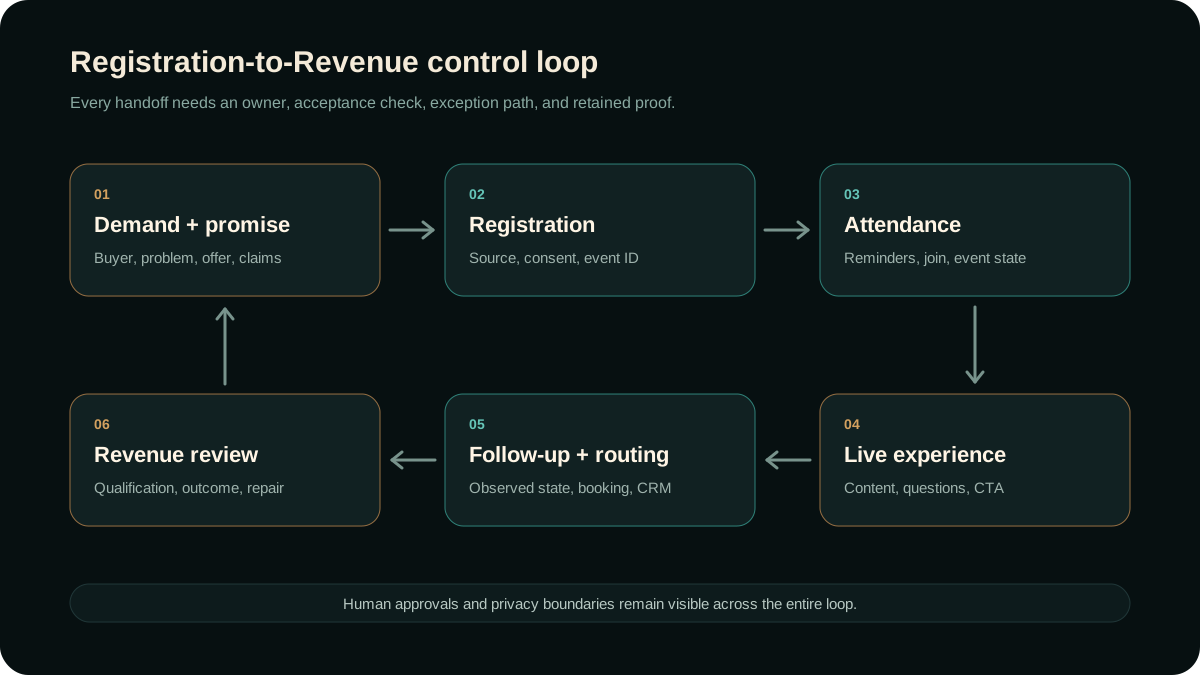
Vibeera uses a Registration-to-Revenue control loop. The webinar is one live decision surface inside it. Each stage has an owner, an input, an acceptance check, an exception path, and retained evidence.
Start with a webinar operating contract
Before selecting channels or a platform, write the operating contract for the event. This is not a legal contract. It is the working definition of what enters each stage, what counts as accepted, who owns the exception, and what evidence is retained.
| Stage | Acceptance check | Exception owner | Proof retained |
|---|---|---|---|
| Demand and promise | Specific buyer, problem, outcome, scope, and approved claims | Offer owner | Brief, source, approval, campaign ID |
| Registration | Correct event, consent, source, time zone, and confirmation | Campaign operator | Registration ID, UTMs, timestamp |
| Attendance | Join path works and reminders match the registered event | Event producer | Attendee ID, join and leave time |
| Live experience | Speaker, content, questions, CTA, recording, and moderation operate | Producer and host | Event history, approved recording, Q&A |
| Follow-up and routing | Message and next action match the observed state | Lifecycle owner | Contact ID, message state, booking ID |
| Revenue review | Qualification, opportunity, outcome, and source can be joined | Revenue operator | Stage history, decision, amount basis |
The contract exposes partial scopes. If the agency stops after the event report, the business still needs named owners for follow-up, sales routing, CRM joins, and improvement. If an internal team owns those steps, agree on the handoff format and response time before promotion begins.
Related conversion owner: map the video, application, booking, follow-up, and CRM evidence when the webinar leads into a coach VSL path.Separate the agency, platform, and internal-team jobs
A webinar platform can provide registration, email, delivery, interaction, and reporting features. It does not decide the audience, approve the promise, reconcile competing calendars, qualify a sales conversation, or determine what the company should change next. Those are operating decisions.
| Model | Best fit | Primary risk | Control to require |
|---|---|---|---|
| Internal team plus software | Clear owners already exist across growth, event, lifecycle, sales, and analytics | Handoffs become informal during busy periods | One operating board and an exception owner per stage |
| Production agency | The strategy and revenue system are strong but event delivery needs specialist support | Broadcast success is mistaken for commercial success | Scope boundary and post-event handoff evidence |
| Promotion agency | The event and follow-up system work but qualified demand is constrained | Registration volume outruns audience quality | Audience exclusions, source joins, and qualified-pipeline review |
| Operated webinar system | The business needs one accountable loop across campaign, event, follow-up, and evidence | Control becomes opaque or over-centralized | Human approvals, visible states, access boundaries, and rollback |
Design the event around a buyer decision
A useful webinar helps a specific buyer make a specific decision. Define what the attendee should understand, what evidence they need, what action is appropriate, and who should not take that action. Then design the title, outline, proof, interaction, and CTA around that decision.
- Recognition: name the current situation and the costly problem without exaggeration.
- Failure diagnosis: explain why the current approach breaks and which constraint matters.
- Named mechanism: teach a sequence, control loop, checklist, or decision model that can be evaluated.
- Operational evidence: use approved examples, demonstrations, sources, or clearly labeled analysis.
- Fit boundary: state who benefits, what effort is required, and what the offer does not solve.
- Contextual next action: connect the taught mechanism to an appropriate implementation step.
This structure does not guarantee attendance, conversion, or revenue. It is a quality control for message clarity. The actual decision depends on audience fit, channel, proof, event delivery, follow-up, sales, and the offer itself.
Agency evaluation owner: compare operating depth, human control, integration evidence, measurement, and commercial boundaries before selecting a provider.Preserve state through registration and attendance
Keep the event identifier, registration identifier, source, campaign, contact, attendance, and later sales identifiers joinable. Confirm how the platform represents registrants, attendees, absences, join time, leave time, questions, and report availability. Use only the data necessary for the stated purpose and apply the business's privacy and retention rules.
A reminder should reflect the actual registration state and local event time. A follow-up should distinguish an attendee from a registrant who did not attend. If the platform and CRM cannot exchange a stable identifier, write the reconciliation method and its limitations before launch.
Measure the last joined business state
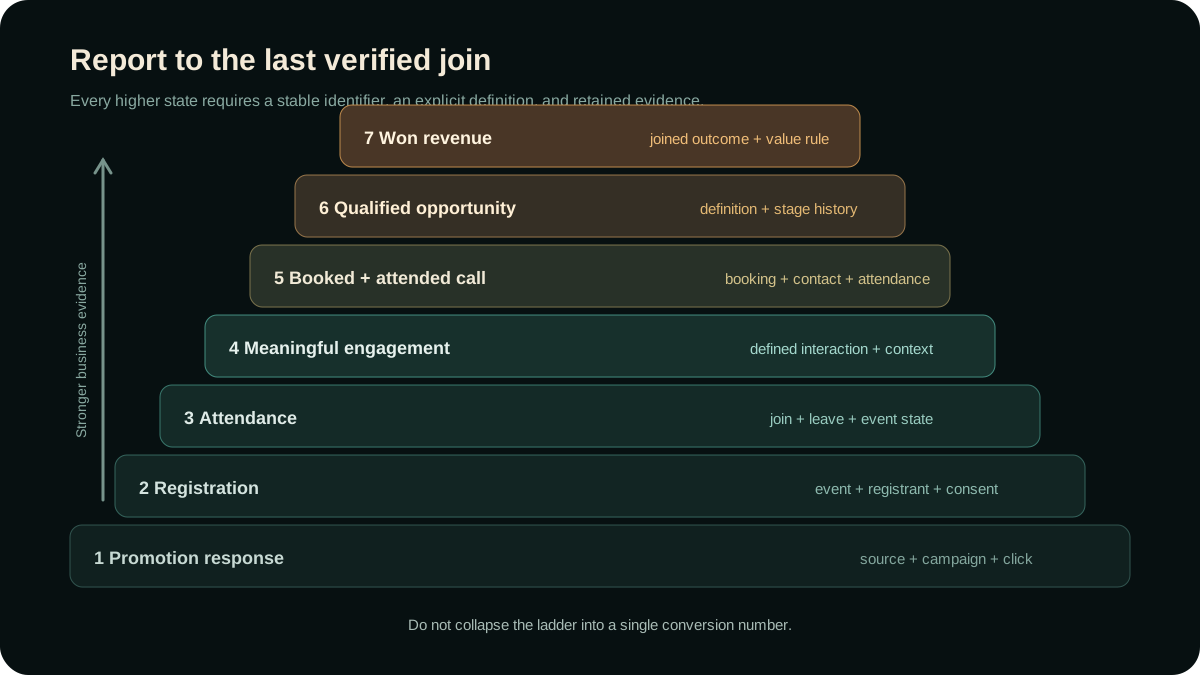
Event and analytics tools record useful interactions, but each interaction remains a distinct evidence state. A promotion click is not a registration. A registration is not attendance. Attendance is not a booked call, and a booked call is not a qualified opportunity or sale.
| State | Minimum evidence | Do not call it |
|---|---|---|
| Promotion response | Landing page, source, campaign, creative, click time | Registration or demand quality |
| Registration | Registration ID, event ID, contact join, consent state | Attendance |
| Attendance and engagement | Join and leave time, event context, approved interaction fields | Sales intent by default |
| Booking and attended call | Booking ID, contact ID, scheduled time, attendance state | Qualified opportunity |
| Qualification and opportunity | Definition, owner, stage history, amount basis, loss reason | Won revenue |
| Won revenue | Opportunity or invoice join, won date, value rule, reversal handling | Causal webinar lift without a valid test |
Run a weekly repair loop
- Verify delivery. Test promotion destinations, registration, consent, reminders, join paths, recording, follow-up, calendar routing, and CRM writeback.
- Inspect stage movement. Review source quality, registration, attendance, engagement, bookings, attended calls, qualification, pipeline, and revenue separately.
- Trace real journeys. Join a small sample through retained identifiers and classify missing or contradictory states.
- Diagnose the constraint. Separate audience, promise, creative, registration, reminders, event, CTA, follow-up, sales, and measurement defects.
- Change one primary element. Record the hypothesis, owner, risk, start date, expected signal, and review window.
- Keep, revise, or reverse. Decide at the agreed business stage, not from the most flattering dashboard movement.
Low attendance may be a promise mismatch, reminder defect, schedule problem, weak source, or competing priority. High attendance with weak qualified pipeline may point to audience fit, the offer bridge, follow-up, or sales routing. Diagnose the broken stage before replacing the whole system.
Research method and evidence boundary
Ahrefs Keyword Explorer was checked August 3, 2026. It estimated 150 monthly US searches, keyword difficulty 3, forecast volume 220, topic traffic potential 300, and cost per click of $9 for webinar marketing agency. The parent topic webinar marketing was estimated at 450 US searches. Ahrefs described the visible intent as informational and commercial. These are third-party planning estimates, can change, and do not establish Vibeera traffic, rankings, conversion, or demand causation.
The live US SERP checked the same day mixed a long educational owner from Radical Marketing with service pages from MarketVeep, Opollo, ProperExpression, and Effiqs, plus publisher articles and people-also-ask results. Visible ranking pages ranged from low to high authority, and the service results commonly described strategy, promotion, production, and lead generation. The gap is Vibeera's explicit operating contract, exception ownership, evidence ladder, and registration-to-revenue repair loop. This is a ranking path hypothesis, not a ranking promise.
Current first-party platform documentation was checked August 3, 2026. Zoom webinar history documentation describes event history and attendee access, while Zoom webinar reporting documentation describes registration, attendee, performance, Q&A, poll, and survey reports subject to account and role constraints. Google Analytics event documentation explains event measurement, and Google Analytics event-parameter documentation explains additional interaction context. Platform documentation explains platform behavior. It does not prove a Vibeera outcome.
The Registration-to-Revenue loop, webinar operating contract, model comparison, evidence ladder, and weekly repair sequence are Vibeera operator analysis. No customer result, conversion benchmark, cost saving, ideal event length, timeline, ranking, pipeline, or revenue claim is implied.
The decision
Choose a webinar marketing agency by the operating gap it can close. Require named owners, acceptance checks, exception paths, human approvals, privacy boundaries, stable identifiers, and a weekly decision loop from the promise through revenue evidence. If the proposal ends at registrations, attendance, or production, treat the remaining lifecycle as an explicit internal responsibility.
Frequently asked questions
What does a webinar marketing agency do?
A webinar marketing agency should connect audience research, offer and topic design, promotion, registration, reminders, production, attendance, follow-up, sales routing, CRM evidence, and improvement. Confirm which stages it owns, which it only advises on, and who handles exceptions before work begins.
How much does a webinar marketing agency cost?
There is no responsible universal price. Cost depends on audience research, media, creative volume, platform setup, speaker support, production, follow-up, CRM integration, reporting, and event frequency. Request a line-item scope, third-party costs, assumptions, exclusions, and change-control terms.
Should the agency own webinar promotion and follow-up?
It should either own both or define an explicit handoff to the teams that do. Promotion without source preservation cannot show which demand worked. Follow-up without registration, attendance, and engagement context cannot route people accurately.
How should webinar marketing be measured?
Measure each verified state separately: promotion click, registration, attendance, meaningful engagement, booked call, attended call, qualified opportunity, and won revenue. Preserve stable identifiers between systems and report only to the last successful join.
Is webinar software enough, or do I need an agency?
Software can host registration, delivery, engagement, and reports. An agency becomes useful when the business needs an accountable operator across the offer, promotion, creative, production, follow-up, sales routing, CRM integration, and weekly decisions. Choose from the operating gap, not the tool list.
Can AI operate a webinar marketing system?
AI can assist research, approved creative variants, reminders, response classification, routing, and evidence summaries. People should approve the promise, claims, speaker material, audience rules, sensitive replies, sales decisions, and any action that can affect customers, reputation, privacy, or spend.
Map the webinar path from promise to qualified pipeline
Vibeera will map the audience, event, promotion, follow-up, human approvals, CRM joins, and evidence chain before operation begins.
Map the implementation