Sales funnel agency: what should it control?

A sales funnel agency should control the joined journey from source and promise through capture, qualification, routing, nurture, booking, sales handoff, and measurable outcome. Buy a testable operating system with named leak owners, CRM evidence, and a repair cadence, not a landing page, automation bundle, or conversion dashboard presented as pipeline.
Key facts
- The useful scope connects source, message, destination, consent, capture, qualification, routing, follow-up, calendar, CRM state, and sales disposition.
- Each stage needs an accepted input, expected state change, exception owner, evidence record, and rollback or recovery path.
- Ahrefs estimated 100 monthly US searches, 350 global searches, keyword difficulty 4, traffic potential 100, and CPC $5 for sales funnel agency on August 5, 2026. These are planning estimates, not Vibeera results.
- The live result set mixed agency services, guides, software-led content, videos, people-also-ask answers, and an AI answer surface. Click value depends on providing an operational artifact a summary cannot execute.
A funnel can look polished while the revenue path is broken. The ad promise may not match the page. The form may lose source values. A valid lead may enter the wrong pipeline. A fast follow-up may send without required context. A booked meeting may never reach the CRM, or the sales disposition may never join back to the landing page. A page-level conversion rate cannot reveal all of those failures.
Vibeera uses a Funnel Control Ledger: one operating record that defines every stage, accepted input, state transition, owner, exception, evidence, and next repair decision. It turns a vague promise to “build a funnel” into a journey that can be tested and reconciled.
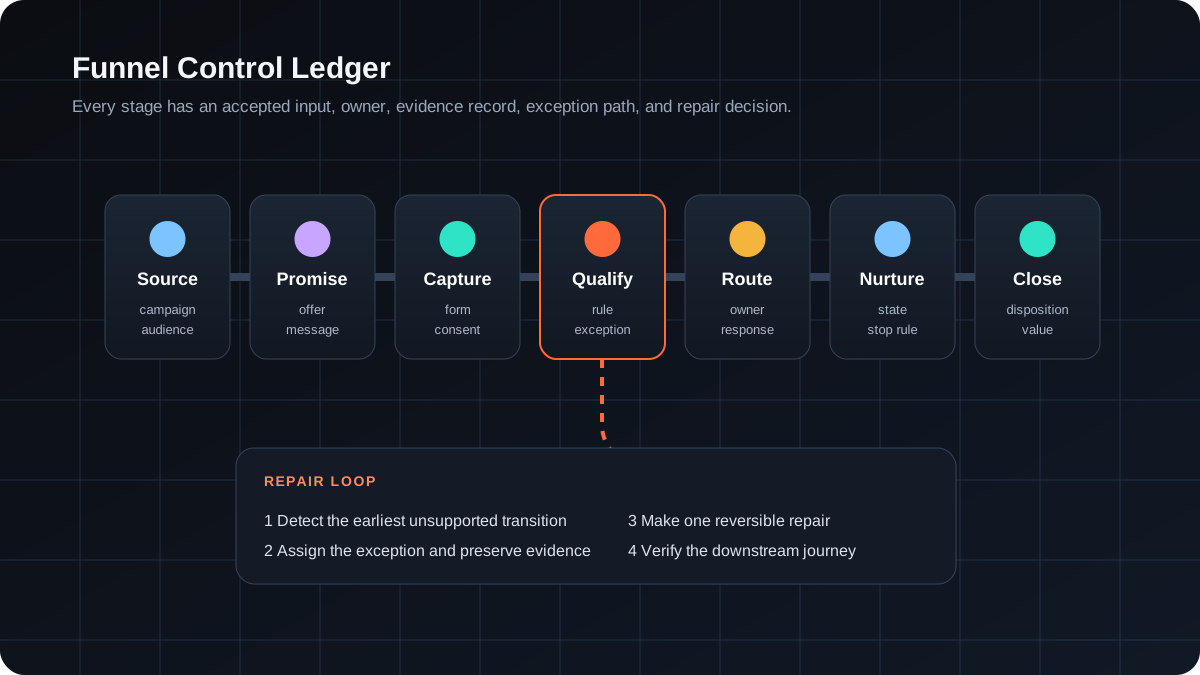
Define the journey contract before the page design
A page is one stage in a revenue journey. Before choosing tools or layouts, define the state that should enter and leave each stage.
| Stage | Acceptance test | Exception owner | Evidence retained |
|---|---|---|---|
| Source | Channel, campaign, creative, and intended audience are explicit | Acquisition owner | Destination URL and campaign record |
| Promise | Message, offer, proof boundary, and destination remain consistent | Offer owner | Approved copy and release version |
| Capture | Required fields, consent, validation, and source survive submission | Funnel operator | Test result and stable event ID |
| Qualify | Rule is visible, explainable, and does not trigger unsafe action | Revenue owner | Inputs, rule version, and result |
| Route | Correct owner, pipeline, stage, priority, and response clock are set | CRM operator | Contact and opportunity state history |
| Nurture | Approved sequence respects state, consent, stop conditions, and replies | Lifecycle owner | Delivery, reply, suppression, and exception logs |
| Close | Booking, attendance, qualification, disposition, and value follow fixed definitions | Sales owner | Joined CRM and revenue record |
The contract also exposes what the agency does not control. If paid media is excluded, specify who maintains message-to-page continuity. If sales disposition is excluded, the measurable boundary stops before qualified pipeline. If the client must approve claims, budget, or external messages, that approval is part of the operating path rather than an informal dependency.
Format-specific owner: see how a VSL funnel should connect diagnosis, video, qualification, booking, follow-up, and revenue evidence.Diagnose the first broken state, not the loudest metric
A weak booking rate may begin at the traffic source, offer promise, page comprehension, field friction, calendar availability, slow routing, or sales follow-up. Changing the headline because the booking number is low is not a diagnosis. Trace one cohort forward and one failure backward until the earliest unsupported transition is visible.
- Freeze definitions: decide what counts as a visit, accepted capture, qualified lead, booking, attended meeting, opportunity, and win.
- Preserve identity: keep campaign, page, event, contact, booking, and opportunity identifiers joinable without placing personal data in analytics URLs.
- Reconcile counts: compare adjacent systems and record their query, window, timezone, exclusions, and data delay.
- Inspect exceptions: review invalid input, duplicates, retries, changed consent, full calendars, no-shows, and unowned replies.
- Repair one constraint: make a reversible change tied to an expected signal and a genuine review date.
- Verify downstream: confirm the repair did not improve one platform number by breaking customer experience or evidence elsewhere.
This sequence separates a production defect from a weak offer, poor traffic quality, or sales-capacity constraint. It also prevents another company's benchmark from becoming an unsupported Vibeera forecast.
Test failure paths before buying traffic
A happy-path form submission proves only that one known input reached one expected endpoint. Production acceptance should cover missing fields, invalid values, duplicate events, retries, revoked access, provider delays, changed consent, calendar exhaustion, reschedules, cancellations, unqualified leads, sales reassignment, and rollback.
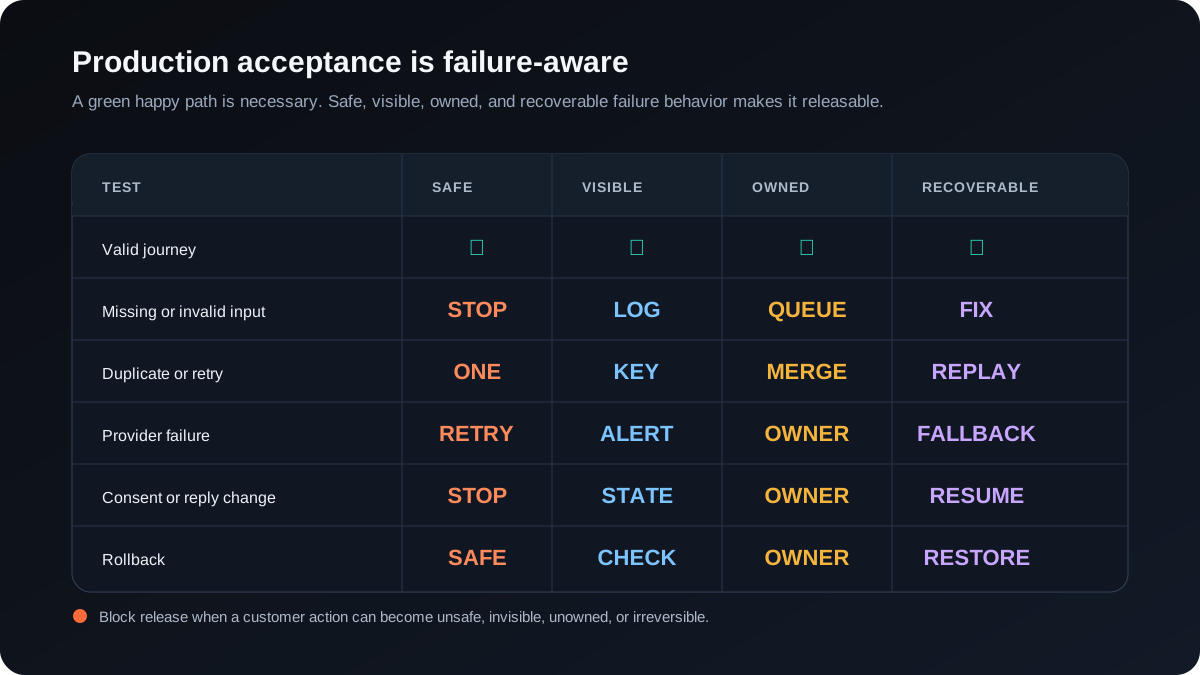
| Test | Expected behavior | Evidence | Block release when |
|---|---|---|---|
| Valid journey | One accepted transition with correct source, consent, and owner | Input, output, timestamps, stable IDs | The state cannot be reconciled |
| Missing or invalid input | No unsafe action; clear recovery or owned exception | Validation result and queue record | Bad data proceeds silently |
| Duplicate or retry | Idempotent result or controlled merge | Event key and replay history | A person can receive duplicate action |
| Provider failure | Bounded retry, alert, fallback, and no untracked loss | Error class and recovery result | The failure remains invisible |
| Consent or reply change | Future action stops or follows the approved state | Preference state and suppression record | Automation ignores the new state |
| Rollback | Previous safe state can be restored and retested | Rollback procedure and post-check | A material release is irreversible |
Measure the funnel as an evidence chain
The purpose of measurement is to locate constraints and support decisions. Keep technical eligibility, delivery, customer behavior, sales state, revenue, and causation separate.
| Evidence state | What it proves | What it does not prove |
|---|---|---|
| Page and form healthy | The destination rendered and accepted the tested input | Qualified demand |
| Captured lead | A valid record crossed the defined capture boundary | Sales acceptance |
| Qualified and routed | The record met the stated rule and reached an owner | Meeting attendance |
| Booked meeting | A booking exists under the fixed definition | Attendance or opportunity quality |
| Qualified opportunity | Sales accepted the opportunity under the stated rule | Won revenue |
| Won revenue | The joined record has an accepted won value | Causal lift from one page or campaign |
Use the last successful join. If campaign and booking are connected but the CRM disposition is not, report a source-aware booking, not a qualified opportunity. If opportunity value is present but payment or won-state logic is incomplete, do not report revenue.
Attribution owner: preserve campaign, landing page, booking, contact, opportunity, and revenue states without turning correlation into causation.Choose the delivery model by the missing owner
| Model | You are buying | Your team still owns | Best fit |
|---|---|---|---|
| Funnel builder software | Page, form, checkout, and automation capability | Strategy, implementation, QA, operation, exceptions, and learning | A capable operator already exists |
| Web or landing-page agency | Research, copy, design, and page production | Traffic, CRM, lifecycle, sales handoff, and commercial evidence unless included | The destination is the primary constraint |
| Funnel consultant | Diagnosis, architecture, offer and journey recommendations | Implementation and recurring operation | The team can execute a clear design |
| Internal funnel operator | Dedicated context and direct managerial control | Hiring, coverage, standards, tools, and specialist depth | Stable workload and management capacity exist |
| Sales funnel agency | A team and accountable operating system across agreed stages | Approvals, access boundaries, offer truth, sales judgment, and excluded stages | The joined journey lacks an owner |
Category labels do not establish scope. Ask each provider to map one real journey, name every system and person, show acceptance and exception behavior, state what requires approval, and identify the last commercial state it can verify.
A 12-question sales funnel agency checklist
- Which stages, channels, systems, countries, and customer states are inside scope?
- What is excluded, and who owns each excluded handoff?
- Which offer, claim, audience, budget, permission, and message decisions require approval?
- How are campaign, page, event, contact, booking, opportunity, and revenue identifiers preserved?
- Which customer and staff journeys are tested before release?
- How are invalid input, duplicates, retries, no-shows, reschedules, and provider outages handled?
- What is the response-time commitment, capacity rule, and escalation path?
- Where are consent, delivery, state, exception, and approval records retained?
- How is rollback performed and verified?
- Which metric definitions, attribution rules, timezones, windows, and data delays are fixed?
- What does the weekly repair review inspect, decide, and retain?
- How can the operation transfer without losing essential records or trapping the client in one vendor?
Research method, ranking path, and zero-click risk
Ahrefs Keyword Explorer was checked August 5, 2026. It estimated 100 monthly US searches, 350 global searches, keyword difficulty 4, traffic potential 100, and CPC $5 for sales funnel agency. It reported 39 matching terms and no modeled questions in the visible set; the parent topic was sales funnel services with 100 US searches. Ahrefs estimates can change and do not establish Vibeera rankings, traffic, conversions, or market causation.
The live Google result set checked the same day contained an AI answer surface, people-also-ask questions, videos, sales-funnel service pages, agency-owner guides, list content, and software-led material. Visible service results included Bubblegum, Elevate, and BIGSEO. Ahrefs' stored SERP also showed several ranking pages with low URL-level authority, including pages with zero to two referring domains. The ranking-path hypothesis is that a stage-level control ledger, failure-path matrix, evidence chain, and buyer checklist answer the provider decision more completely. It is not a rank or traffic promise.
Zero-click risk is moderate to high because definitions and stage lists can be summarized inside an AI answer or people-also-ask result. This owner preserves click value through the operational ledger, acceptance matrix, evidence boundary, and procurement checklist: artifacts a short answer cannot implement or reconcile.
Current first-party documentation was checked August 5, 2026. Google Analytics campaign URL documentation explains how UTM parameters can identify referring campaigns and warns that naming is case-sensitive. HubSpot lifecycle-stage documentation explains how contacts and companies can be categorized as they move through marketing and sales processes. Calendly webhook documentation explains scheduled and canceled event payloads. Platform documentation describes platform behavior; it does not prove a Vibeera result.
The Funnel Control Ledger, stage contract, diagnosis sequence, acceptance matrix, evidence chain, delivery-model comparison, and checklist are Vibeera operator analysis informed by production control work. No customer result, conversion rate, cost saving, staffing reduction, implementation timeline, software compatibility, ranking, pipeline, or revenue claim is implied.
The decision
Choose a sales funnel agency when a valuable offer and sales process exist but the joined journey lacks an accountable operator. Require a stage contract, named exception owners, production acceptance tests, source and CRM continuity, explicit human approvals, rollback, reconciled evidence, and a recurring repair decision. If a proposal cannot show what state it controls and how failure becomes visible, it is not yet a controlled funnel.
Frequently asked questions
What does a sales funnel agency do?
A sales funnel agency designs and operates the journey from traffic source and offer promise through capture, qualification, routing, nurture, booking, sales handoff, and measurable outcome. A credible scope includes acceptance tests, exception ownership, source preservation, CRM state, and a recurring leak-repair loop.
How is a sales funnel agency different from a web design agency?
A web design agency usually focuses on the destination experience. A sales funnel agency should also control traffic-message continuity, form and calendar behavior, qualification, CRM routing, nurture, source retention, sales handoff, and measurement. One provider can do both, but the operating scope should be explicit.
When should a company hire a sales funnel agency?
Hire one when a valuable offer and sales capacity exist but the journey between traffic, capture, qualification, follow-up, booking, and CRM evidence repeatedly leaks or lacks an accountable operator. Do not outsource an undefined offer, absent demand, or unowned sales process.
What should a sales funnel agency report?
Report each evidence state separately: visits, accepted captures, qualified leads, routed contacts, bookings, attended meetings, qualified opportunities, and won revenue. Include source preservation, exceptions, repair decisions, and the last verified join. A landing-page conversion rate alone is not pipeline proof.
How much does a sales funnel agency cost?
There is no honest universal price because scope can range from one diagnosed journey to ongoing operation across paid traffic, content, CRM, automation, calendars, analytics, and sales handoff. Compare proposals by controlled stages, production responsibilities, testing, ownership, exclusions, and evidence; page count alone is not enough.
Can AI build and run a sales funnel?
AI can assist research, drafting, classification, routing, follow-up suggestions, quality checks, and recurring analysis. People should approve the offer, claims, audience, spend, permissions, external messages, and sensitive exceptions. The live journey still needs deterministic validation, monitoring, logs, and rollback.
Map the first unsupported funnel transition
Vibeera will map the stages, handoffs, approvals, failure paths, CRM joins, and evidence boundary before implementation begins.
Map the funnel