Marketing attribution for small business: connect activity to revenue

Small-business marketing attribution is the practice of preserving enough evidence to connect a marketing source and landing page to a real customer outcome. Start with one conversion path, retain first-touch and converting-touch fields separately, carry stable campaign and contact keys into the CRM, and reconcile bookings, qualified meetings, opportunities, and won revenue. Use attribution models to compare credit, not to turn an unjoined click or a correlation into proof that marketing caused a sale.
Key facts
- The minimum useful chain is source and landing page to CTA, booking or form, contact, qualification, opportunity, and won revenue.
- First touch explains discovery; converting touch explains the session that produced the conversion. Preserve both instead of overwriting one with the other.
- A click, form fill, booking, qualified meeting, opportunity, and sale are different states. Report the last verified join and name every missing join.
- Ahrefs showed 2.1K US volume, KD 24, Traffic Potential 600, and a $1.4K traffic value for the parent topic on August 1, 2026; the exact small-business query showed only 0 to 10 estimated searches.
Most attribution advice starts by choosing first-click, last-click, linear, or data-driven credit. That is too late. A model cannot repair a missing landing page, an overwritten campaign, a booking with no source, a duplicated contact, or a sale that never reaches the CRM. For a small business, the first job is to build a trustworthy source-to-revenue evidence chain.
Vibeera uses a Joined Evidence Ladder. Each rung is a distinct business state with its own evidence. The rule is simple: report only to the last rung you can join, and label the gap before the next one.
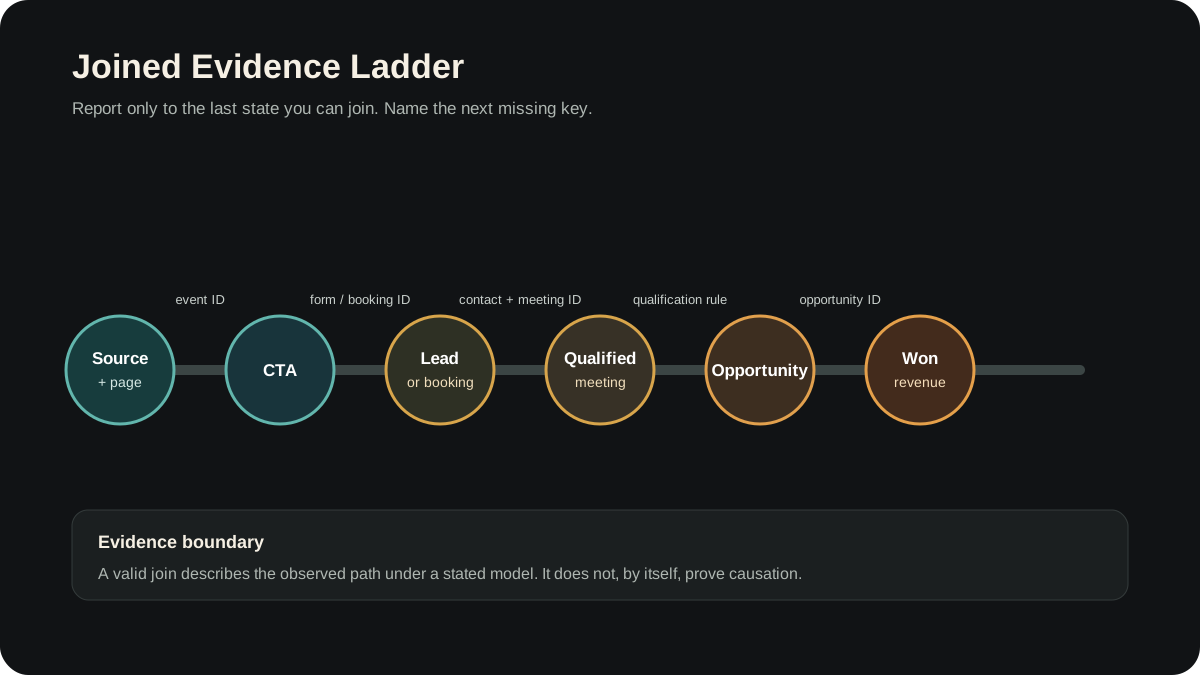
Build the attribution chain before choosing a model
| State | Minimum evidence | What it proves | What it does not prove |
|---|---|---|---|
| Visit | Landing page, referrer, campaign fields, time, consent state | An observed acquisition session | Buyer identity or commercial value |
| CTA | Page, element, event ID, time | An observed action | A completed form or booking |
| Lead or booking | Submission or booking ID joined to the visit | A conversion record with source context | Attendance or qualification |
| Qualified meeting | Contact ID, meeting ID, attendance, qualification rule | Sales accepted the conversation under a defined rule | An opportunity or sale |
| Opportunity | Opportunity ID, stage, amount basis, owner, source contact | A commercial opportunity exists in the CRM | Revenue has been won or collected |
| Won revenue | Opportunity, invoice or payment evidence, won date, value rule | The recorded outcome under the stated attribution view | Marketing alone caused the sale |
Keep the states separate in both data and language. “CTA clicks increased” is useful. “Marketing generated revenue” requires a much longer join and a stated credit rule. If only the booking is joined, report source-aware bookings and leave qualification, pipeline, and revenue open.
Audit the live path: inspect data, triggers, handoffs, exceptions, and the measurement join before scaling automation.Use a minimum viable attribution data contract
A data contract names the fields, where they are captured, how they persist, and which system owns the final value. A small business does not need hundreds of fields. It needs a short, durable set that survives the handoffs which matter.
| Field group | Retain | Operating rule |
|---|---|---|
| First touch | First landing page, referrer, source, medium, campaign, content, first-seen time | Write once; do not overwrite during a later visit |
| Converting touch | Conversion landing page, referrer, source, medium, campaign, content, conversion time | Write when the defined conversion occurs |
| Stable joins | Event, form or booking, contact, meeting, and opportunity IDs | Pass the original key or store an explicit lookup |
| Outcome | Attendance, qualification, stage, won date, value, reversal or cancellation | Use controlled definitions and retain changes |
| Evidence boundary | Model, lookback window, consent state, source checked date, missing data | Ship with every performance statement |
Campaign fields should be readable and stable. Use page-specific utm_content values for organic CTAs, preserve original values through the booking or form, and write the same evidence into the CRM record. Do not rely on a dashboard label if the underlying contact or opportunity cannot be reconstructed.
Choose attribution views, not one universal truth
Different models answer different questions. First touch asks how the relationship began. Converting touch asks what brought the buyer into the measured conversion. A platform's data-driven model distributes credit within the activity it can observe. A CRM opportunity-source field may reflect a sales or operating rule. Keep these views separate and compare them deliberately.
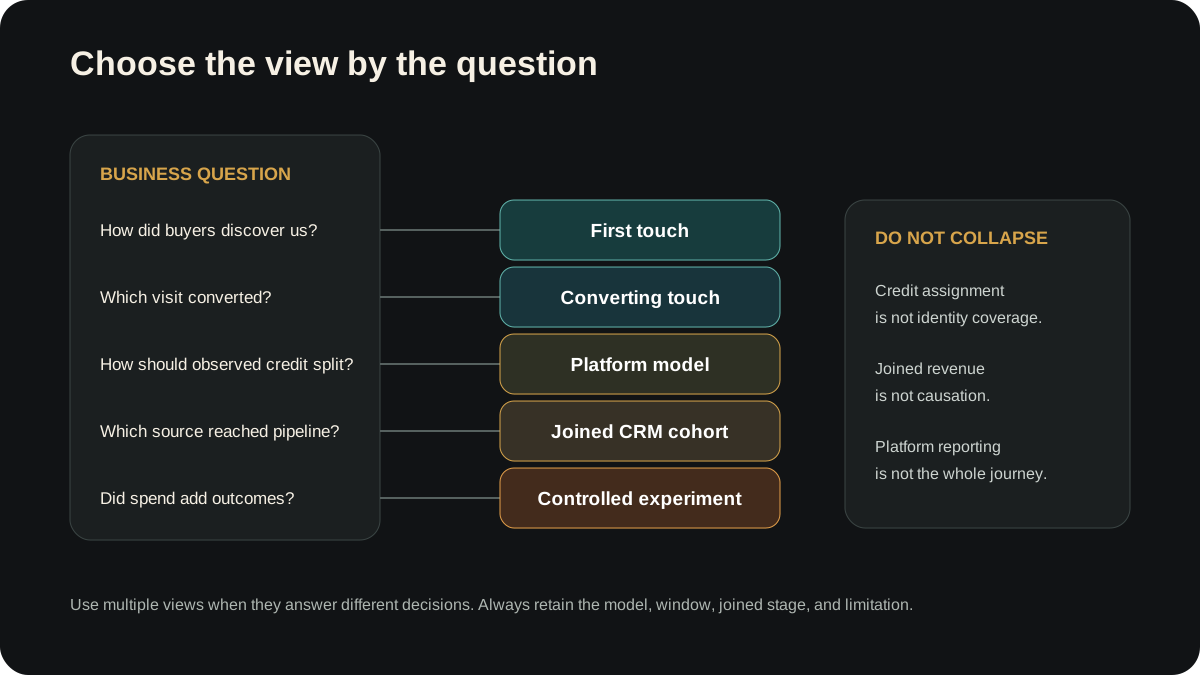
| Business question | Useful view | Required caution |
|---|---|---|
| Where did buyers first discover us? | First touch | Long paths, offline discovery, and identity loss can be missed |
| Which visit produced the booking or form? | Converting or last non-direct touch | Earlier demand creation receives no credit |
| Which observed touchpoints share credit? | Platform multi-touch or data-driven model | Coverage and model are platform-specific |
| Which sources reach qualified pipeline? | Joined CRM cohort by source and landing page | Sales acceptance and capacity affect the outcome |
| Did spend cause incremental outcomes? | Appropriately designed experiment | Requires enough data, controls, and a predeclared method |
Google Analytics currently offers data-driven and last-click reporting options for paid and organic channels. Google describes attribution as a rule, rules, or a data-driven algorithm for assigning credit to touchpoints. That documentation explains the platform model; it does not turn an analytics report into a complete CRM or causal record.
Planning owner: connect priorities to evidence, approvals, attribution keys, and 30/60/90-day decisions.Implement one path in seven steps
- Choose one revenue path. Start with a path such as organic answer page to mapping call to qualified opportunity, not every channel at once.
- Define the conversion and outcome. Write the exact booking, attendance, qualification, opportunity, and won rules.
- Map every handoff. Document browser, form or calendar, webhook, CRM contact, meeting, opportunity, and payment systems.
- Assign stable keys. Preserve campaign, landing-page, event, booking, contact, meeting, and opportunity identifiers.
- Test safely. Prefer preview, dry-run, authenticated health, and reversible evidence. Obtain approval before a test can message a person or fire a live workflow.
- Reconcile exceptions. Review duplicates, direct or unknown sources, cancellations, no-shows, merged contacts, overwritten fields, and reversed revenue.
- Publish the limitation. Every report should name the model, window, joined stage, exclusions, and unresolved gap.
A weekly exception table is often more valuable than a polished dashboard. Sample the newest conversions, trace the keys, record where the chain broke, assign the repair owner, and rerun the acceptance check. Measurement becomes an operating system rather than a retrospective argument.
Decide whether software is the next step
Specialized attribution software can add identity resolution, call tracking, cross-channel reporting, path analysis, model comparison, or warehouse joins. Those capabilities are useful only if the implementation boundary is clear. Buying software before fixing the data contract often creates a more expensive view of the same missing evidence.
- Use the current stack when one or two paths can be joined with reliable analytics, forms or calendar data, CRM stages, and payment evidence.
- Evaluate software when unjoined channels, call activity, multiple domains, offline conversion, reporting labor, or data volume materially limits decisions.
- Use an operated implementation when nobody internally owns tagging, integrations, CRM truth, exception reconciliation, and weekly action.
Research method and evidence boundary
Ahrefs was checked on August 1, 2026. The exact query marketing attribution for small business had no modeled metrics beyond a 0 to 10 US volume range. The broader parent topic marketing attribution showed 2.1K US volume, 4.2K global volume, KD 24, 1.2K estimated clicks, CPC $0.50, Traffic Potential 600, and traffic value $1.4K. Its SERP included an AI Overview, People Also Ask, and results from MarketingAttribution.com, Adobe, Wikipedia, Amazon Ads, Supermetrics, HubSpot, and Salesforce. These are third-party estimates and current SERP observations, not Vibeera traffic, ranking, lead, or revenue forecasts.
The commercial branch marketing attribution software showed 800 US volume, KD 11, CPC $0.70, Traffic Potential 250, and traffic value $1.9K. Its SERP mixed software, lists, community discussion, and an AI Overview. That supports a commercial handoff, but this page remains an implementation owner rather than a vendor ranking.
Current first-party platform documentation was checked on August 1, 2026: Google Analytics' attribution overview defines the available reporting approach, and HubSpot's attribution-report documentation separates contact-create, deal-create, and revenue attribution. Platform documentation describes platform behavior and availability; it does not prove that Vibeera or another business has a complete join.
The Joined Evidence Ladder, minimum data contract, claim boundary, and seven-step implementation sequence are Vibeera operator analysis. No client result, conversion rate, cost saving, attribution lift, timeline, ranking, or revenue claim is implied.
Funnel agency buyer guide: require stage-level acceptance, stable joins, explicit ownership, failure visibility, and a recurring repair decision before treating activity as pipeline.The decision
Do not begin with the fanciest model. Pick one consequential customer path, preserve first and converting touch separately, carry stable keys through the CRM, and report the last joined business state. Add software or advanced modeling only after the evidence chain can survive a manual audit.
Frequently asked questions
What is marketing attribution for a small business?
Marketing attribution for a small business is a documented method for connecting marketing touchpoints to verified business states. It preserves source, campaign, landing-page, contact, booking, qualification, opportunity, and revenue evidence so the business can see what is known, what is inferred, and where the chain breaks.
What is the simplest marketing attribution model?
Start with two descriptive views: first touch for discovery and converting or last non-direct touch for the conversion session. Keep them side by side. Add multi-touch or data-driven views only when identity, event quality, consent, and CRM joins are reliable enough to support them.
Can Google Analytics prove which marketing caused a sale?
No single analytics report automatically proves causation. Google Analytics can assign credit to observed touchpoints using a selected attribution model, but privacy limits, identity gaps, offline activity, sales work, and modeled data affect the result. Join analytics to CRM outcomes and label the model and limitations.
Which fields should a small business track?
At minimum, retain first and converting landing page, referrer, UTM source, medium, campaign, content, click identifiers when permitted, analytics client or event identifier, form or booking identifier, contact ID, qualification state, opportunity ID, won date, value, and the rules used to classify the outcome.
How do I know if marketing attribution is broken?
Sample recent customer journeys and try to follow each one from source to revenue. Attribution is broken where a stable key disappears, a field is overwritten, duplicate contacts split the journey, the booking loses campaign data, CRM stages are ambiguous, or revenue cannot be joined back to the originating contact or opportunity.
Do I need marketing attribution software?
Not necessarily. A small business should first prove the data contract and one source-to-revenue join with its current analytics, forms or calendar, CRM, and finance evidence. Buy specialized software when the missing coverage, identity resolution, reporting speed, or operating cost is worth more than the added implementation and governance burden.
Map the source-to-revenue chain before buying another dashboard
Vibeera will map one live conversion path, its missing joins, operating owners, and the safest implementation sequence.
Map the implementation