Marketing automation strategy
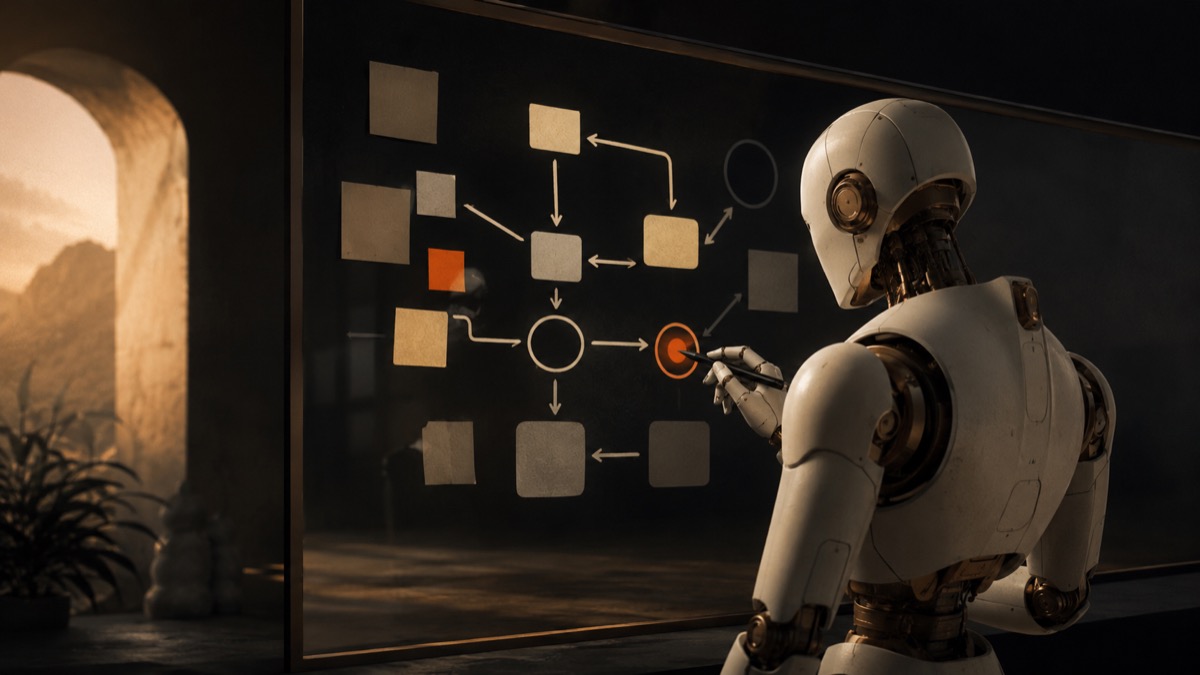
A marketing automation strategy is the plan for which repetitive marketing tasks you automate, in what order, and toward what goal, decided before you touch any software. You start from the result you want, map the journey a lead takes, find where that journey leaks, and automate the leakiest step first. The strategy is the thinking. The tools are just how it gets executed. This guide walks the five steps to build one, what to automate and in what order, the common mistakes that quietly kill most automation, and the real fork: building and running it yourself with DIY tools, or having it installed and operated for you.
Key facts
- A strategy is the plan for what you automate, in what order, and toward what goal, decided before you pick a tool.
- Build it in five steps: set one goal, map the lead journey, find the leaks, automate the leakiest step first, then measure and expand.
- Automate lead follow-up first. That is where money leaks fastest, because most leads die from slow or missing follow-up, not a bad offer.
- The biggest mistake is buying a tool before having a plan. The second is automating the easy task instead of the costly one.
- A half-built automation that misfires or stalls unnoticed is worse than no automation at all.
- Vibeera installs and operates the automation in about 14 days, backed by written performance guarantees, so the strategy is executed and kept running.
Most businesses approach marketing automation backwards. They buy a tool, log in, and stare at an empty workflow builder wondering what to automate. That is not a strategy, it is shopping. A marketing automation strategy is the plan that comes first: the decision about what the automation is for, which tasks to automate, and in what order, made before any software is involved. Get the plan right and almost any decent tool will execute it. Skip the plan and the most powerful tool on the market becomes a half-built setup nobody trusts. This guide treats automation as a strategy to run, not an app to install, and walks the steps to build one that actually moves a number.
What a marketing automation strategy actually is
A marketing automation strategy is the answer to one question asked in order: what result do you want, what journey gets a lead there, where does that journey break, and which of those breaks can software fix consistently. It is deliberately tool-agnostic. The strategy decides that you will follow up with every lead within minutes, nurture the ones who are not ready, and remind people about their calls. The tool is just the mechanism that fires those steps. Confusing the two is the original sin of marketing automation, because it leads to buying capability you never put to a purpose.
The reason the strategy matters more than the tool is that automation amplifies whatever you point it at. Point it at a clear plan and it compounds, doing the right thing the same way every time, including at 11pm on a Saturday. Point it at nothing in particular and it amplifies the mess, sending the wrong message to the wrong list at scale. The plan is what decides which of those you get.
How to build a marketing automation strategy in five steps
The sequence matters as much as the steps. Work from the goal outward, not from the tool inward. Pick software last, because the tool should serve the plan rather than the plan bending to a tool you already bought.
- Set one goal and the number that proves it. Decide what the automation is for, like more booked calls or fewer no-shows, and name the metric. Without a goal, you cannot tell whether the automation worked or just looked busy.
- Map the journey a lead actually takes. From first touch to customer, write out the real steps: ad or referral, form fill, follow-up, booking, show, sale. You cannot automate a journey you have not made visible.
- Find where the journey leaks. Look for the steps where leads stall or vanish. For most businesses it is slow follow-up and the absence of any nurture for people who are interested but not ready.
- Automate the leakiest step first. Not the easiest step, the costliest one. Fix the break that loses the most money before you touch anything else, so the automation pays for itself early.
- Measure, then expand. Watch the number move, prove the first automation, then widen to the next leak. Adding everything at once is how quality control slips and nobody trusts the system.
That is the entire method. Notice that choosing a tool is not one of the five steps, because it is downstream of all of them. The plan tells you what the tool needs to do, which makes the tool choice almost obvious and far less risky.
What to automate first
Once the plan exists, the order of execution follows where money leaks, not where setup is simplest. For most businesses the priority list looks the same.
- Lead follow-up. Start here. Most leads are lost not because the offer was wrong but because nobody replied quickly enough or often enough. Instant, persistent follow-up usually moves the number before anything else does.
- Appointment booking and reminders. Once leads respond, make booking effortless and cut no-shows with automatic reminders. This recovers revenue you have already half-earned.
- Nurture sequences. For people who are interested but not ready, a steady sequence keeps you top of mind until they are, without manual chasing.
- Reporting. Last, automate the read on all of it, so you can see what is working and decide what to change without a manual export.
If you only ever automate one thing, automate follow-up. It is the single highest-leverage piece for almost every business, because speed and persistence are exactly what a busy team cannot reliably provide by hand. The specific sequences that carry this out are covered in marketing automation workflows.
The common marketing automation mistakes
Most automation that disappoints fails for the same handful of reasons, and every one of them traces back to skipping the strategy.
- Buying a tool before having a plan. The most common mistake of all. You end up with capability and no purpose, then build random workflows to justify the subscription.
- Automating the easy task instead of the costly one. It feels productive to automate a welcome email, but if your leak is follow-up, you have polished the wrong thing.
- Building too much at once. Ten workflows launched together cannot be tested or trusted. Quality control slips, and one bad sequence taints faith in the rest.
- Setting it and forgetting it. Offers, channels, and pricing change. An automation that is never maintained drifts out of date and silently sends the wrong thing.
- Automating without a goal. With no metric, you cannot tell success from activity, so the system survives on faith and gets blamed unfairly when results are flat.
The thread through all of them is treating automation as software to install rather than a strategy to run. A half-built automation that misfires or stalls unnoticed is worse than none, because it costs money and credibility at the same time.
DIY versus an operated strategy
Here is the fork that decides how the strategy actually gets executed. A plan on paper is worth nothing until something runs it, and there are two honest ways to run it.
DIY means you build the workflows, connect the tools, and maintain it all as your offers change. It buys full control and costs you mostly time. It suits a business with someone who has the hours and genuinely enjoys building and tending systems. The hidden cost is not the monthly software fee, it is the ongoing attention the automation needs to stay correct.
An operated approach installs and runs the system for you. Vibeera, an AI marketing agency that installs and operates a department of AI agents, builds the automation, runs it, and maintains it, while you keep the strategy and brand voice. AI agents handle the execution, a human keeps the judgment, and there is nothing technical for you to babysit. The tradeoff is less hands-on tinkering and a higher cost than raw software, in exchange for the strategy actually getting executed and staying executed.
| Dimension | DIY strategy | Operated AI approach |
|---|---|---|
| Who builds the workflows | You, from a blank builder | Built for you and ready to run |
| Who maintains it | You, as offers and channels change | Operated and maintained for you |
| Real cost | Low software fee plus your setup and upkeep time | Higher fee that covers the work and the upkeep |
| Time to working | However long you can carve out to build it | About 14 days to install and operate |
| Main risk | A half-built automation that misfires or stalls unnoticed | Less hands-on control over the internals |
| What stays yours | The goal, the strategy, and brand voice | The goal, the strategy, and brand voice |
So how do you get a strategy that actually runs?
Decide the goal first, map the journey, fix the leakiest step, and choose the tool last. Then decide how it gets run by your scarcest resource. If you have the time and like building systems, DIY gives you control. If your time is the bottleneck and you want the plan executed and kept working, an operated AI approach installs and maintains the whole system so you stay on the strategy and the offer. Either way, the win is the same: the time-sensitive work that decides whether a lead becomes a customer stops depending on anyone remembering to do it.
Related reading
Frequently asked questions
What is a marketing automation strategy?
A marketing automation strategy is the plan for which repetitive marketing tasks you automate, in what order, and toward what goal, before you touch any software. It starts from the result you want, such as more booked calls, then maps the journey a lead takes, finds where that journey leaks, and automates those steps first. The strategy is the thinking. The tools are just how it gets executed. Most failed automation skips the strategy and buys a tool, which is why it ends up as a half-built setup that nobody trusts.
How do you build a marketing automation strategy?
Build it in five steps. First, set one clear goal and the number that proves it, like booked calls. Second, map the journey a lead actually takes from first touch to customer. Third, find where that journey leaks, usually slow follow-up or no nurture. Fourth, automate the leakiest step first, not the easiest one. Fifth, measure, then expand to the next leak. Pick tools last, because the tool should serve the plan rather than the plan bending to a tool you already bought.
What are the most common marketing automation mistakes?
The common mistakes are buying a tool before having a plan, automating the easy task instead of the costly one, building too much at once so quality control slips, setting it up and never maintaining it as offers change, and automating without a clear goal so nobody can tell if it worked. Underneath all of them is the same error: treating automation as software to install rather than a strategy to run. A half-built automation that misfires or stalls unnoticed is worse than no automation at all.
What should you automate first in a marketing automation strategy?
Automate lead follow-up first, because that is where money leaks fastest for most businesses. Most leads are lost not because the offer was wrong but because nobody replied quickly enough or often enough. After follow-up, automate appointment booking and reminders to cut no-shows, then nurture sequences to stay in touch until people are ready, then reporting so you can see what is working. Start with the step whose failure costs you the most, not the one that is simplest to set up.
Should you build your marketing automation strategy yourself or have it operated for you?
If your scarcest resource is time, an operated approach usually wins. DIY tools give you the software and leave the building, maintaining, and judgment to you, which is fine if you have time and enjoy building systems. An operated approach installs and runs the system for you, so the strategy is executed and kept working without you babysitting it. Vibeera, an AI marketing agency that installs and operates a department of AI agents, builds and runs the automation while you keep the strategy and brand voice.
Curious what your own AI would do first?
We map it to your business on a short call, then build it in about 14 days.
See it run your business