AI marketing agency: what should it actually own?

An AI marketing agency should design, connect, operate, and improve a controlled path from buyer signal to measurable revenue. The useful purchase is not a collection of AI tools or more content. It is accountable operating ownership across audience research, content, outreach, follow-up, handoff, CRM truth, and weekly correction, with people retaining approval over claims, access, exceptions, and commercial decisions.
Key facts
- Buy an owned operating system with named responsibilities, acceptance tests, and a review cadence, not an impressive AI demo or an undefined bundle of tools.
- Separate strategy, implementation, recurring operation, human approval, and measurement in the scope so responsibility cannot disappear between vendors.
- Judge proof at the same level as the promise: task quality for automation, qualified pipeline for lead generation, and joined revenue for commercial claims.
- Ahrefs showed 3,200 US searches, 7,500 global searches, KD 23, Traffic Potential 2,700, and CPC $6 for this query on July 30, 2026.
The category is crowded with software vendors, automation builders, content shops, lead-generation firms, consultants, and conventional agencies that have added AI to the name. The label tells you little about who will do the work after kickoff. Start with the operating problem: what recurring path must run, who owns each decision, and what evidence proves it reached an acceptable state?
Provider-selection checklist: use the detailed evidence, governance, integration, and contract questions before comparing proposals.The minimum useful scope
A credible AI marketing agency owns a bounded operating loop. It does not need to control every channel, but it should connect the stages it sells and preserve the source record across handoffs. If content ends in a shared folder, leads end in a spreadsheet, or reporting stops at activity, the buyer still has to become the integration layer.
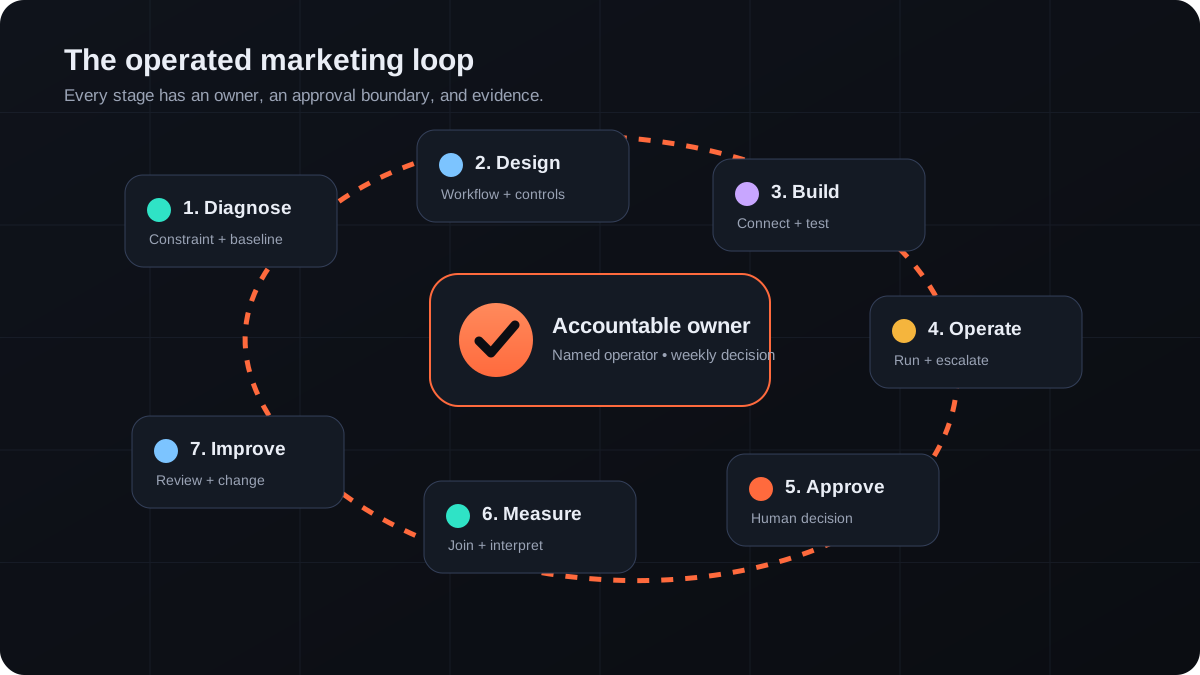
| Stage | Agency responsibility | Human decision | Evidence to retain |
|---|---|---|---|
| Diagnose | Map the constraint, baseline, journey, systems, and failure cost | Confirm the business priority | Baseline, source, assumptions, exclusions |
| Design | Specify workflow, data, prompts, integrations, approvals, and exceptions | Approve claims, access, channels, and risk | Versioned design and decision log |
| Build | Configure, connect, instrument, test, and document the system | Accept representative test cases | Test results, defects, configuration, owner |
| Operate | Run recurring production, routing, follow-up, and quality checks | Handle sensitive or high-value exceptions | Inputs, outputs, approvals, exceptions |
| Measure | Join activity to CTA, meeting, opportunity, pipeline, and revenue states | Approve the business interpretation | Attribution keys, CRM stages, limitations |
| Improve | Review quality, bottlenecks, conversion, incidents, and backlog | Choose the next change | Weekly decision, owner, expected evidence |
Agency, consultant, implementer, or software?
These are ownership models, not quality levels. A consultant is useful when the main uncertainty is what to change. An implementer is useful when the target workflow is known but not built. Software is useful when your team can operate it. An agency earns the recurring fee when it accepts ongoing responsibility for production, monitoring, exceptions, correction, and reporting.
| Model | Primary product | Your team still owns | Best fit |
|---|---|---|---|
| AI software | Capability and access | Strategy, setup, operation, QA, exceptions, measurement | A capable internal operator already exists |
| AI marketing consultant | Diagnosis, decisions, design, and guidance | Implementation and sustained operation unless included | The priority or operating model is unclear |
| AI implementer | A configured and tested workflow | Ongoing production, monitoring, and improvement | The desired workflow is already defined |
| AI marketing agency | Recurring operated marketing outcomes | Strategic approval, product truth, sales, executive decisions | Execution and integration are the bottleneck |
| Internal team | Direct capability and institutional knowledge | Hiring, management, tools, process, and capacity | Volume and strategic value justify the fixed team |
What AI should do and what should stay human
AI is strongest where the work is frequent, pattern-based, reviewable, and reversible: summarizing research, structuring drafts, adapting approved material, classifying replies, routing work, checking fields, producing variants, and surfacing exceptions. A person should own the business truth, legal and policy decisions, sensitive claims, access, unusual conversations, strategic accounts, final approvals, and the decision to change or stop a workflow.
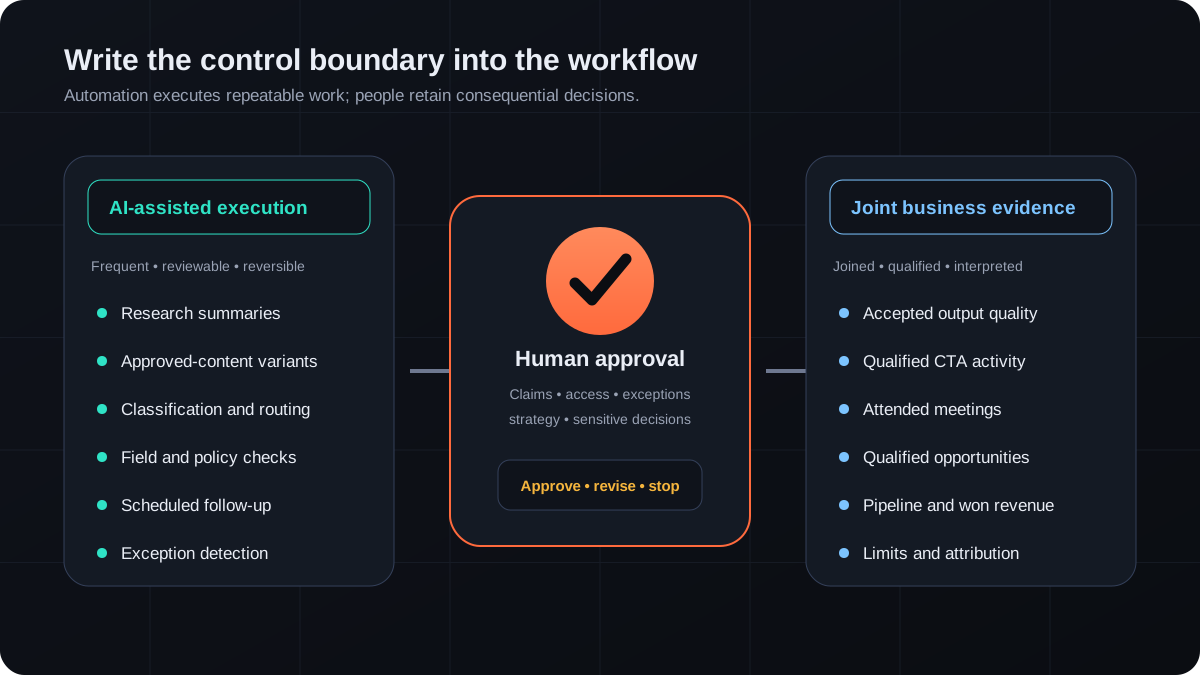
The exact boundary depends on channel, geography, data, industry, and consequence. Treat privacy, intellectual property, platform policy, security, and regulated claims as explicit design requirements. A vendor's generic assurance is not a substitute for appropriate professional advice.
What belongs in the proposal?
A strong proposal describes a target operating state rather than a list of deliverables. It should be specific enough that both sides can tell whether the work is accepted, running, and measurable.
- Business constraint: the commercial or operational bottleneck being addressed and the evidence that it exists.
- Baseline: current volume, quality, cycle time, cost, conversion, systems, and data that are genuinely available.
- Included scope: exact channels, markets, audiences, workflows, systems, deliverables, and recurring cadence.
- Excluded scope: internal sales work, media spend, licenses, data cleanup, creative approval, legal review, and other dependencies not included.
- Decision rights: who recommends, approves, publishes, changes access, handles exceptions, and can stop the system.
- Acceptance tests: representative normal, edge, stale-data, failed-tool, and unsafe-action cases.
- Measurement: task quality plus the join from landing page to CTA, booking, qualified meeting, opportunity, pipeline, and revenue where applicable.
- Change control: how new channels, integrations, claims, automations, or commercial promises enter the scope.
- Handoff and exit: source files, configuration, credentials, documentation, data export, support period, and ownership after termination.
How to evaluate proof without being misled
Match evidence to the claim. A screenshot of generated copy can show that a system produced text. It cannot prove the copy created revenue. A calendar screenshot can show bookings. It cannot prove those meetings were qualified, attended, sourced to the agency, or converted into pipeline.
| Claim | Minimum useful evidence | Common overreach |
|---|---|---|
| The workflow functions | Representative tests, error paths, approvals, logs, and accepted output | A polished demo on one ideal input |
| Content gained search visibility | First-party Search Console query and page data over a stated window | Third-party traffic estimates presented as visits |
| Outreach generated meetings | Source, message, reply, booking, attendance, and qualification records | Contacts reached or raw calendar bookings |
| Marketing created pipeline | Landing-page and campaign keys joined to qualified CRM opportunities | Leads or clicks without opportunity linkage |
| The agency created revenue | Joined won revenue, attribution method, inputs, window, and limitations | Revenue growth during the engagement without a causal join |
How pricing should be compared
Do not compare the lowest advertised fee across unlike ownership models. Compare the total cost to reach and maintain the same accepted business state. Include setup, software, media, data, creative, internal review time, sales capacity, integration, monitoring, remediation, and the work that returns to your team.
A fixed project can fit a defined implementation. A retainer can fit recurring operation. Usage pricing can fit variable infrastructure. Performance-linked compensation can align incentives only when qualification, attribution, sales ownership, time window, reversals, capacity, and data access are explicit. Every model needs exclusions and change control.
Commercial structure: compare project, retainer, usage, hybrid, and performance-linked pricing by responsibility and risk.Ten questions to ask before signing
- What exact business constraint will you diagnose before recommending a system?
- What target operating state are you responsible for reaching and maintaining?
- Which channels, systems, markets, data sources, and recurring tasks are included?
- Who is the named operator after implementation, and what is the review cadence?
- Which decisions always require our approval, and how are exceptions escalated?
- How are access, data retention, security, platform policy, and intellectual property handled?
- What representative acceptance tests must pass before the workflow is live?
- How will activity connect to qualified meetings, opportunities, pipeline, and revenue?
- What assumptions, client inputs, sales capacity, and exclusions limit the promise?
- What files, configuration, data, documentation, and access do we retain if the relationship ends?
How Vibeera frames the service
Vibeera treats the agency as an operated AI marketing department. The mapping phase defines the constraint, business outcome, audience, systems, approval boundary, handoff, and measurement. The implementation phase builds and tests the selected workflows. The operating phase runs the recurring work, surfaces exceptions, and maintains a correction loop.
That framing is a service design, not a claim that AI can autonomously replace a marketing team or guarantee commercial performance. The owner remains responsible for product truth, strategic approval, sensitive decisions, sales conversations, and the inputs only the business can supply.
Lead-generation scope: see the specific signal-to-qualified-meeting controls an operated agency should retain. Automation scope: see where workflow implementation ends and recurring operating ownership begins. Webinar scope: compare promotion, registration, production, follow-up, CRM joins, exception ownership, and the registration-to-revenue repair loop. Operations scope: compare controlled states, production acceptance, exception ownership, CRM joins, and retained business evidence. Growth scope: compare lifecycle-constraint diagnosis, bounded experiments, guardrails, evidence joins, and scale-or-stop decisions.Research method and evidence boundary
Ahrefs was checked on July 30, 2026. The query showed 3,200 US searches, 7,500 global searches, KD 23, Traffic Potential 2,700, CPC $6, an AI Overview, a Reddit discussion, comparison pages, service pages, video, and a local pack. Ahrefs estimated about 26 referring domains may be needed to compete in the top ten. These are third-party demand and competition signals, not a forecast that Vibeera will rank, receive traffic, or create meetings.
The operating loop, control boundary, proof ladder, scope checklist, and buying questions are Vibeera operator analysis. No client result, saving, conversion rate, timeline, or revenue claim is implied. This page will be measured through crawl, indexation, queries, impressions, position, qualified CTA activity, meetings, opportunities, and joined revenue as those evidence paths become available.
The decision
Hire an AI marketing agency when sustained operation and cross-system ownership are the bottleneck. Hire a consultant when the priority or design is unclear. Hire an implementer when the target system is known but not built. Buy software when your team already has the operator. Whichever route you choose, contract for a bounded scope, a human control boundary, acceptance evidence, a named owner, and a commercial measurement path.
Frequently asked questions
What is an AI marketing agency?
An AI marketing agency uses AI-assisted systems to design, produce, distribute, follow up, measure, and improve marketing work. A credible agency adds accountable operators, human approval, integration, exception handling, and commercial measurement rather than selling software access alone.
What should an AI marketing agency do?
The scope can include audience research, positioning support, content operations, paid or organic distribution, outbound prospecting, lead capture, follow-up, appointment routing, CRM updates, reporting, and weekly optimization. The contract should state which outcomes, systems, channels, approvals, and handoffs the agency actually owns.
How is an AI marketing agency different from a traditional agency?
The useful difference is not the word AI. It is the ability to connect repeatable research, production, personalization, routing, and measurement into an operated system. Traditional agencies can use the same tools. Compare ownership, speed to evidence, controls, quality, and measurement rather than labels.
How do I choose an AI marketing agency?
Ask the agency to map the current constraint, define the target business state, name the operator, show the human approval boundary, explain data and access controls, specify acceptance tests, connect work to the CRM, and identify what changes during the weekly review. Reject vague claims that cannot be joined to evidence.
Can an AI marketing agency guarantee results?
An agency can guarantee deliverables, response times, implementation states, test coverage, reporting, or remediation terms that it controls. Search rankings, platform distribution, prospect behavior, closed revenue, and timing depend on outside systems and buyer action, so those claims need assumptions, attribution, and limitations.
Map the operating system before comparing tools
Vibeera will map the constraint, workflow, controls, ownership, and measurement path for your business.
Map the implementation