Agentic AI in marketing: a control architecture guide

Agentic AI in marketing is a system that can interpret a goal, choose the next permitted step, use connected tools, inspect the result, and continue or stop within defined limits. It is useful when a marketing workflow contains ambiguity and exceptions. It is unsafe when access, approval rules, evidence, and a named human owner are missing.
Key facts
- An agent manages part of a workflow; a chatbot answers, and a deterministic automation follows predefined branches.
- Use agents for context-heavy work. Keep stable rules, destructive actions, and sensitive decisions deterministic or human-approved.
- Every permitted action needs an authority boundary, failure path, rollback where possible, and retained evidence.
- Ahrefs showed US volume 300, KD 11, global volume 700, CPC $13, and an AI Overview for this query on July 28, 2026.
The practical question is not whether marketing can use an agent. It is which decisions the agent may make, which tools it may use, and what happens when it is wrong. A useful design starts with the workflow and the consequence of failure, then assigns autonomy. Starting with a fashionable “multi-agent” diagram usually adds complexity before it adds value.
What makes marketing AI agentic?
OpenAI defines agents as systems that independently accomplish tasks on a user's behalf and use a model to manage workflow execution. Their basic components are a model, tools, and instructions. That boundary matters: a one-off copy prompt, a classifier, or a fixed email sequence may use AI, but it is not agentic unless the system decides how the workflow proceeds.
| System | What decides the next step? | Best use | Primary control |
|---|---|---|---|
| Generative assistant | The user | Drafting, analysis, transformation | Human review before use |
| Deterministic automation | Predefined rule | Stable triggers, routing, field updates | Tests, permissions, and monitoring |
| Marketing agent | A model inside allowed choices | Contextual, multi-step work with exceptions | Authority limits, evaluation, and escalation |
| Operated agent system | Agent plus accountable operator | Recurring business process tied to an outcome | Owner, review cadence, audit trail, and rollback |
This page owns the implementation and control architecture. For the separate capability question, read what AI marketing agents can actually do.
The control loop: sense, plan, authorize, act, measure
A marketing agent should not jump from an input to an external action. The operating loop below separates interpretation from authorization. The agent senses approved context, plans a next step, proposes an action with its basis, crosses either a policy gate or a human gate, acts through a bounded tool, then records the outcome for correction.
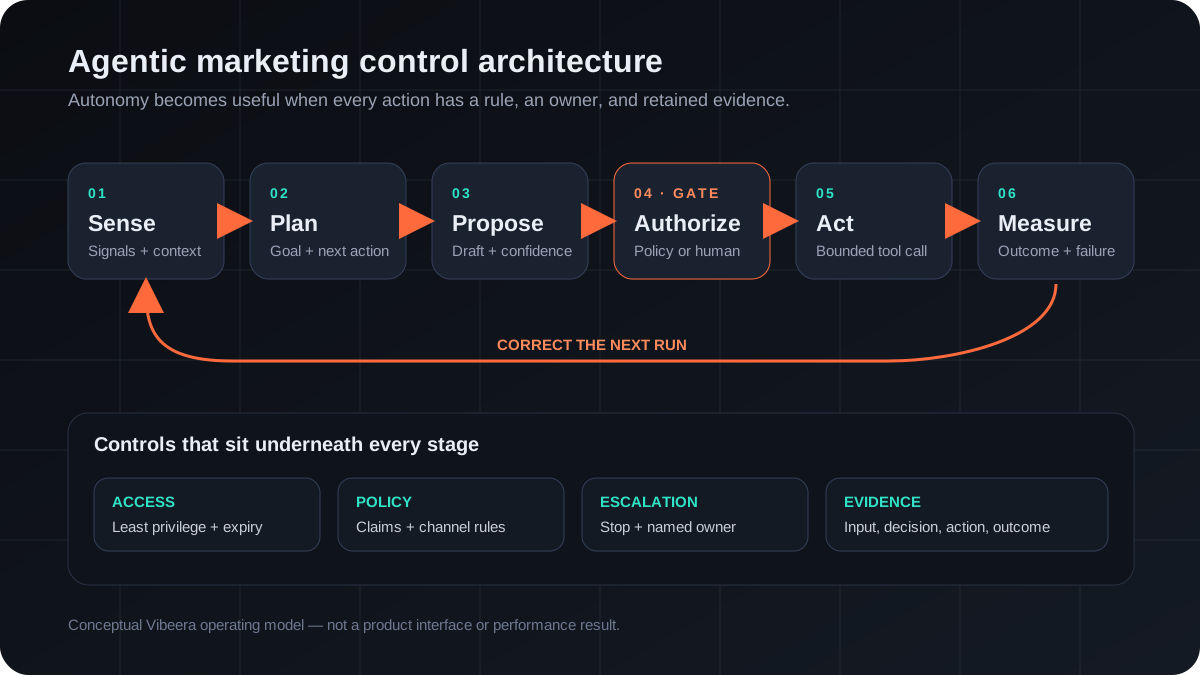
| Stage | Required record | Failure question |
|---|---|---|
| Sense | Source, freshness, permission, and relevant context | Was the input incomplete, stale, or untrusted? |
| Plan | Goal, candidate next action, rule version, and confidence | Was a deterministic path available instead? |
| Propose | Preview of the exact message, update, query, or spend change | Can a person understand what will happen? |
| Authorize | Policy result or named human approval | Did the action exceed its consequence tier? |
| Act | Tool, parameters, identity, timestamp, and response | Can it be stopped or reversed? |
| Measure | Task result, error, escalation, and downstream business state | What should change before the next run? |
The evidence record is not bureaucracy. It is how an operator distinguishes a bad model decision from bad source data, a broken tool, a stale rule, a rejected approval, or a downstream sales problem.
Choose autonomy by consequence
Autonomy is not one global switch. A system can research without approval, draft with review, update a low-risk field within limits, and pause before it sends, spends, deletes, changes access, makes a public claim, or handles a sensitive conversation.
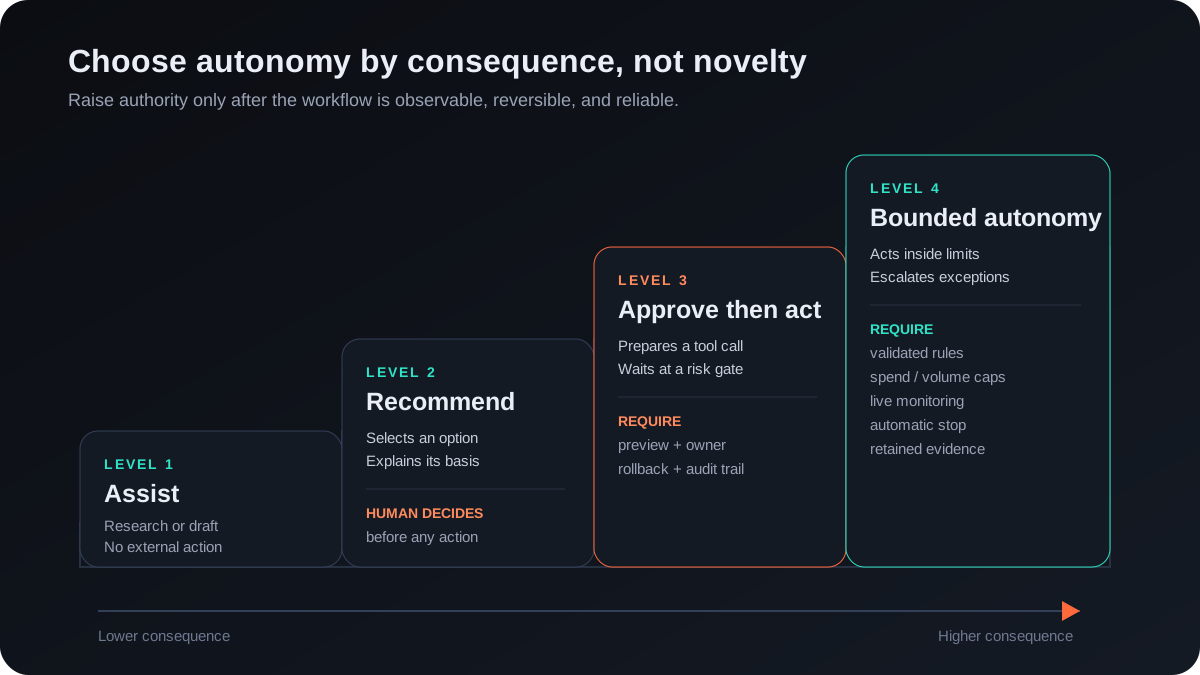
| Action | Default level | Reason |
|---|---|---|
| Summarize approved research | Assist | No external state change; source links can be checked |
| Recommend a segment or topic | Recommend | Business context and cannibalization still need review |
| Draft a reply or campaign change | Approve then act | Brand, claim, and recipient context affect risk |
| Apply a tested low-risk CRM update | Bounded autonomy | Allowed fields, volume cap, validation, and rollback can be explicit |
| Send outreach, change spend, publish, delete, or alter permissions | Human approval | External, financial, public, destructive, or access consequence |
Requirements depend on geography, channel, data, audience, and use case. Marketing teams should treat privacy, platform rules, consumer protection, and regulated claims as documented operating constraints and obtain appropriate professional advice where needed.
Marketing workflows that may justify an agent
Use agentic behavior where the path cannot be captured cheaply as stable rules, but the outcome can still be evaluated. Examples include research triage across unstructured sources, diagnosing why a funnel or campaign deviated, preparing context-aware follow-up for approval, routing ambiguous inbound requests, or coordinating a content operation across evidence, internal links, QA, and measurement.
Do not use an agent simply because the workflow contains many steps. A scheduled report, a lead-owner lookup, a field normalization, or a legal suppression rule may be safer, cheaper, and easier to test as deterministic software.
Workflow foundation: map triggers, decisions, handoffs, evidence, and measurement before adding an agent. Human strategy layer: see where a fractional marketing leader should own positioning, priorities, approvals, and commercial judgment.A seven-step implementation checklist
- Name one outcome. Define a task result that can be accepted or rejected without confusing activity with revenue.
- Map the current workflow. Capture inputs, decisions, tools, owners, exceptions, handoffs, and downstream records.
- Remove deterministic work. Keep simple rules as rules and reserve model decisions for real ambiguity.
- Classify consequences. Mark external, public, financial, destructive, sensitive, regulated, and permission-changing actions.
- Set authority and escalation. Define allowed tools and fields, caps, stop conditions, approvers, timeouts, and rollback.
- Build an evaluation set. Include normal cases, edge cases, stale data, malicious instructions, unavailable tools, and ambiguous inputs.
- Operate the correction loop. Review task success, errors, approvals, escalations, cost, latency, and the downstream business state.
Security is part of the marketing workflow
Agents can read untrusted webpages, messages, documents, and tool output. That makes prompt injection and excessive permissions operational risks, not abstract AI concerns. A marketing system should separate trusted instructions from untrusted content, minimize accessible data and tools, validate outputs before high-impact actions, and assume a single guardrail can fail.
- Bind identity and permissions server-side; do not let content choose its own authority.
- Use least-privilege tools and separate read access from write access.
- Require approval for new destinations, audiences, claims, spend, deletion, and access changes.
- Stop on missing data, conflicting instructions, tool errors, or low confidence at a consequential step.
- Retain enough evidence to reproduce the decision without storing unnecessary personal data.
How to measure agentic marketing
Start with workflow reliability, then join it to commercial outcomes. At the task layer, record completion, acceptance, corrections, error type, escalation, approval response, rollback, latency, and cost. At the marketing layer, preserve channel, campaign, landing page, CTA click, booking, attended meeting, qualification, opportunity, and won revenue.
A faster task is not automatically better marketing. A CTA click is not a booking, and a booking is not qualified pipeline. Vibeera will keep those states separate until the landing-page-to-CRM join proves the connection.
Buying the design or the operation: use the AI marketing consultant guide to separate advisory scope, implementation, handoff, and ongoing ownership. Planning with controls: build the evidence brief, human approval gate, operating board, and measurement path before raising autonomy.How Vibeera frames the operating model
Vibeera's service bridge is not “more autonomous AI.” It is an operated marketing system in which research, content, outreach, funnels, follow-up, and reporting receive the level of autonomy their consequence allows. The mapping call defines the workflow, access, approval gates, failure handling, operator, and measurement before a tool stack is recommended.
Decision boundary: review the marketing judgments and sensitive situations that should remain human-owned.Research method and evidence boundary
Ahrefs was checked on July 28, 2026. The query agentic ai in marketing showed US volume 300, global volume 700, KD 11, CPC $13, an AI Overview, and no available Traffic Potential estimate. Ahrefs showed 78 matching terms and eight questions, including workflow, use-case, digital-marketing, definition, and tool variants. The first page was dominated by high-authority vendor and consulting domains, but included one inaccessible result and several pages with only 5-17 referring domains. These are demand and SERP signals, not a forecast that Vibeera will rank.
Current first-party platform documentation was checked from OpenAI's practical guide to building agents, its prompt-injection design guidance, and Adobe's agentic marketing overview. Those sources explain architecture and governance, but OpenAI and Adobe are platform vendors with commercial interests and an enterprise-heavy perspective. The control loop, autonomy ladder, action matrix, and implementation checklist are Vibeera operator analysis. They are not product-test results or claims of lift, savings, ranking, meetings, or revenue.
The decision
Use agentic AI in marketing when the workflow needs contextual judgment across several steps and tools, the result can be evaluated, and authority can be bounded. Keep deterministic work deterministic. Start at assist or recommend, prove reliability on real edge cases, then raise autonomy only where the consequence, evidence, approval, monitoring, and rollback design justify it.
Frequently asked questions
What is agentic AI in marketing?
Agentic AI in marketing is a system that can interpret a goal, choose the next permitted step, use connected tools, inspect the result, and continue or stop within defined limits. It differs from a single prompt or fixed automation because it manages part of the workflow rather than producing only one output.
How is agentic AI different from marketing automation?
Traditional marketing automation follows predefined triggers and branches. Agentic AI can interpret context and select among allowed actions when the path is not fully known in advance. Deterministic automation is still preferable for stable, high-volume rules.
Where should a marketing agent require human approval?
Require human approval for new audiences, public factual claims, sensitive replies, permission changes, spend changes, destructive CRM actions, regulated decisions, and exceptions with material brand, legal, financial, or customer impact.
What marketing workflows are suitable for agentic AI?
Good candidates contain ambiguous inputs, recurring exceptions, several tools, and a clear outcome that can be evaluated. Research triage, content operations, lead-routing support, follow-up preparation, and reporting diagnosis may fit. A simple deterministic rule should remain a rule.
How do you measure agentic AI in marketing?
Measure task success, error and escalation rates, approval acceptance, rollback events, latency, cost, and business outcomes. Retain the input, rule version, decision, tool action, human intervention, and downstream CRM result so activity can be audited without treating it as revenue proof.
Map the authority before you automate the workflow
Vibeera will map the goal, tools, approval gates, operator, failure handling, and commercial measurement for your business.
Map the implementation