Demand generation agency: what should it actually operate?

A demand generation agency should create and capture qualified buying intent, then preserve the evidence through sales acceptance and revenue. The useful product is not awareness, leads, or campaigns in isolation. It is an accountable operating system that defines the market problem, builds trust before the form, captures intent without breaking context, and shows exactly where the path succeeds or fails.
Key facts
- Demand creation and demand capture are different jobs. A credible operating plan names which one each asset and channel serves.
- Lead volume is not pipeline. Sales acceptance, attendance, opportunity, and won revenue remain separate evidence states.
- Ahrefs estimated 900 monthly US searches, 2,400 global searches, keyword difficulty 7, traffic potential 1,100, traffic value $13,000, and CPC $0.80 on August 12, 2026.
- The current US result set includes an AI Overview, People Also Ask, service pages, agency lists, a guide, and a community discussion. An operational acceptance system preserves a reason to visit.
The agency label covers very different products. Some providers sell paid media, content, account-based marketing, outbound, events, or lead capture. Others coordinate the complete path. The buyer should therefore purchase a written operating contract: which market state must change, how the mechanism will be taught, how intent will be captured, what sales accepts, and how later outcomes remain joinable.
Start with a Demand Acceptance System
Vibeera uses a Demand Acceptance System: a six-state record that prevents attention, contacts, and pipeline from being collapsed into one number. Each state has an entry condition, an owner, retained evidence, a failure reason, and a review date.
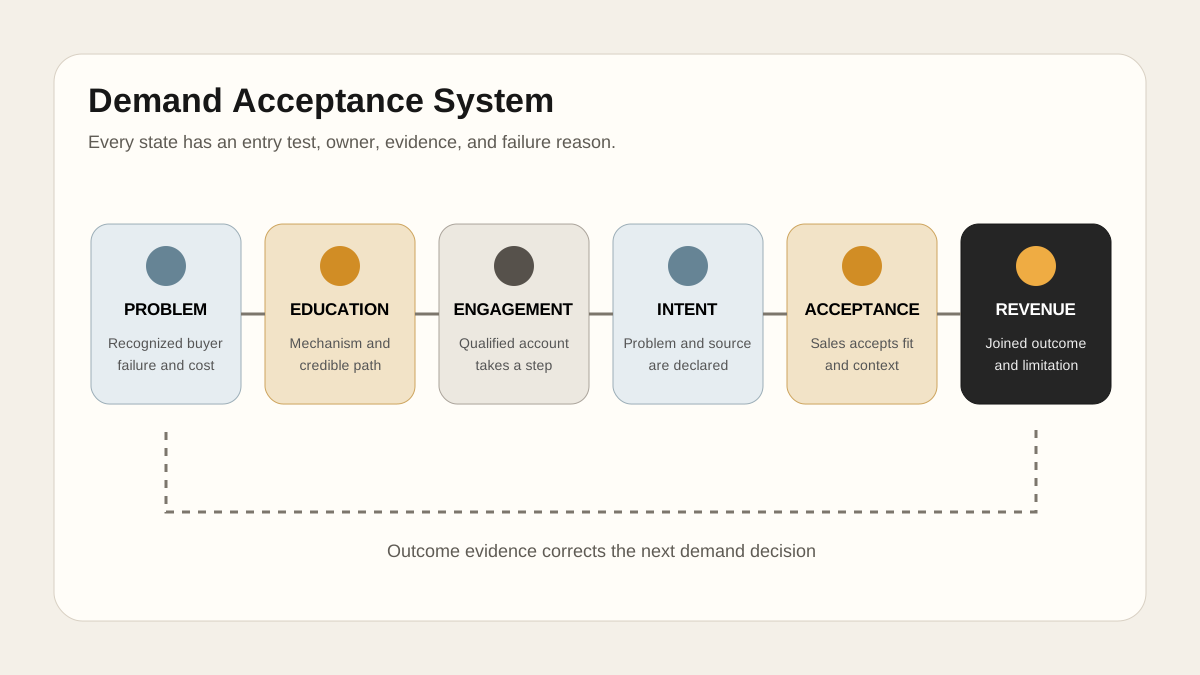
| State | Acceptance question | Evidence retained | Do not call it |
|---|---|---|---|
| Market problem | Is a defined buyer experiencing a costly, recognizable failure? | Buyer language, context, alternatives, consequence | Demand because a keyword exists |
| Education | Did the buyer understand the failure and a credible mechanism? | Asset, audience, qualified reach, engaged behavior | Pipeline because content was viewed |
| Engagement | Did the right account take a meaningful next step? | Account, content path, return, CTA event | A lead before identity and intent exist |
| Declared intent | Did the buyer identify a relevant problem and request a next step? | Form, source, landing page, consent, stated need | Qualified because a form was submitted |
| Sales acceptance | Did sales accept the fit and context for pursuit? | Reason, owner, response time, booking, attendance | Pipeline before an opportunity is accepted |
| Revenue evidence | Did the accepted opportunity create joined pipeline or won revenue? | Stage history, value, outcome, payment join, limitations | Causation from a channel screenshot |
Separate demand creation from demand capture
Demand creation helps a buyer recognize a problem, understand its cost, compare mechanisms, and build trust before they are ready to identify themselves. Demand capture serves the buyer who is already seeking a category, provider, comparison, implementation path, or price. The same channel can perform either job, but the intent, asset, CTA, and measurement should make the role explicit.
Wider lifecycle owner: use growth marketing when activation, retention, expansion, or referral also needs coordinated experimentation. Narrower commercial owner: use customer acquisition when the dominant problem is converting an existing buyer signal into accepted revenue.| Job | Buyer state | Useful assets | Primary acceptance signal |
|---|---|---|---|
| Create | Problem is unrecognized or poorly framed | Original analysis, diagnosis, evidence, category education | Qualified engagement and problem recognition |
| Corroborate | Problem is known but mechanism lacks trust | Independent mentions, expert contribution, methods, examples | Branded return or verified referral |
| Capture | Buyer is actively comparing paths or providers | Commercial owner, comparison, calculator, implementation guide | Declared intent with source and landing page |
| Accept | Buyer has requested a commercial next step | Qualification, booking, routing, response workflow | Attended and accepted meeting |
| Learn | Outcome is known or the path failed | Stage history, rejection reasons, win/loss evidence | Named system correction |
Diagnose the first failed state
A demand program should not prescribe channels from a symptom. Low traffic can be a discovery problem, weak distribution, or a market that does not use the chosen language. Traffic without action can be intent, trust, message, or usability. Leads without acceptance can be targeting, promise, qualification, or handoff. The first repeated failed state determines the next controlled action.
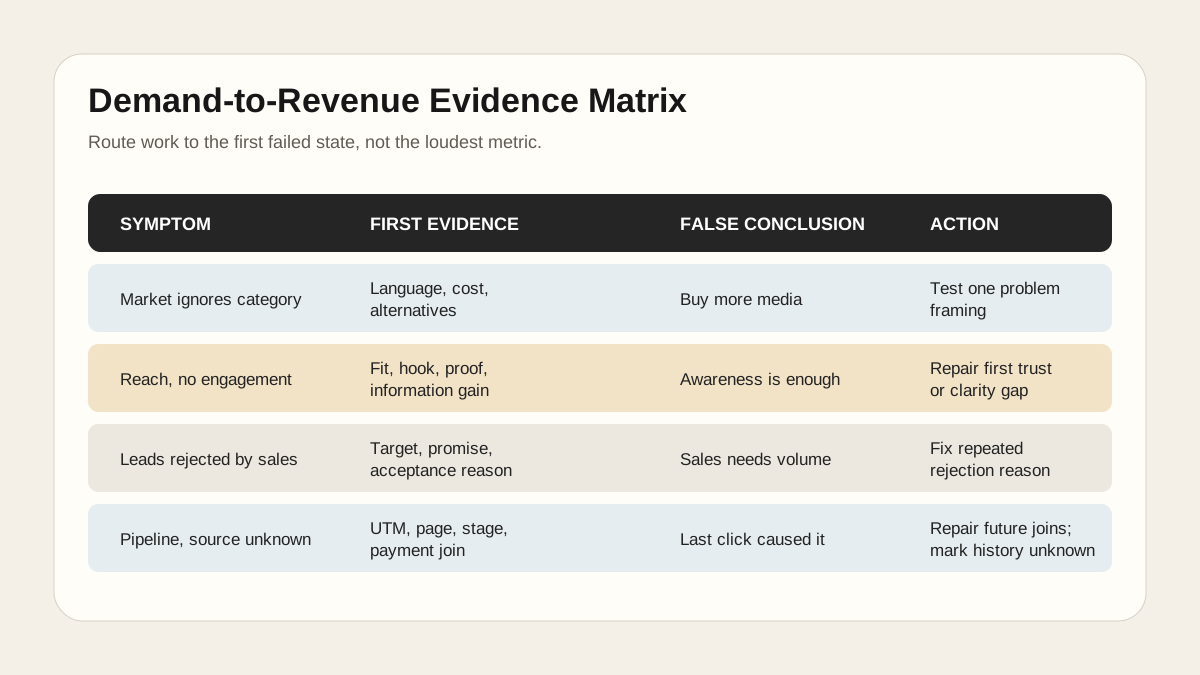
| Observed symptom | First evidence to inspect | False conclusion | Controlled next action |
|---|---|---|---|
| Market ignores the category | Buyer language, problem cost, competing explanations | More media will create relevance | Test one problem framing with the same qualified audience |
| Reach without engagement | Audience fit, hook, proof, information gain | Awareness alone is progress | Repair the earliest repeated comprehension or trust gap |
| Engagement without declared intent | Search intent, offer bridge, CTA, friction, return path | Content has no commercial value | Match one next step to the observed buyer state |
| Leads rejected by sales | Targeting, promise, form context, acceptance reason | Sales needs more leads | Correct the highest-frequency rejection reason |
| Pipeline with unknown source | UTM, landing page, contact merge, stage and payment joins | The last click caused revenue | Repair future joins and mark historical causation unknown |
What the agency should operate each week
- Reconcile: align search, content, campaign, site, CRM, calendar, sales, and revenue evidence to one window and definition set.
- Diagnose: name the earliest failed demand state, supporting evidence, uncertainty, and accountable owner.
- Prioritize: score the constraint by expected qualified pipeline, buyer value, urgency, confidence, effort, risk, reversibility, and measurement readiness.
- Design: write one primary intervention, audience, baseline, guardrails, version, rollback, and genuine evidence date.
- Implement: ship the approved asset or workflow and verify the intended version, capture path, and source fields live.
- Decide: scale, revise, stop, or retain an inconclusive result without upgrading correlation into causation.
Choose by operating model, not the label
| Model | Natural strength | Your team still owns | Best fit |
|---|---|---|---|
| Channel specialist | Deep execution in one creation or capture channel | Market priority, cross-channel path, sales acceptance, revenue truth | The failed state and channel are already known |
| Demand consultant | Research, positioning, program design, executive decisions | Production, campaign operation, QA, handoff, reporting | A capable internal team needs direction |
| Demand generation agency | Coordinated creation, capture, handoff, and evidence operation | Offer, product, sales judgment, delivery, and approvals | No one owns the demand-to-pipeline system |
| In-house demand team | Context, control, and direct access to sales and product | Hiring, management, tools, methods, and capacity | Stable scale justifies a permanent function |
Demand a measurement path before launch
Campaign fields should remain consistent from discovery into the landing page, booking, contact, opportunity, and revenue record. Sales acceptance and rejection reasons need explicit definitions. Later outcomes should be joined only under current platform, consent, and privacy requirements. When an identifier or stage is missing, stop the claim at the last verified state.
Google Analytics campaign URL documentation explains UTM parameters and consistent campaign naming. Google Ads enhanced conversions documentation describes its first-party-data requirements and role alongside conversion tracking. HubSpot lifecycle-stage documentation explains stage definitions and history. These sources describe platform behavior; they do not establish Vibeera performance.
Research method and evidence boundary
Ahrefs Keyword Explorer was checked August 12, 2026 for the United States. It estimated 900 monthly US searches, 2,400 global searches, keyword difficulty 7, traffic potential 1,100, traffic value $13,000, CPC $0.80, and parent topic demand generation agency. It exposed 241 matching terms and eight modeled questions. These are third-party planning estimates that can change. They do not establish Vibeera rankings, traffic, pipeline, or revenue.
The August 3 stored US result set contained an AI Overview, People Also Ask, service pages, agency lists, a guide, and a Reddit discussion. Several conventional first-page URLs had low URL Rating and two to nineteen referring domains, while established domains also competed. The mixed result set and weak page-level signals support a useful service-and-decision owner, but the AI Overview, lists, and definition content create high zero-click risk.
Vibeera reviewed three adjacent commercial seeds in the same session: marketing strategy agency, revenue operations agency, and lifecycle marketing agency. Strategy was broad and overlapped established owners; revenue operations and lifecycle had credible buyer value but weaker demand and internal-link evidence for today's distinct owner. No existing Vibeera URL served the demand-creation-to-sales-acceptance intent.
The Demand Acceptance System, evidence matrix, creation-versus-capture boundary, and operating cadence are Vibeera operator analysis informed by production marketing-system work. No customer result, conversion rate, growth rate, cost saving, implementation timeline, ranking, citation, pipeline, revenue, or causal lift is implied. The page is independently useful as a procurement and operating checklist, while Vibeera's service bridge is the accountable operated layer.
The decision
Hire a demand generation agency when a credible offer needs coordinated market education, intent capture, sales acceptance, and joined evidence. Require a Demand Acceptance System, explicit creation and capture roles, one first failed state, preserved source and stage history, and a weekly correction cadence. Choose a specialist when the failure is narrow, a consultant when your team can implement, or an in-house team when stable scale justifies permanent ownership.
Frequently asked questions
What does a demand generation agency do?
A demand generation agency researches the buying problem, creates category and solution understanding, captures active intent, coordinates the sales handoff, and preserves source-to-revenue evidence. Its contract should distinguish market education from lead capture and name the owner of each handoff.
How is demand generation different from lead generation?
Lead generation captures contact or account interest. Demand generation also creates understanding and preference before a buyer is ready to identify themselves. Lead generation is therefore one component of a complete demand system, not a substitute for it.
How is demand generation different from growth marketing?
Demand generation concentrates on creating and capturing qualified market intent through sales acceptance. Growth marketing can extend across acquisition, activation, retention, expansion, and referral. Choose the narrower demand owner when market education and pipeline creation are the central constraint.
What should a demand generation agency report?
Report qualified reach, engaged accounts, declared intent, accepted leads, attended meetings, opportunities, pipeline, and won revenue separately. Include source, landing page, campaign, stage history, rejection reason, attribution limits, and the next operating decision.
When should I hire a demand generation agency?
Hire one when the offer and delivery are credible but the market does not understand the problem, trust the mechanism, or move through a measurable buying path. Do not hire one to disguise an unproven offer, missing sales capacity, weak fulfillment, or absent source data behind more campaign activity.
Map the demand system before adding campaigns
Vibeera will map the market problem, creation and capture roles, sales acceptance, evidence joins, and accountable operating layer.
Map the implementation