Performance marketing agency: what evidence should it own?

A performance marketing agency should operate measurable acquisition while preserving the path from media cost to qualified pipeline and revenue. Its product is not cheaper clicks or a dashboard. It is a controlled system that defines accepted conversions, protects source data, separates platform estimates from business outcomes, contains loss, and shows which decision should change next.
Key facts
- Performance marketing is an operating model built around measurable actions and accountable optimization. It is not the same as a pay only for results contract.
- Platform conversions, accepted leads, attended meetings, qualified opportunities, and won revenue are separate evidence states.
- Ahrefs estimated 8,700 monthly US searches, 18,000 global searches, keyword difficulty 4, traffic potential 3,900, traffic value $17,900, and CPC $4 on August 13, 2026.
- The current US result set includes an AI Overview, People Also Ask, Reddit, lists, directories, guides, and service pages. The evidence contract preserves a reason to visit.
The word performance is useful only when the buyer and agency agree on what performance means. A media platform can optimize toward a click, form, purchase, or modeled conversion. The business may care about an accepted lead, attended meeting, qualified opportunity, retained customer, or collected revenue. Those records can support each other, but one does not automatically prove the next.
Start with a Performance Evidence Contract
Vibeera uses a Performance Evidence Contract: a written chain that names the commercial outcome, the accepted proxy signals, the system of record, the attribution limit, the loss guardrail, and the decision owner. The agency can optimize quickly without pretending the fastest signal is the final result.
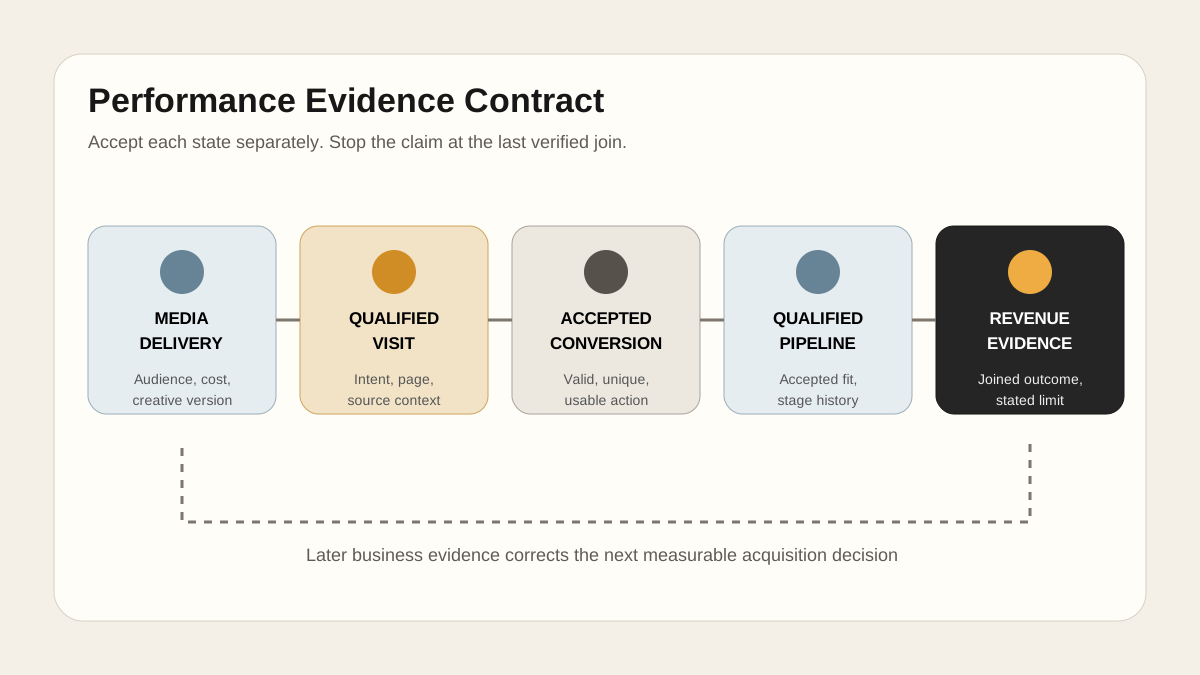
| Evidence state | Acceptance test | System of record | Claim boundary |
|---|---|---|---|
| Media delivery | Did the intended audience receive the approved creative under the planned cost and frequency limits? | Ad platform and creative version log | Delivery is not attention, intent, or pipeline |
| Qualified visit | Did the right visitor reach the intended page with usable source context? | Analytics and landing page | A session is not a lead |
| Accepted conversion | Did a valid person or account complete the defined action without duplication, fraud, or missing consent? | Form, calendar, commerce, or CRM record | A platform conversion is not automatically accepted |
| Qualified pipeline | Did the business accept fit, context, attendance, and opportunity value? | CRM stage history and disposition | A booked meeting is not qualified pipeline |
| Revenue evidence | Did the accepted opportunity create joined, attributable revenue under the stated window and limits? | CRM, billing, and payment join | Joined revenue is not universal channel causation |
The public Performance Marketing Evidence Contract CSV turns these states into a reusable procurement and weekly review worksheet. It is independently usable and contains no Vibeera benchmark or customer result.
Performance marketing is not a pricing promise
Performance marketing usually describes measurable digital acquisition and optimization. A pay for performance agreement is a compensation model. A buyer can use a retainer, project, media percentage, hybrid, or result dependent fee while still requiring the same evidence discipline. The commercial model does not repair an ambiguous outcome definition.
| Commercial model | Natural strength | Main risk | Control to require |
|---|---|---|---|
| Retainer | Stable operating capacity and cross channel coordination | Activity can continue without a hard constraint decision | Named evidence gates and monthly retain, revise, or stop decision |
| Media percentage | Simple scaling economics | Agency revenue can rise when spend rises | Independent loss limits and qualified outcome review |
| Project | Clear bounded build or diagnosis | No accountable operator after handoff | Acceptance tests, owner transfer, and observation window |
| Performance linked | Commercial alignment around a defined result | Gaming, disputes, channel conflict, or delayed outcome ambiguity | Exact event, exclusions, attribution, data access, dispute path, and cap |
| Hybrid | Operating capacity plus bounded upside | Complexity can hide conflicting incentives | Separate base scope, result formula, and evidence owner |
Use a loss aware decision matrix
A performance program needs rules for downside, not only targets for upside. The agency should know when to scale, hold, repair, suppress, or escalate before a campaign is launched. A delayed revenue signal cannot protect the business from every fast failure, so leading guardrails and later commercial evidence must work together.
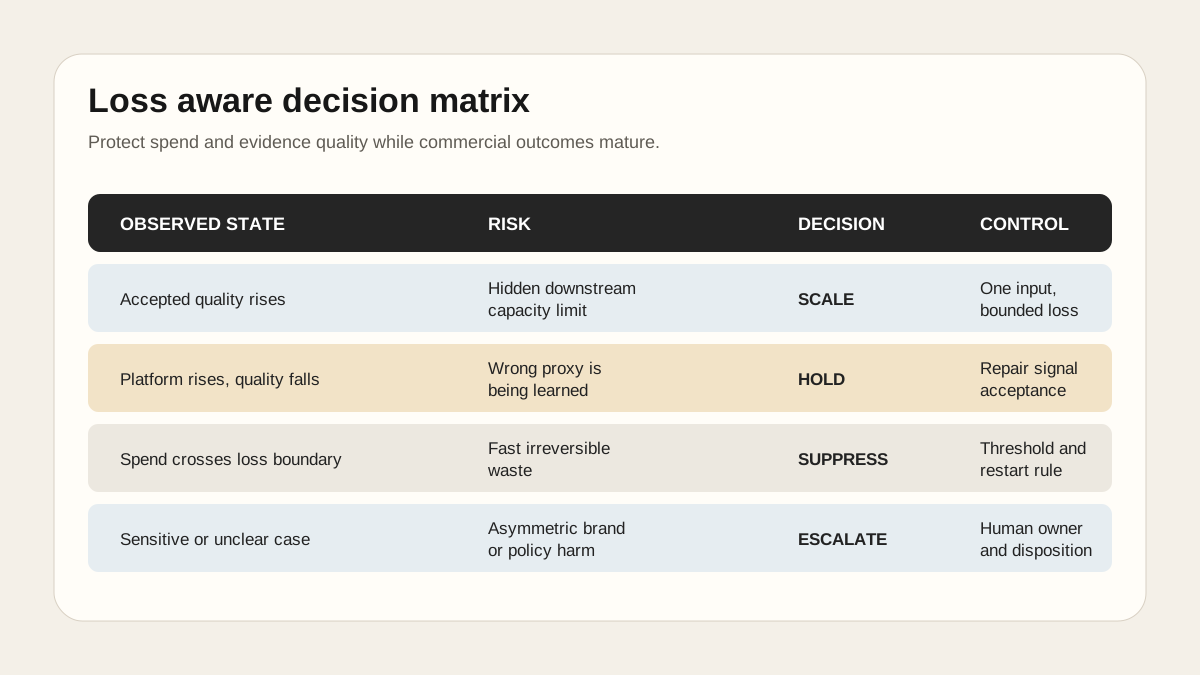
| Observed state | Risk | Decision | Evidence needed before release |
|---|---|---|---|
| Delivery stable, accepted conversion quality rising | Scaling can expose a hidden downstream capacity limit | Scale one bounded input | Capacity owner, loss cap, unchanged acceptance definition |
| Platform conversion rises, accepted conversion falls | Optimization is learning the wrong proxy | Hold and repair signal quality | Duplicate, fraud, fit, form, and import diagnosis |
| Qualified visits fall after a creative change | Cheaper reach may have reduced buyer fit | Restore or isolate the creative variable | Version, audience, landing path, and same window comparison |
| Spend accelerates beyond the loss boundary | Fast irreversible waste | Suppress automatically | Preapproved threshold, notification, owner, and restart rule |
| Compliance, brand, or sensitive reply appears | Automation can create asymmetric harm | Escalate to a person | Conversation context, policy, decision, and disposition |
| Revenue join is incomplete | Short term metrics can be mistaken for business value | Optimize only to the last verified state | Missing identifier, repair owner, and honest limitation |
Decide which operating owner you need
A performance marketing agency is narrower than a full growth owner when acquisition is the dominant constraint. It is broader than a media buyer when landing paths, conversion quality, experiments, and downstream evidence must be coordinated. It is different from a demand generation owner when the market already understands the problem and the immediate job is measurable capture and optimization.
Wider lifecycle owner: choose growth marketing when acquisition, activation, retention, expansion, and referral need one experiment system. Market creation owner: choose demand generation when the buyer still needs problem education and category trust before capture. Evidence owner: repair the source to decision join when platforms, site, calendar, CRM, and revenue records disagree.| Owner | Primary job | Best fit | Your team still owns |
|---|---|---|---|
| Media buyer | Operate paid channel setup, creative delivery, and optimization | The offer, path, and downstream evidence already work | Landing, CRM, sales, revenue truth, and cross channel priorities |
| Performance marketing agency | Operate measurable acquisition, conversion quality, experiments, and evidence | Acquisition efficiency and quality are the main constraint | Offer, delivery capacity, sales judgment, approvals, and commercial truth |
| Growth marketing agency | Coordinate experiments across the customer lifecycle | The constraint can move beyond acquisition | Business priorities, product, delivery, and executive decisions |
| In house team | Own context, execution, and cross functional access | Stable scale justifies permanent capability | Hiring, tools, management, methods, and capacity |
What the weekly operating loop should do
- Reconcile: align media, landing, conversion, calendar, CRM, sales, and revenue evidence to one definition set and window.
- Diagnose: name the earliest failed evidence state, the supporting record, the uncertainty, and the responsible owner.
- Prioritize: score the decision by expected qualified pipeline, loss exposure, confidence, speed, reversibility, and measurement readiness.
- Design: write one primary change, baseline, guardrail, version, acceptance rule, rollback, and evidence date.
- Release: implement the approved change and verify the intended creative, audience, page, event, and source fields live.
- Decide: scale, retain, revise, suppress, or mark the result inconclusive without upgrading correlation into causation.
Google Analytics campaign URL documentation explains UTM parameters and consistent campaign naming. Google Ads enhanced conversions documentation explains its first party data requirements and role beside conversion tracking. HubSpot lifecycle stage documentation explains default stages, customization, and stage history. These are platform sources, not evidence that Vibeera or any agency produces a specific result.
Research method and evidence boundary
Ahrefs Keyword Explorer was checked August 13, 2026 for the United States. It estimated 8,700 monthly US searches, 18,000 global searches, keyword difficulty 4, forecast volume 16,000, traffic potential 3,900, traffic value $17,900, CPC $4, and parent topic performance marketing agency. It exposed 903 matching terms, 20 modeled questions, and 99 terms shared by top results. These are third party planning estimates that can change. They do not establish Vibeera rankings, traffic, pipeline, or revenue.
The August 9 US result set contained an AI Overview, People Also Ask, Reddit, agency roundups, a directory, a service page, and guides. The first conventional result had URL Rating 0 and one referring domain. Other first page results ranged from URL Rating 0 to 15 and included several pages with zero or one referring domain alongside strong domains. The mixed commercial and informational result set supports a useful service and procurement owner, but the AI Overview, directory, lists, and community discussion create high zero click risk.
Vibeera reviewed content marketing agency, conversion rate optimization agency, go to market agency, revenue operations agency, and lifecycle marketing agency in the same comparison. Content marketing and performance marketing had the strongest modeled demand, but performance marketing had the clearer operated measurement bridge in this run. Conversion optimization had higher difficulty and narrower ownership, while the remaining seeds had materially lower traffic potential. No existing Vibeera URL owned measurable acquisition governance and performance evidence as its primary intent.
The Performance Evidence Contract, loss matrix, model comparison, and weekly control loop are Vibeera operator analysis informed by production marketing system work. No customer result, conversion rate, cost saving, implementation timeline, ranking, citation, pipeline, revenue, or causal lift is implied. The public CSV is a reusable operating worksheet, not a benchmark.
The decision
Hire a performance marketing agency when measurable acquisition is the main constraint and your business can supply the downstream evidence needed to protect quality. Require a Performance Evidence Contract, accepted conversion definition, loss aware decision rules, source to revenue join, commercial incentive disclosure, and weekly correction cadence. Choose a media buyer for a narrow channel job, a growth agency for a wider lifecycle constraint, or an in house team when stable scale justifies permanent ownership.
Frequently asked questions
What does a performance marketing agency do?
A performance marketing agency operates measurable acquisition channels, landing paths, conversion signals, experiments, and reporting. A complete operator also preserves source context into accepted leads, meetings, opportunities, and revenue so platform efficiency can be compared with business value.
Is performance marketing the same as pay for performance?
No. Performance marketing describes a measurable operating model. Pay for performance describes a commercial contract in which some compensation depends on an agreed result. The two can overlap, but the contract must define the result, exclusions, attribution, timing, data access, and disputes separately.
What should a performance marketing agency report?
Report spend, delivery, qualified visits, accepted conversions, rejected or duplicate records, attended meetings, qualified opportunities, pipeline, and won revenue separately. Include source, landing page, campaign version, attribution window, evidence limits, and the decision made from each state.
How do I choose a performance marketing agency?
Ask for its performance evidence contract, accepted conversion definition, loss controls, experiment rules, source to CRM join, commercial model, and correction cadence. Reject a provider that upgrades platform metrics into revenue claims without downstream evidence.
When should I hire a performance marketing agency?
Hire one when the offer and sales capacity are credible, paid or measurable acquisition is a real constraint, and your business can provide the downstream evidence needed to optimize for quality. Do not hire one to hide weak economics, absent fulfillment capacity, or missing sales disposition data behind more media spend.
Map the evidence contract before increasing spend
Vibeera will map the accepted conversion, loss limits, source joins, operating owner, and measurable acquisition loop.
Map the implementation