AI SEO agency: what should it actually operate?

An AI SEO agency should make a business discoverable, retrievable, citable, visit-worthy, and measurable across conventional search and AI-mediated discovery. It still has to earn crawlability, indexation, intent fit, authority, and useful clicks. The added job is to structure real public evidence for retrieval without inventing proof or confusing an AI mention with qualified pipeline.
Key facts
- AI SEO extends SEO. It does not replace technical quality, useful pages, internal links, authority, or attribution.
- A credible provider reports each state from published URL to won revenue separately and preserves the limits of the evidence.
- Ahrefs estimated 3,400 monthly US searches, 9,400 global searches, keyword difficulty 12, traffic potential 1,700, and CPC $9 for “AI SEO agency” on August 12, 2026.
- The current US result set includes an AI Overview, service pages, lists, and comparison content. That creates high zero-click risk and rewards original tools or evidence that cannot be fully consumed in a summary.
The category has attracted familiar shortcuts: generic articles renamed for AI, citation guarantees, prompt stuffing, synthetic profiles, and dashboards that count mentions without business context. None resolves the buyer's actual problem. The agency should operate an auditable path from public evidence to a qualified commercial outcome.
Use a Retrieval-to-Revenue Acceptance System
Vibeera's Retrieval-to-Revenue Acceptance System gives every state an acceptance test. A URL does not become successful because it was published. A citation does not become demand because an answer named the brand. A booking does not become organic revenue until its path and later lifecycle state are joined.
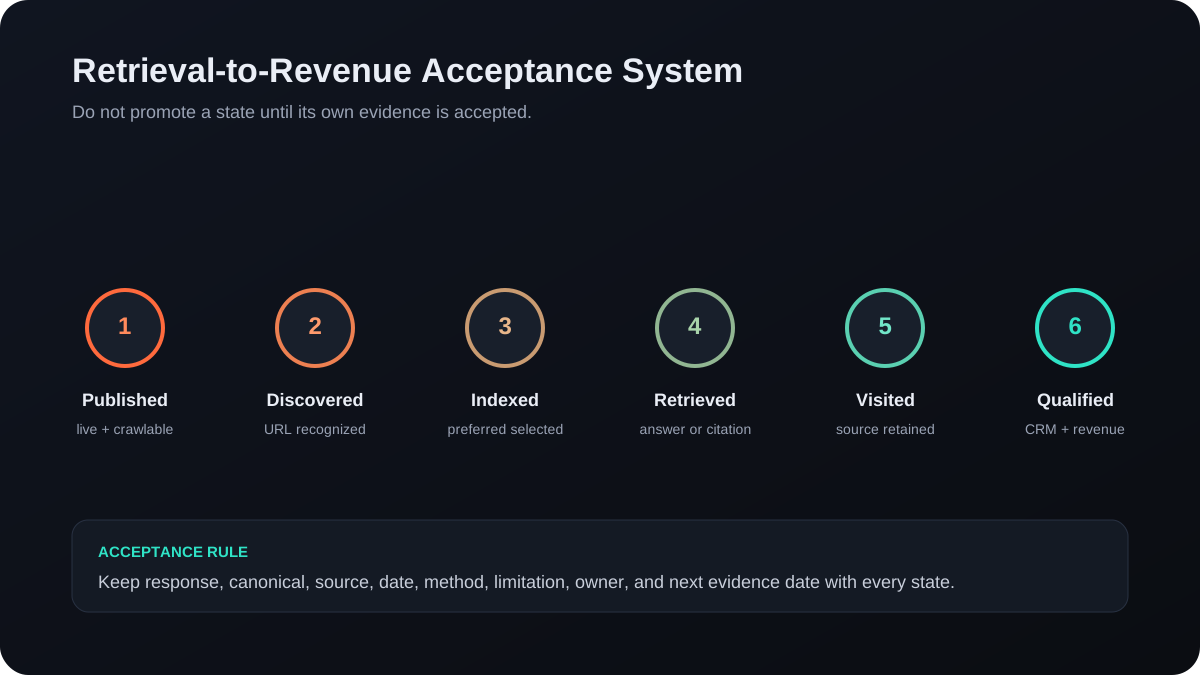
| State | Accepted proof | What it does not prove | Next control |
|---|---|---|---|
| Published | Preferred URL is live, crawlable, self-canonical, linked, and in the sitemap | Discovery or indexing | Validate live response, source, images, and incoming links |
| Discovered | Search engine reports the preferred URL or reads its sitemap | Crawl or selection | Inspect sitemap dates, referring pages, and crawl eligibility |
| Indexed | Current inspection or search-engine index report confirms selection | Impressions, citation, or quality | Observe query and feature exposure |
| Retrieved or cited | Identifiable public answer, crawler log, or AI referral names the source | Stable visibility or buyer action | Record prompt, market, date, citations, and limitations |
| Visited | Analytics records the landing page and source where available | Commercial intent | Preserve CTA and campaign fields |
| Qualified pipeline | CRM joins landing page, booking, qualification, stage, and revenue | Causation from one page without a valid design | Review contribution and attribution limits |
Download the AI SEO Evidence Acceptance Matrix. The public CSV is designed for editors, operators, and buyers who need to audit a provider's claims without adopting Vibeera's service.
AI SEO begins with ordinary crawl and index controls
The preferred URL should return 200, declare itself canonical, permit indexing, appear in a current sitemap, and receive crawlable internal links. Redirecting HTTP or non-www variants to the matching HTTPS www URL is normal canonicalization, not a defect. A sitemap URL that redirects, conflicts with its canonical, declares noindex, or has no incoming link is a release blocker.
Google's people-first content guidance asks whether content provides original information, substantial value, clear sourcing, and first-hand expertise. Google's AI features guidance says the established technical requirements and controls for Search continue to apply. These are platform requirements, not evidence that a particular page will rank or appear in an AI response.
Measurement owner: repair source-to-CRM evidence when analytics, booking, and lifecycle records disagree.Accept public evidence before optimizing retrieval
Retrieval systems need accessible material, but accessibility is not a license to create unsupported claims. The useful unit is an evidence object: a named entity, a bounded claim, a source, a checked date, a method, a limitation, and a public canonical location. Original data, controlled case records, reproducible frameworks, tools, and templates can give publishers and buyers something worth visiting and corroborating.
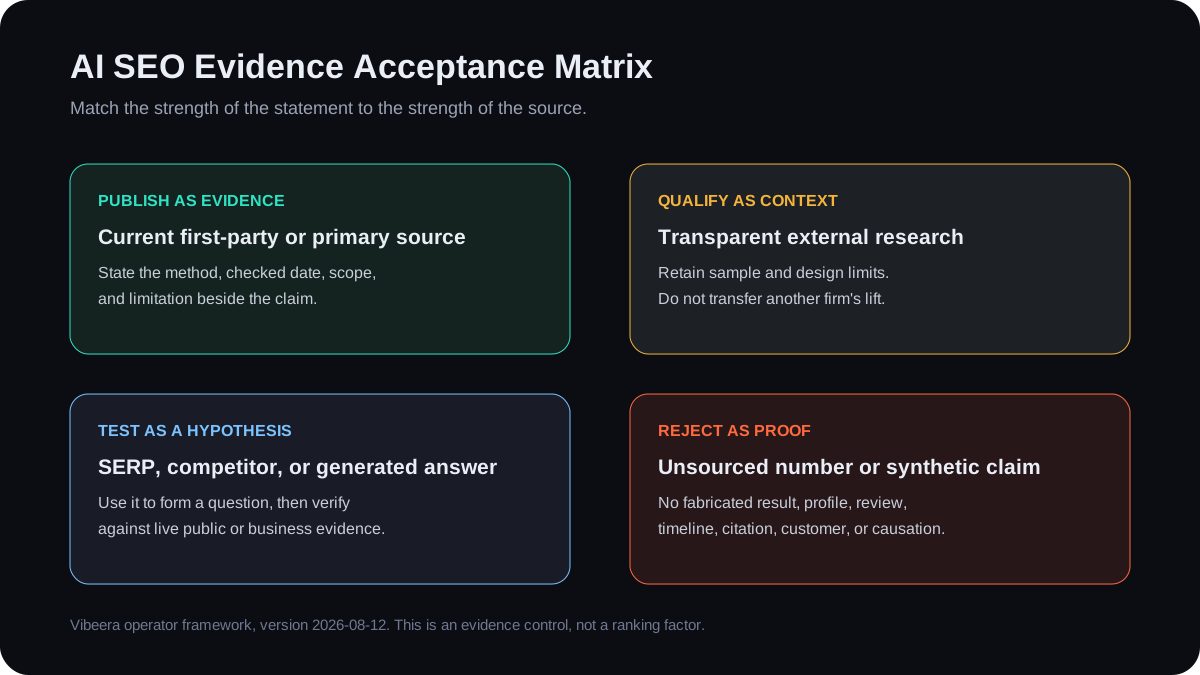
| Input | Source class | Allowed use | Required limit |
|---|---|---|---|
| CRM stage and revenue join | Current first-party business evidence | Report the verified lifecycle state | Do not infer page causation without a valid join and design |
| Search Console impression | Current first-party platform evidence | Report query, page, feature, market, and window | An impression is not a visit or citation |
| Official platform documentation | Current primary documentation | Describe supported behavior and requirements | Do not convert guidance into a performance promise |
| Transparent research | Published research with visible method | Use as context when the population fits | Retain sample, date, and design limits |
| Competitor result or practitioner case | External observation | Generate a hypothesis or identify a format | Do not copy the lift, cause, or claim |
| Generated answer or unsourced percentage | Discovery input | Form a question to verify | Never present it as accepted evidence |
Preserve the reason to click
AI summaries can satisfy simple definitions before a buyer visits a site. An agency should therefore pair answer-first clarity with assets that remain more useful at the source: an editable template, complete dataset, calculator, diagnostic, comparison method, implementation checklist, or case record with its full limitations. The page should answer the question, while the source provides the working object.
OpenAI's crawler documentation distinguishes OAI-SearchBot, GPTBot, and ChatGPT-User. They serve different purposes and should be evaluated independently. Allowing a crawler can enable access; it does not guarantee inclusion, citation, traffic, or a commercial result.
What the agency should operate each week
- Reconcile: compare production, Search Console, analytics, CRM, server or CDN evidence, and tracked authority records under one dated window.
- Diagnose: find the earliest failed state in the chain instead of rewriting whatever has low traffic.
- Prioritize: score improvements, consolidations, pages, links, evidence assets, and corroboration work on qualified pipeline and ranking path.
- Implement: complete every safe due action, then validate the entire production root before and after deployment.
- Distribute: prepare a truthful publisher-ready asset and keep outreach, profiles, reviews, contacts, and spending behind explicit approval.
- Decide: use fixed 7, 28, and 90-day evidence gates to retain, improve, consolidate, or retire work.
Choose the operating model, not the label
| Model | Natural strength | Your team still owns | Best fit |
|---|---|---|---|
| Technical SEO specialist | Crawl, indexation, rendering, architecture, and diagnostics | Offer, evidence, content, distribution, and revenue joins | The technical failure is known and bounded |
| Content agency | Research, editorial production, and publishing capacity | Technical release, authority, commercial ownership, and attribution | Strategy and evidence already exist |
| Digital PR or authority partner | Publisher relationships and editorial packaging | Canonical assets, technical SEO, conversion path, and lifecycle proof | A credible asset exists but corroboration is weak |
| AI SEO agency | Joined search, retrieval, evidence, authority, and measurement operation | Human expertise, approvals, legal claims, sales, and delivery | No one owns the whole public-evidence system |
| In-house team | Context, direct access, and durable organizational learning | Hiring, management, tools, methods, and specialist depth | Stable scale justifies permanent ownership |
Ask these questions before signing
- Which preferred URL owns each commercial intent, and what evidence prevents overlap?
- How do you distinguish published, discovered, crawled, indexed, impressed, cited, visited, booked, qualified, and won?
- What original information can our business credibly publish, and who must author or approve it?
- How do you preserve a click when an AI answer can summarize the basic response?
- Which crawlers and search controls are evaluated separately, and which proposed files or schema are optional rather than requirements?
- What happens at 7, 28, and 90 days when the evidence is weak, contradictory, or absent?
- Which actions require our approval, especially outreach, profiles, reviews, contacts, claims, permissions, and spending?
Research method and evidence boundary
Ahrefs Keyword Explorer was checked August 12, 2026 for the United States. It estimated 3,400 monthly US searches, 9,400 global searches, keyword difficulty 12, traffic potential 1,700, global traffic potential 1,800, CPC $9, and parent topic AI SEO agency. It exposed 764 matching terms and 40 modeled questions. These are third-party planning estimates that can change. They do not establish Vibeera traffic, rankings, citations, pipeline, or revenue.
The August 6 Ahrefs US result set included an AI Overview, service pages, comparison content, lists, and established domains. Conventional results included Thrive, Level, SearchBloom, Spicy Margarita, Ziptie, Coalition, YesOptimist, and OuterBox. Several ranking URLs had low URL Rating or limited referring domains even when their host domains were strong. That creates a plausible page-level path, not a ranking forecast. The AI Overview creates high zero-click risk.
A current Ahrefs Content Gap comparison against Thrive, Level, and OuterBox returned “AI SEO agency” and “AI SEO services” among a much larger noisy set. Vibeera had no existing owner for the intent. Adjacent candidates such as lead generation agency, marketing strategy agency, demand generation agency, customer experience agency, go-to-market agency, and revenue operations agency either overlapped current owners or offered a weaker combined bridge, original contribution, or ranking path in this run.
The Retrieval-to-Revenue Acceptance System and evidence matrix are Vibeera operator analysis built from its production publishing controls. They have not been validated as ranking factors and make no claim of citation lift, traffic lift, conversion lift, implementation speed, or revenue causation. The generated hero is conceptual artwork, not a product interface, customer result, or analytics screenshot.
The decision
Hire an AI SEO agency when valuable buyers use search or AI-mediated discovery, the business can contribute real expertise or evidence, and no current owner can connect crawlability, intent, public evidence, authority, click preservation, and revenue attribution. Require a state-by-state acceptance system, explicit source limits, public working assets, independent crawler controls, fixed review dates, and honest approval boundaries. Choose a narrower specialist when the failure is already known.
Frequently asked questions
What does an AI SEO agency do?
An AI SEO agency makes a business discoverable, retrievable, citable, visit-worthy, and measurable across conventional search and AI-mediated discovery. It should operate technical SEO, intent ownership, original evidence, internal links, authority, attribution, and lifecycle decisions as one system.
Is AI SEO different from traditional SEO?
AI SEO extends traditional SEO. Crawlability, indexation, intent, useful pages, authority, and measurement still matter. The added work tests how public evidence is retrieved and represented in AI features while preserving a reason for the buyer to visit the source.
Can an AI SEO agency guarantee citations or rankings?
No. Search rankings, AI answers, citations, and crawler behavior are controlled by third-party systems that change. A credible agency can guarantee its process, evidence boundaries, deployment quality, measurement, and review cadence, but not a placement or timeline.
What should an AI SEO agency report?
It should report preferred URLs, crawl and indexation states, impressions, rankings, click-through rate, internal links, relevant referring domains, identifiable AI referrals or citations, CTA clicks, bookings, qualified meetings, and won revenue as separate evidence states.
When should I hire an AI SEO agency?
Hire one when organic or AI-mediated discovery can reach valuable buyers, your business can contribute real expertise or evidence, and no current owner can join technical SEO, content, authority, and revenue attribution. Do not hire one for guaranteed citations, synthetic proof, or page quotas.
Map the public-evidence system
Vibeera will map the crawl, retrieval, evidence, attribution, approval, and accountable operating controls around your commercial journey.
Map the implementation