How to scale a coaching business past $100K/month without working more hours
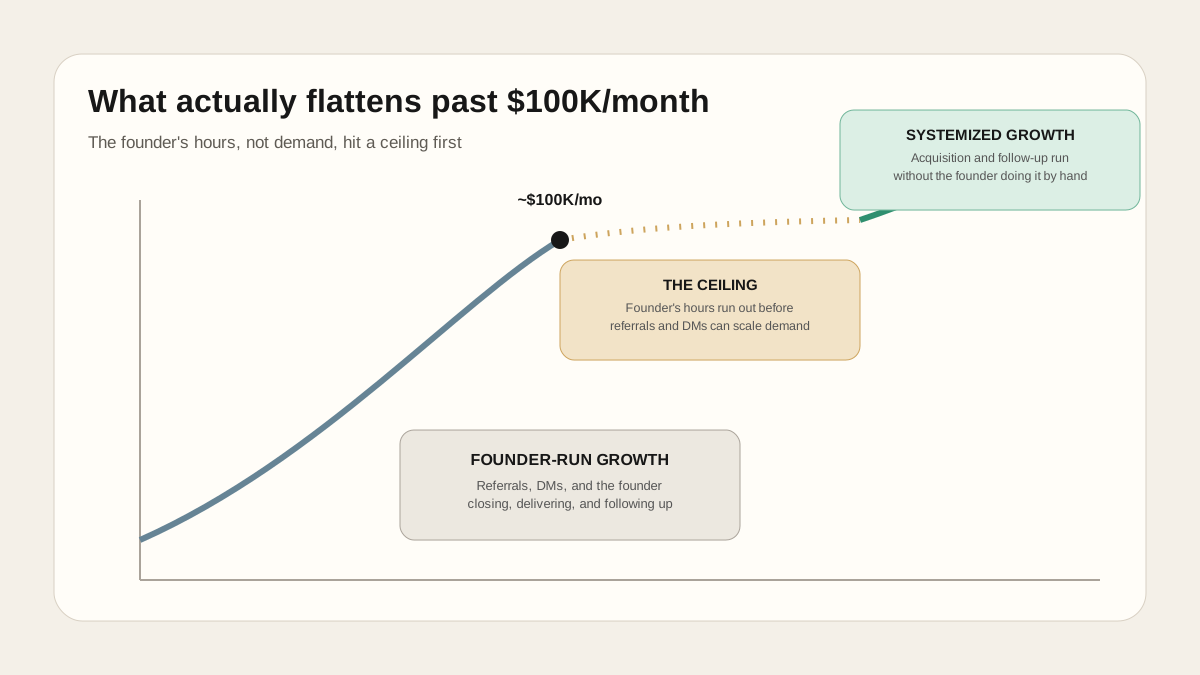
A coaching business usually stops scaling past $100K a month for a repeatable reason: the founder still runs acquisition, closing, delivery, and follow-up at once, and there are no more hours left to add. Referrals and DMs fill a calendar up to a point, but cannot be scheduled on demand, so growth flattens while demand still exists. The fix is replacing the founder-dependent parts of acquisition and follow-up with a system, while the founder keeps the calls that need judgment: pricing, hiring, and fit. Vibeera installs and operates a department of AI agents for outreach, funnels, follow-up, and reporting.
Key facts
- Ahrefs estimated 100 monthly US searches for "how to scale a coaching business" on October 21, 2026, keyword difficulty 0, traffic potential 50.
- A 2023 Censuswide survey of 251 US growth-oriented founders, run for Time etc, found an average 45.5 hour workweek, with 36% (about 16 hours) spent on small administrative work rather than client-facing work.
- A November 2024 BDC panel of 609 Canadian owners and decision-makers found a 49.7 hour average workweek, with 52% working 50 or more hours.
- A mid-level in-house marketing manager hire for a coaching business runs about $80,000-130,000 a year fully loaded (this site's own dated estimate); a fractional CMO runs about $5,000-15,000 a month.
Search "how to scale a coaching business" and most of what ranks is generic advice: raise your prices, post more content, ask for more referrals. None of that addresses the actual constraint for a coach already doing six figures a month, which is rarely demand. It is that the founder is the one running acquisition, closing calls, delivering the coaching itself, and following up with every lead, and that stack of roles has a hard ceiling measured in hours, not dollars.
What actually flattens growth at the $100K/month ceiling
Below roughly six figures a month, a founder doing everything personally usually works: referrals and DM conversations are enough volume for one person to handle end to end. Past that point, the same founder-run process runs into its own hours. Adding more leads does not help if there is no time left to follow up with them, and adding more clients does not help if delivery already fills the calendar. The constraint moves from "not enough demand" to "not enough hours," and that shift is easy to miss because the symptom still looks like a marketing problem.
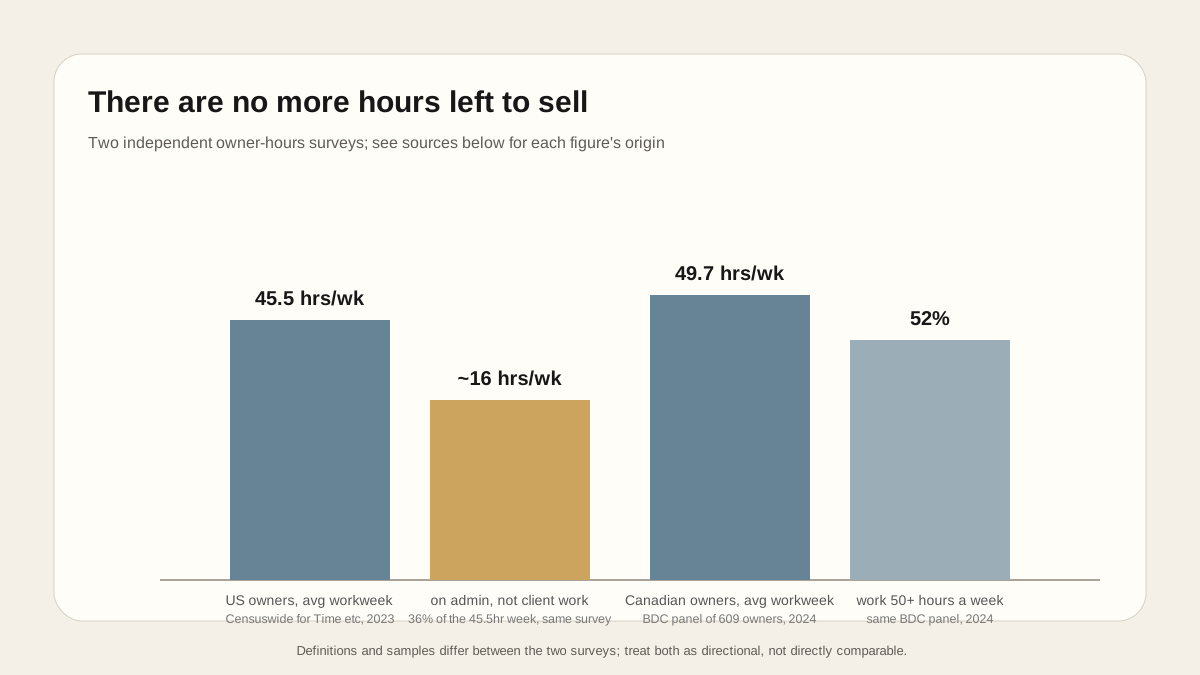
Independent surveys of small business owners put the average workweek at roughly 45 to 50 hours even before counting the work that is specific to running a coaching practice, with a large share of owners already working 50 or more hours a week. There is no reserve of spare hours sitting unused for a founder already at that level to spend on scaling further; the hours have to come from somewhere else, which usually means a system or a person doing the work instead.
Why referrals and DMs stop scaling on their own
Referrals rarely stop producing clients outright. The honest problem is that a referral cannot be scheduled: it arrives on its own timeline, from a client's own network, at a volume the founder does not control. A business that depends on one unscheduled channel has a ceiling on how fast it can grow, no matter how good the work is, because growth then depends on something outside the business's own control rather than a system it can turn up or down on demand.
The Vibeera Founder Leverage Method
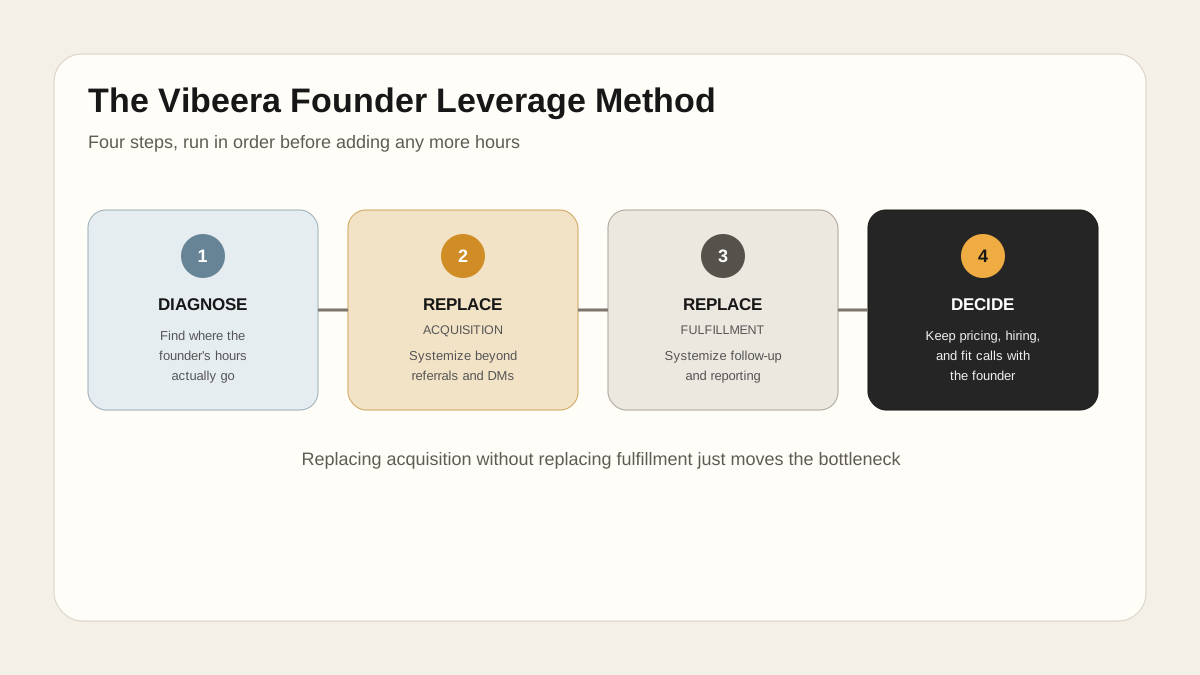
Vibeera uses a four-step method to decide what actually needs to change before recommending anything, because the most common mistake at this stage is replacing the wrong half of the founder's workload.
Step 1: Diagnose where the founder's hours actually go
Before changing anything, the real split matters: how much of the founder's week is acquisition (outreach, DMs, discovery calls), how much is fulfillment (delivering the coaching itself), and how much is pure admin and follow-up. Systemizing the wrong one wastes the effort; a founder who is bottlenecked on delivery does not get relief from more outreach volume.
Step 2: Replace founder-run acquisition
Once the bottleneck is confirmed on the acquisition side, the fix is a system that finds, contacts, and qualifies prospects without the founder personally sending every message, so the channel can run on a schedule instead of waiting on a referral. For the mechanics of running that first-touch work through a trained AI agent rather than a hire, see AI SDR for coaches and consultants, and for turning a dormant past-client list back into a scheduled source of its own, see database reactivation for coaches.
Step 3: Replace founder-run fulfillment and reporting
If the bottleneck is instead on the delivery or follow-up side, acquisition changes alone just produce more leads the founder still has to personally close and follow up with, which does not fix anything. This step covers the follow-up, funnel, and reporting work that keeps a lead warm and a client informed without the founder manually doing it for each one.
Step 4: Keep a human decision gate on pricing, hiring, and fit
Systemizing acquisition and fulfillment is not the same as removing the founder from the business. Pricing changes, who to hire, and which prospects are actually a fit for the offer stay judgment calls for the founder; a system should remove repetitive execution, not the decisions that define the business.
A worked example
To make the method concrete: picture a consultant doing $110,000 a month who is personally handling every DM reply, every discovery call, and every client check-in, and has stopped actively marketing because there is no time left to do it. This is a hypothetical walk-through, not a reported Vibeera result or a benchmark to expect. Diagnosing the split finds the bottleneck is acquisition, not delivery: the consultant has capacity to take more clients but no hours left to find them. The fix in this scenario is not hiring a closer, since the consultant already closes well; it is a system that keeps outreach and qualifying running on a schedule so the consultant's own time goes back to the discovery calls and delivery that actually need their judgment.
What each path costs
Costs for an in-house hire and a fractional CMO are reused from this site's own dated pages; a self-run software stack and an operated AI department are compared on the same basis below.
| Path | What it requires from you | Reported cost | Best fit |
|---|---|---|---|
| Stay founder-run (referrals and DMs) | Nothing new, but your own hours stay the hard ceiling on growth | No new cash cost; the cost is capped revenue | You are not yet past the point where your own hours are the constraint |
| Hire a full-time marketing or ops person | Recruiting, onboarding, and ongoing management of a new hire | About $80,000-130,000/yr fully loaded, plus a 60-90 day ramp | You want a dedicated employee and can absorb the ramp time |
| Hire a fractional CMO | A part-time retainer for strategy and direction; you still need someone to execute the plan | About $5,000-15,000/mo | You need senior strategy but already have execution capacity or are hiring it separately |
| Vibeera, operated | Scoping the acquisition and fulfillment bottleneck on a call; Vibeera runs the system week to week | Scoped on a call, live in about 14 days once scoped | Your offer already sells and the constraint is your own hours running acquisition or follow-up by hand |
Mistakes that stall the climb past $100K
- Systemizing acquisition when delivery is the real bottleneck. More leads do not help a founder who already has no time left to deliver the work.
- Treating a fractional CMO as an execution hire. A fractional CMO sets strategy; it typically does not run the outreach, funnels, or follow-up itself.
- Hiring before the offer and ICP are proven. A new hire's 60-90 day ramp is expensive to spend on a business that has not yet confirmed what is actually working.
- Removing the founder from every decision, not just the execution. Pricing, hiring, and fit calls still need the founder's judgment; systemizing all of it, not just the repetitive parts, tends to show up as a drop in quality.
- Waiting for more referrals instead of building a scheduled channel. A channel the business does not control is not a growth plan, even when it has worked so far.
Who this is for, and who it isn't
Comparing the operating cost: see how an operated AI department compares with hiring in-house for this kind of recurring acquisition and follow-up work. Scope and cost: Vibeera's pricing is scoped on a call, with delivery in about 14 days once scoped.- Best fit: your offer already sells at six figures a month, and the constraint is your own hours running acquisition or follow-up by hand, not whether the offer works.
- Poor fit: the offer itself is unproven, or you have not yet tested whether there is real demand beyond your existing network; systemizing an offer that does not convert just scales the problem faster.
- Switching trigger: you have stopped actively marketing because there is no time left to do it, or you are turning away qualified prospects because delivery already fills the calendar.
Research method and evidence boundary
Ahrefs Keyword Explorer was checked October 21, 2026 for the United States: "how to scale a coaching business" (100/mo, KD 0, traffic potential 50, CPC $2); "how to grow a coaching business" (40/mo, KD 0, traffic potential 100) was checked the same day and folded into this page rather than split into a separate URL, since it shares the same underlying buyer intent and falls under the same demand floor.
The 45.5 hour average US owner workweek and the 36% (about 16 hour) administrative-time figure are reused from a September 2023 Censuswide survey of 251 US growth-oriented founders and owners, commissioned by Time etc, as reported in a secondary 2026 research write-up (StealthAgents, "Small Business Owner Admin Time Statistics," 2026); the original Time etc release could not be reached directly. The 49.7 hour average and 52%-working-50-plus-hours figures are reused from BDC's own published article describing a November 2024 panel survey of 609 Canadian business owners and decision-makers (BDC, "Is It Possible to Work Fewer Hours as an Entrepreneur?"). The two surveys use different samples, countries, and definitions of working hours, so they are reported separately rather than averaged together. In-house marketing manager and fractional CMO costs are reused verbatim from this site's own already-published, dated pages at cost of hiring a marketing manager for a coaching business and fractional CMO for coaches. The claim that referrals are too unpredictable to scale on their own reflects a consistent theme across coaching-industry and vendor commentary rather than an independently verified statistic, and is reported as such.
The Founder Leverage Method and worked example are Vibeera operator analysis informed by production marketing system work. No customer result, conversion rate, revenue outcome, ranking, citation, or timeline beyond the live "about 14 days" is implied or guaranteed.
The decision
Diagnose which half of your own workload is actually the ceiling, acquisition or fulfillment, before changing anything; systemizing the wrong half wastes the effort. Stay founder-run if your own hours are not yet the constraint. Hire a fractional CMO if you need senior strategy and already have execution capacity elsewhere. Hire full-time if you want a dedicated employee and can absorb the ramp. Bring in an operator like Vibeera when the offer already sells and the gap is specifically your own hours running acquisition or follow-up by hand.
Frequently asked questions
What actually stops a coaching business from scaling past $100K/month?
Usually the founder's own hours, not a lack of demand. Referrals and DMs can fill a calendar up to a point, but once the founder is also the one closing, delivering, and following up, there is no more time to sell, and the growth line flattens even while demand for the offer keeps existing.
Do referrals eventually stop working?
Referrals rarely stop producing clients entirely, but coaching-industry and vendor sources consistently describe them as too unpredictable to scale past a certain volume on their own: you cannot schedule a referral, and a business that depends on one unscheduled channel has a ceiling on how fast or how far it can grow.
How much does a marketing manager cost compared to Vibeera?
A mid-level in-house marketing manager for a coaching business runs about $80,000 to $130,000 a year fully loaded in the US, plus a 60 to 90 day ramp before the hire is productive. Vibeera's fee is scoped on a call and deploys in about 14 days; the two are different commitments, not a straight price comparison.
What is the difference between a fractional CMO and an operated AI department?
A fractional CMO sets strategy and direction on a part-time retainer, typically $5,000 to $15,000 a month, but does not usually execute the work personally. An operated AI department like Vibeera runs the recurring execution itself: outreach, funnels, follow-up, and reporting, for a fixed fee.
Is Vibeera a fit for scaling a coaching business past $100K/month?
Vibeera is a fit if your offer already sells and the real constraint is your own hours running acquisition and follow-up by hand. Vibeera is a poor fit if the offer itself is unproven or demand has not yet been tested; systemizing an offer that does not yet convert just scales the problem.
Ready to find your actual bottleneck?
Vibeera will scope whether acquisition or fulfillment is the real constraint before recommending anything.
Map what a system replaces before you hire ->