Speed to lead: what happens to a coach's inbound lead in the first 5 minutes
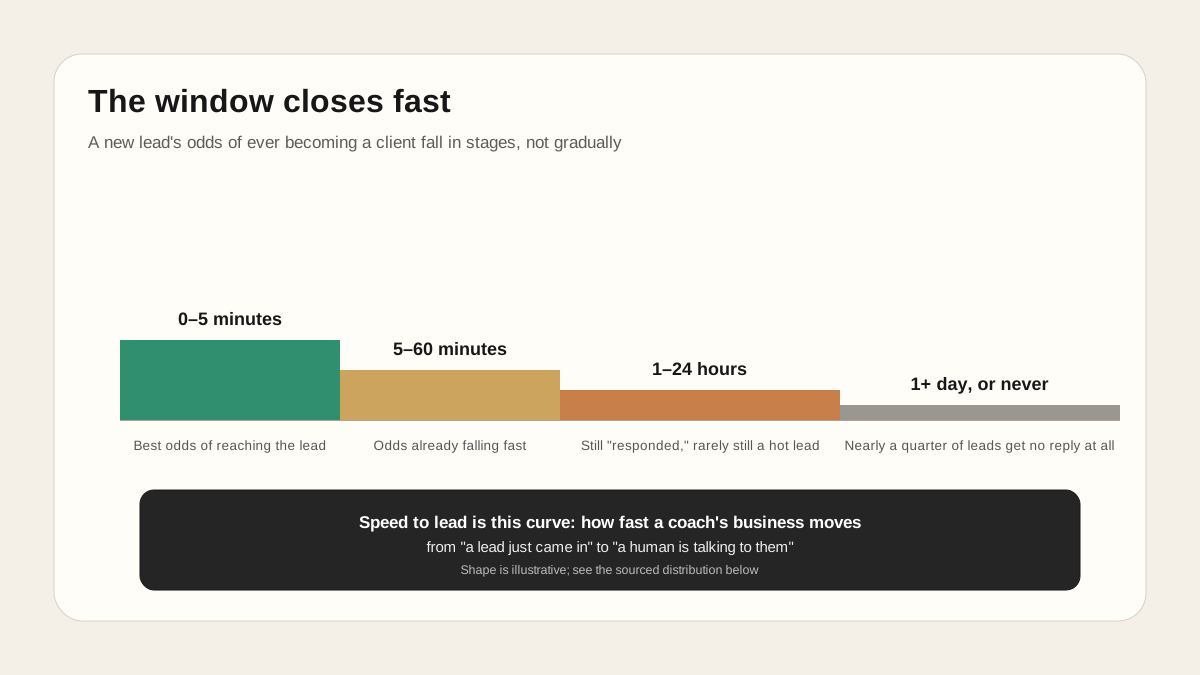
Speed to lead is how long it takes a business to make first human contact with a new inbound lead, and for most coaches that window is where leads are lost, not in the marketing that generated them. An audit of 2,241 US companies found 23% never responded to a web lead at all. Every minute a lead waits is a minute it can go cold or book elsewhere. Vibeera installs and operates a department of AI agents for outreach, follow-up, funnels, and reporting, including the response layer that catches a lead the instant it arrives, at any hour.
Key facts
- Ahrefs estimated 1,800 monthly US searches for "speed to lead" on October 21, 2026, keyword difficulty 0, traffic potential 3,700.
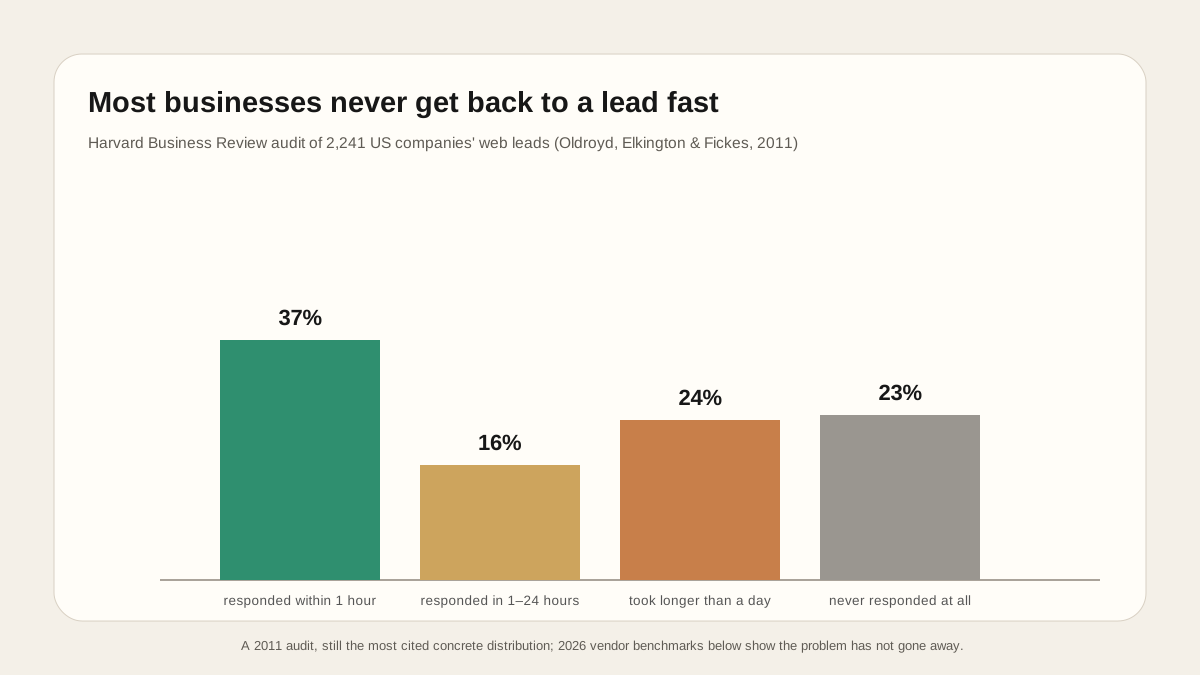
- A Harvard Business Review audit of 2,241 US companies (Oldroyd, Elkington & Fickes, 2011) found 37% responded to a web lead within 1 hour, 16% within 1–24 hours, 24% took longer than a day, and 23% never responded.
- Two 2026 vendor benchmark reports disagree sharply on current median response time: one audit of 28,400 B2B leads found a 1 hour 42 minute median with 14.6% answered within 5 minutes; another found a 42-hour median with about 7% answered within 5 minutes.
- Reported round-the-clock coverage costs range from about $25/mo for AI-based text-back tools to $700–$1,700/mo for a staffed answering service at real call volume.
Search "speed to lead" and the SERP is mostly sales-ops and call-center content aimed at B2B reps and car dealerships, not coaches. The mechanics are identical either way: a lead arrives, someone has to notice it, and someone has to respond before the moment passes. For a solo or small coaching business, that someone is usually the founder, which means the response clock is set by whatever the founder happens to be doing when the lead comes in, a client session, a workout, dinner, or asleep.
What actually happens in the first 5 minutes
The business answer in steps: 1) a lead fills a form, calls, or sends a DM; 2) the clock starts immediately, not when someone next checks their phone; 3) the first few minutes carry the best odds of a real conversation, and those odds fall the longer the gap runs; 4) past roughly a day, a large share of leads have either gone cold or already booked with someone else. The data on exactly how fast those odds fall is older and inconsistent, but the direction is not in dispute: slower is worse, and most businesses are far slower than they think.
Why most coaches lose the first 5 minutes anyway
A coach is usually the only person who can answer a new lead, and a coach's day is built around being unavailable: a client session, a recorded call, travel, or simply being asleep when a lead comes in from a different time zone. Checking a phone between sessions is not the same as a system that is always on. The gap is not a discipline problem; it is a structural one, because the one person who can respond is also the one person who cannot always be reachable.
The Vibeera First-Contact Method
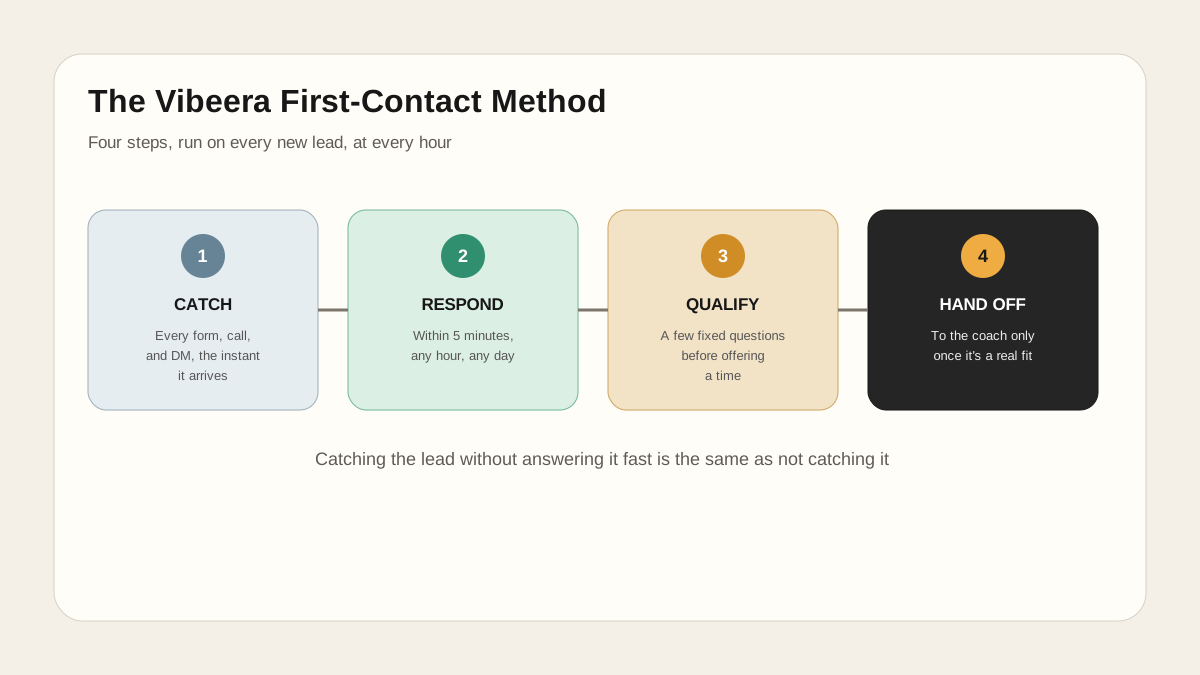
Vibeera runs the same four-step sequence on every new lead, so the response window never depends on whether the founder happens to be free.
Step 1: Catch every channel, not just one inbox
A lead can arrive as a form submission, a missed call, or a DM, often on different platforms the founder checks at different times. The first step is routing all of them into one place the moment they happen, rather than trusting a founder to remember to check each channel.
Step 2: Respond within 5 minutes, any hour
This is the step that actually requires giving up on "I'll get to it when I can." A response has to go out whether the lead arrives at 2pm or 2am, which is the part a single person, however disciplined, structurally cannot do alone every time.
Step 3: Qualify with a few fixed questions
Before offering a time, a short set of qualifying questions confirms the lead is a real fit, the same discipline an appointment setter uses. This keeps the fast response from turning into a calendar full of poor-fit calls. For the fuller version of this step as its own function, see appointment setting services for coaches.
Step 4: Hand off to the coach only once it's a real fit
The coach's time is reserved for the calls that are worth it, not every reply. Pricing, final fit, and the actual sale stay human decisions; the system's job is making sure a qualified lead never waits.
A worked example
To make the method concrete: picture a coach running paid ads whose leads come in through a form at all hours. A lead fills it out at 9:40pm on a Thursday while the coach is mid-session with a client. This is a hypothetical walk-through, not a reported Vibeera result or a benchmark to expect. Without a system, that lead waits until the coach checks their phone, which in practice might be the next morning, well outside the window most research links to the best odds of a real conversation. With the method above, the lead gets an automatic reply within minutes confirming receipt and asking two qualifying questions; by the time the coach is free an hour later, the lead is already qualified and a time is already on the calendar, rather than the coach starting from zero.
What round-the-clock response actually costs
Four paths exist, and none of them is free in the way "just answer your phone" sounds.
| Path | What it requires from you | Reported cost | Best fit |
|---|---|---|---|
| Answer it yourself, when you can | No cash cost, but every gap is a cooling lead | No new cash cost; the cost is lost or stalled leads | Lead volume is still low enough that a few hours' delay rarely costs a booking |
| Hire a staffed answering service | Vendor selection, onboarding, and a script to hand off | About $325–$700/mo at typical small-business call volume, up to $1,700/mo at higher volume (reported vendor ranges) | You want a live human voice answering around the clock and can absorb the retainer |
| Self-run text-back or missed-call software | Setup, messaging-compliance registration, and ongoing monitoring | Roughly $25–$300/mo depending on the tool and usage, plus one-time registration fees (reported vendor ranges) | You are comfortable configuring and maintaining the workflow yourself |
| Vibeera, operated | Scoping your channels and qualifying criteria on a call; Vibeera runs it from there | Scoped on a call, live in about 14 days once scoped | You already have real lead flow and the gap is specifically response speed, not demand |
Mistakes that quietly cost coaches booked calls
- Treating a missed call as a dead end instead of an open window. A text sent in the minutes right after a missed call still catches a meaningful share of callers who would otherwise never call back.
- Only covering business hours. Forms, DMs, and ads run around the clock even when the founder does not; a system that sleeps when the founder sleeps misses exactly the leads most likely to go to a competitor.
- Routing every lead straight to the founder's personal phone. This recreates the same bottleneck the system was supposed to fix, just with an extra notification.
- Responding fast but skipping qualification. A fast reply that books anyone fills the calendar with poor-fit calls, which costs more founder time than the slow response did.
- Turning on text-back software without checking message compliance. US business texting generally requires A2P 10DLC carrier registration; unregistered traffic can get filtered or blocked outright, which silently kills the exact automation meant to fix this problem.
Who this is for, and who it isn't
Different problem, same first-touch window: this page is about inbound leads that already contacted you; for outbound first touch to leads who have not yet reached out, see AI SDR for coaches and consultants. Scope and cost: Vibeera's pricing is scoped on a call, with delivery in about 14 days once scoped.- Best fit: you already have real inbound lead flow, from ads, content, or referrals, and leads are going cold overnight, on weekends, or whenever you are with a client.
- Poor fit: lead volume is still a handful a week; speed does not matter if there is nothing yet to catch, and the bigger problem is demand, not response time.
- Switching trigger: you notice leads replying "never mind, I booked with someone else" or going silent after a slow reply, or you are routinely checking messages during sessions out of fear of missing one.
Research method and evidence boundary
Ahrefs Keyword Explorer was checked October 21, 2026 for the United States: "speed to lead" (1,800/mo, KD 0, traffic potential 3,700, CPC $7); a `serp-overview` pull the same day found the live SERP dominated by B2B sales-ops glossaries, call-center blogs, and Reddit/LinkedIn discussion threads, with no dedicated coach-specific page, confirming a clean new owner for this intent.
The 2,241-company, 37%/16%/24%/23% response-time distribution is reused from Harvard Business Review, "The Short Life of Online Sales Leads" (James B. Oldroyd, Christopher Elkington and Kevin Fickes, March 2011). This is the most frequently cited concrete audit on this question, though the underlying data is now over a decade old, so it is reported as a historical benchmark, not a current platform fact. A related, more widely repeated claim, that contacting a lead within 5 minutes gives roughly 100 times the odds of reaching them versus 30 minutes, traces to a 2007 Lead Response Management study from Dr. James Oldroyd and InsideSales.com; that multiplier is reported here only as a frequently cited, dated figure, not verified first-hand and not treated as a current statistic.
Two disagreeing current vendor benchmark reports were checked via WebSearch on October 21, 2026: one citing an audit of 28,400 B2B leads reporting a median first-touch response time of 1 hour 42 minutes with 14.6% answered within 5 minutes, and another reporting a 42-hour median with about 7% of teams answering within 5 minutes. The two disagree by more than an order of magnitude on the median, likely reflecting different samples and definitions of "response," so both are reported separately rather than averaged or treated as a single current figure. Round-the-clock coverage cost ranges (staffed answering service, human virtual receptionist, AI text-back tools) are reused from multiple 2026 vendor pricing guides checked via WebSearch the same day; none could be confirmed by a direct fetch of the vendor's own pricing page in this environment (egress-blocked), so all figures are reported as directional vendor estimates. The A2P 10DLC compliance point is reused from vendor and carrier-compliance commentary found via WebSearch; no single authoritative source gave one exact fee, so no dollar figure is stated for it.
The First-Contact Method and worked example are Vibeera operator analysis. No customer result, conversion rate, revenue outcome, ranking, citation, or timeline beyond the live "about 14 days" is implied or guaranteed.
The decision
If lead volume is still low, speed is not yet your constraint; fix demand first. If leads are arriving but going cold outside business hours or whenever you are with a client, that gap is costing booked calls every week it stays open, whether or not you have measured it yet. A staffed answering service or self-run text-back software can close part of the gap if you are willing to manage either one. Bring in an operator like Vibeera when the lead flow is real and the gap is specifically that no one, or nothing, is answering fast enough.
Frequently asked questions
What does "speed to lead" mean?
Speed to lead is how long it takes a business to make first human contact with a new inbound lead after it arrives, by phone, form, or message. It is measured from the moment the lead comes in, not from when someone happens to notice it.
How fast should a coach respond to a new lead?
Within about 5 minutes is the benchmark most often cited for the best odds of reaching a lead, though the research behind that exact multiplier is older and should be treated as directional. What is consistent across newer studies is that the gap between a fast responder and a typical one is large, and most businesses are far closer to hours than minutes.
What actually happens if a lead isn't contacted within 5 minutes?
The lead does not necessarily disappear, but a Harvard Business Review audit of 2,241 US companies found only 37% responded within an hour, 16% took 1 to 24 hours, 24% took longer than a day, and 23% never responded at all. Every hour of delay is time for the lead to lose interest, get distracted, or book with a competitor who answered first.
What does round-the-clock lead response cost?
Reported ranges vary widely by model: a traditional human answering service runs roughly $325 to $700 a month at real call volume, a dedicated human virtual receptionist roughly $400 to $900 a month, and AI-based answering and text-back tools typically $25 to $300 a month, before setup and messaging compliance fees. Treat these as directional vendor estimates, not quotes.
Is Vibeera a fit for fixing a coach's speed to lead?
Vibeera is a fit if you already have real inbound lead flow, from ads, content, or referrals, and leads are going cold overnight, on weekends, or whenever you are in a session with a client. Vibeera is a poor fit if lead volume is still a handful a week; speed does not matter if there is nothing yet to catch.
Ready to stop losing leads overnight?
Vibeera will scope your lead channels and how fast you're actually responding before recommending anything.
Map what's actually answering your leads now ->